Nebula Matrix Network Driver Queued Ahead Of Linux 7.4
NBL is a new Ethernet networking driver destined to premiere in the upcoming Linux 6.4 kernel for supporting Nebula Matrix NICs...
NBL is a new Ethernet networking driver destined to premiere in the upcoming Linux 6.4 kernel for supporting Nebula Matrix NICs...
GNU Wget 2.3 is out today as the latest version of this free and open-source, multithreaded successor to the GNU Wget command-line downloader, bringing security hardening, bug fixes, and improved Wget1.x compatibility.

A fresh update is here for Proton Experimental to get even more Windows games working on SteamOS / Linux.Read the full article on GamingOnLinux.
The open-source consulting firm Igalia has put out an announcement celebrating 25 years of working on upstream FOSS projects for its clients. The list of projects the company has worked on is rather eye-opening: WebKit, mobile-browser rendering (on Maemo, Moblin, MeeGo, and Tizen), the Linux kernel (CPU and GPU scheduling), 3D graphics drivers, the Orca screen reader, GStreamer, and lots more. Beyond that, the company, which is a worker-owned cooperative, does its work in ways that benefit the community as well as its clients: None of this is charity. Igalia is a consultancy, and most of the work above was paid for by someone with a product to ship: a device maker who needs the web to run well on their hardware, a platform that needs a feature its users keep asking for, a company whose roadmap depends on something deep in the stack working better than it does today. What they get from us is not a patch to carry forever. We do the work upstream, in the project itself, so it arrives in the next release and keeps working long after the contract ends. Our customers ship products built on code that nobody has to maintain alone, and everyone else gets the same code. That has been the arrangement from the start.

Here's some of the highest-rated Steam Deck Verified games released on Steam during August 2026. Helping you find something great to play on the go!Read the full article on GamingOnLinux.
With the in-development Linux 7.3 kernel showing some nice performance improvements over Linux 7.2 in different areas, Linux 7.2 also having brought some nice gains especially for I/O, and the preceding kernels also having seen some nice performance optimizations this year, I wanted to measure how far the Linux kernel performance has evolved so far in 2026. Today's article is looking at that with how the Linux kernel performance has evolved since the Linux 6.18 LTS kernel at the end of 2025 to the current Linux 7.3 kernel.
Greg Kroah-Hartman has released the 7.2.7, 6.18.53, and 6.12.111 stable kernels. As is usual these days, they are quite large; also no surprise is that they provide many important fixes throughout the kernel tree. Users of those kernels are advised to update.

There's at least 15 author-driven lawsuits underway against AI companies, while publishers have filed roughly 10 more coordinated suits of their own, notes Publisher's Weekly. Yet "While the lawsuits play out, some publishers are building bridges." Google recently announced a partnership with Bloomsbury, De Gruyter Brill, Johns Hopkins University Press, Macmillan, O'Reilly Media, and Penguin Random House to enhance e-books from its Google Play store with AI, allowing readers to interact with the text of the books directly, ask questions and get answers, and develop tools such as quizzes and slideshows... [The CEO of the Author's Guild called the partnership "a positive step forward in the legitimized use of books in the AI ecosystem to the benefit of readers, publishers, and authors alike."] Of even more significance is the growing number of licensing deals publishers are striking with AI companies. In 2024, HarperCollins became the first of the Big Five to publicly reveal that it had signed a deal to license its content for AI training. The three-year agreement paid $5,000 per participating title, split equally between HarperCollins and the authors. Wiley announced its first AI licensing deal in 2024 and has since made several more. For fiscal year 2026, it reported earning $49 million in revenue from the deals. The company also has a number of strategic collaborations with companies including Amazon Web Services, Microsoft, Anthropic, Perplexity, IQVIA, OpenEvidence, and others. And publishers are even building in-house AI tools for producing royalty statements, proofreading, and providing customer service: In its 2025 Salary and Jobs Report, Publisher's Weekly reported that 63% of industry professionals surveyed said their organizations were using AI... Keith Riegert, president of the Stable Book Group and CEO of Perfect Bound, has been a vocal advocate for the use of AI in publishing — despite calling himself a "hardcore techno-pessimist." He tells PW, "I do this because you use AI or you die at this point...." Like many in the industry, he maintains any use of AI must "start with a human and end with a human," and he draws a clear line, avoiding AI for core creative work, such as selecting titles, designing covers, or creating illustrations — reserving it for developmental editing, formatting, and admin instead... What is known is that each of the Big Five is developing proprietary AI systems for internal use, as proven by the numerous AI-related job openings the companies have posted... [And the parent company of Penguin Random House said in 2025 they used AI for marketing and to forecast demand.] There've been a few high-profile controversies about prominent authors accused of using AI. But Princeton University Press CEO Christie Henry "is less concerned about authors secretly using AI to write than about the time spent policing the situation." "It pulls us away from having focused time to think," she says. Princeton University Press is currently vetting companies that promise to be able to certify that a given book was written by a human, including Created by Humans, Human Authored, and Verify My Writing. Henry adds that the proliferation of plagiarized, copycat, and pirated books online, now supercharged by AI agents mass producing and reproducing content, is further draining resources, as it demands constant vigilance and takedown requests sent to Amazon, YouTube, and others. Read more of this story at Slashdot.

The free CE build is frozen on 2.x, while all new development goes into a Kubernetes-first, closed-source implementation.
NetBSD has long had support for running Linux binaries via its kernel-level compat_linux feature, but test coverage for it was less complete than some might hope. In order to provide better testing for compat_linux, Google Summer of Code (GSoC) participant Henrique Brito opted to work on enabling the Linux Test Project (LTP) test suite to compile and run on NetBSD. At EuroBSDCon 2026, Brito's mentor, Stephen Borrill, provided a report on the project, and the status of LTP on NetBSD. The work has already resulted in some minor fixes, and a good list of additional problems to solve.
Security updates have been issued by AlmaLinux (kernel, perl-Net-DNS, sudo, tomcat, and tomcat9), Debian (chromium, gimp, libde265, libevent, linux-6.12, ruby-jwt, and unbound), Fedora (asterisk, chromium, doctl, dovecot, evolution, firefox, forgejo, freeciv, freeipa, gegl04, gimp, libheif, nss, opkssh, parted, ruby, stb, thunderbird, unbound, and webkitgtk), Mageia (bind, gawk, gdk-pixbuf2.0, graphicsmagick, gstreamer1.0-plugins-base, libde265, libpcap, libssh, mpg123, ntfs-3g, ntpsec, patch, perl-YAML, postfix, python-configargparse, and python-httplib2), Oracle (.NET 10.0, .NET 8.0, .NET 9.0, firefox, image-builder, kernel, libevent, libsoup, libsoup3, perl-Net-DNS, python-lxml, sudo, tomcat, tomcat9, and unbound), Slackware (stunnel), SUSE (alloy, dovecot22, ffmpeg-8, firefox, firefox-esr, freeipmi, glibc, google-guest-agent, google-osconfig-agent, helm, ImageMagick, jq, kbd, kernel-devel, libpcap, libsoup, libzypp, zypper, NetworkManager-applet-l2tp, nginx, openCryptoki, pcre2, python311, python313-aiosmtplib, python313-litellm, rpm, and thunderbird), and Ubuntu (linux-aws, linux-aws-fips, linux-azure-5.15, linux-azure-fde-5.15, linux-azure-fips, linux-azure-5.4, linux-gcp-fips, linux-azure-fips, linux-nvidia-tegra, linux-raspi, linux-raspi-realtime, and rclone).
Rsync 3.5.1 addresses several regressions from version 3.5 while introducing protocol 33 and new 4 KiB logical block statistics.
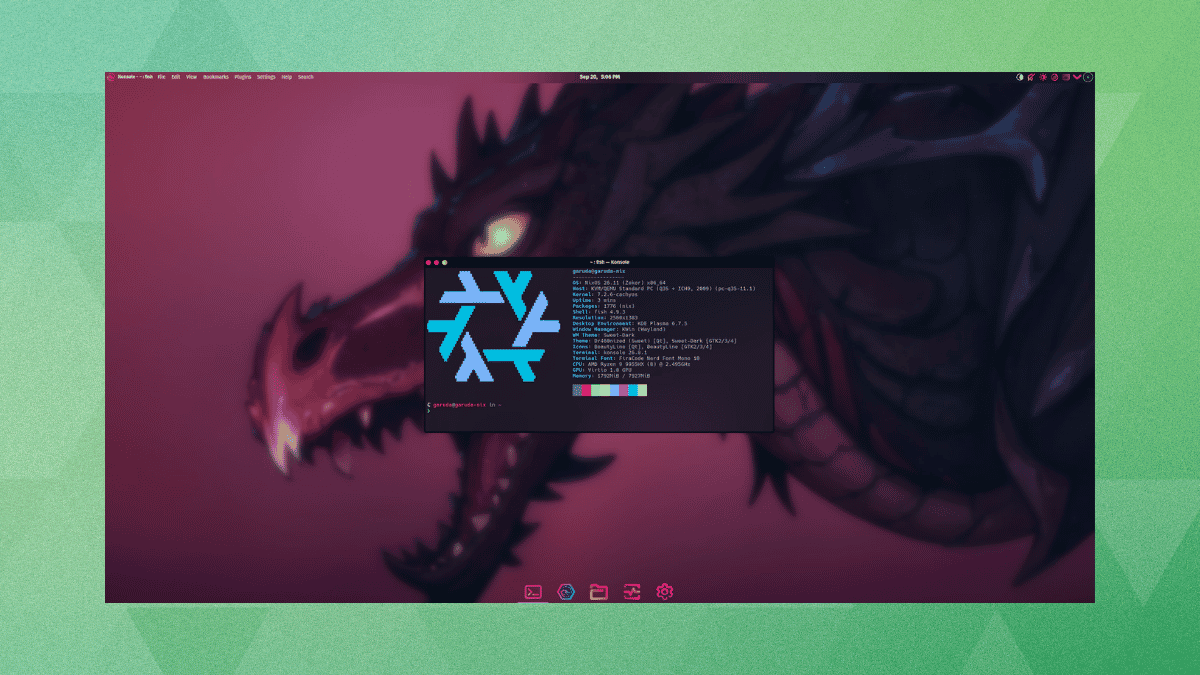
The Nix subsystem now installs as a standalone distro and is available in the Dr460nized and Mokka flavors.
Amazon released the Kindle 4 back in 2011 with a 6-inch E-ink display, 2GB internal storage, and running a modified version of Linux. In the years since the Amazon Kindle 4 has been jail-broken and there are some customized Linux distributions with a patched kernel to run on the Kindle 4. Now in 2026 there are patches on the Linux kernel mailing list looking to mainline support for that fifteen year old e-reader device...
Here's some very intriguing work taking place by a Google engineer... With the hyperscalers and other cloud providers pushing for zero-downtime, a set of experimental patches for "Orphaned VMs" allow for the virtual machines to continue to run while the host kernel is offline for security updates or rebooting with the Live Update Orchestrator. The experimental patches and request for feedback from other Linux kernel stakeholders was sent out this weekend on Orphaned VMs...
GNU Wget2 is up to version 2.3 today with the first new release of 2026 for this popular command-line tool for non-interactive file downloading and being able to easily fetch website contents...
The AMD BC-250 as the product designed at the time for cryptocurrency mining and based on a cut-down Sony PlayStation 5 APU continues having an interesting second-life being re-tasked for Linux use from general purpose workloads to AI. Sent out this weekend were the latest Linux kernel patches for continuing to enable more of the BC-250...
The Igalia Linux/open-source consulting firm based out of A Coruña, Spain is celebrating twenty five years of contributions to upstream open-soure projects...

I love the silly idea of Really Illegal Golf that the publisher tells us is basically "Metal Gear Golf With Friends".Read the full article on GamingOnLinux.

Ubuntu 26.10 is shipping a change that should keep the desktop standing when your memory runs out.
"Australia is considering barring the use of camera-equipped smart glasses in government workplaces..." reports Reuters, "in what it said could be the first ban of its kind." But meanwhile "more than 70 people who bought, used or were recorded with Meta's smart glasses have sued the social media giant," reports the Los Angeles Times, "claiming their intimate and sensitive images were exposed to workers abroad who are paid to review and label photos and videos." The contractors in Kenya work for companies that help train Meta's artificial intelligence, according to a proposed class-action lawsuit amended in late August. The smart glasses users, some in California, allege the gadget captured footage of themselves and family members undressing, going to the bathroom, having sex and entering passwords. In some cases, the people said they weren't aware the camera-equipped glasses were recording. One California user, referred to as PL18 in the lawsuit, alleges his glasses were unknowingly recording after he placed the smart glasses on the bathroom counter. "He noticed that at times photos of his family members using the bathroom and bathing began appearing in his gallery — footage no one in his household intended to take," the lawsuit said.... The 230-page lawsuit, filed in a federal court in Northern California, accuses Meta of fraud and false advertising, along with violating other consumer protection laws in various states. Tina Wolfson, one of the lawyers representing the plaintiffs, said the case also centers on Meta's surveillance of people's lives without their consent and the exploitation of their image and likeness. "People who bought these glasses and thought that they were cool gadgets weren't aware that every time they activated AI, video was sent to train Meta's AI," said Wolfson, a principal at law firm Ahdoot & Wolfson in Burbank. Meta disagrees with the allegations and intends to fight them. "If you use Meta AI, we may review that data to help improve our products and people's experiences — this works the same way as many other companies. We take steps to filter this data to help remove identifying information and to protect people's privacy," a Meta spokesperson said in a statement... The lawsuit alleges people wearing the smart glasses were unwittingly transmitting data to Meta whenever they used Meta AI by saying "Hey Meta," or sometimes accidentally when adjusting the glasses. "Every activation of the AI features, intentional or accidental, captures video and audio that is transmitted to Meta's servers, routed overseas, and reviewed by low-paid human workers who watch, label, and embed these moments into Meta's AI models," the lawsuit said... The lawsuit also seeks to block Meta from deploying biometric tools through its glasses. The company has been exploring a controversial feature called "NameTag" that would allow people to identify others... A separate lawsuit, filed in September in a federal court in Illinois, alleges Meta has been using images of people's faces uploaded to their public Facebook and Instagram accounts to train AI that powers NameTag and other AI tools. Read more of this story at Slashdot.
A big patch series sent out this weekend for the Linux kernel's perf subsystem removes the embedded Python and Perl scripting in favor of standalone Python scripts with a new Python perf module. This perf module for Python written in C is much faster than the status quo...

Toxic Frontier was announced at the PC Gaming Show Tokyo Direct, bringing some interesting ideas for fans of turn-based roguelike city-builders.Read the full article on GamingOnLinux.

Spaceborn Awakening is a narrative-driven bullet-heaven roguelite made in the spirit of Deep Rock Galactic: Survivor, Death Must Die and Soulstone Survivors.Read the full article on GamingOnLinux.

Moylo is a hand-drawn action game featuring melee combat and challenging boss battles inspired by 1930s & 1940s animations.Read the full article on GamingOnLinux.

Thief: The Dark Project Remastered from Nightdive Studios has a new trailer that was shown off during the PC Gaming Show Tokyo Direct 2026.Read the full article on GamingOnLinux.

More retro Nintendo goodies for you with The Legend of Zelda: Twilight Princess reimplementation Dusklight version 2.0 bringing major new features.Read the full article on GamingOnLinux.

A fresh release is here of the community Proton build dwproton-11.0-13, which focuses on keeping various Anime games working on SteamOS / Linux.Read the full article on GamingOnLinux.

The Windows compatibility layer Wine 11.18 development release is out now with an assortment of feature additions and bug fixes.Read the full article on GamingOnLinux.
"I would like to verify your technical abilities, so please download the specified file and complete the assigned task..." Fake job listings aimed at software developers and IT professionals led to 30,000 infected devices in over 100 countries — and 7,000 compromised cryptocurrency wallets, leading to over $10 million (USD) transferred to North Korea. Inc. reports: The hacks occurred from December 2025 through July 2026, according to a joint cybersecurity advisory issued Friday by Japanese, Australian, German, and U.S. authorities, including the Federal Bureau of Investigation and the Defense Department's Cyber Crime Center... The group reportedly has been active since 2023, carrying out both financially motivated attacks and cyberespionage... The hackers lure job seekers through social media, online job platforms, gig-work sites and freelance marketplaces. WaterPlum asks responders to take part in virtual technical interviews or complete coding assignments. The attackers then instruct targets to download and run malicious files, sometimes under the guise of completing an assignment or troubleshooting a problem with videoconferencing software. Once the group gains access to a device or network, it uses malware to steal information, including browser passwords, screenshots, files, and cryptocurrency-wallet data. An infected computer can also provide an avenue into the network of the target's employer, opening the door to intellectual-property theft and espionage, authorities said. The operation overlaps with a separate scheme in which North Korean nationals conceal their identities and locations to obtain remote IT work with companies abroad, officials said. The malicious files are "hosted on multiple online collaboration software developer platforms and code repositories," the advisory points out, and includes malicious Node Package Manager (NPM) packages.." Stolen ID images can also be used by North Korean IT workers to impersonate victims to obtain contracts and receive payment in foreign currency, but "The actors can also use stolen sensitive information for extortion." In one case, a North Korean IT worker "extorted a company over payment and published its proprietary source code online. In another case, an IT Worker hired for website maintenance defaced the hiring company's website and rendered the site inaccessible." The advisory provides clues for employers. It warns these malicious IT workers "tend to favor payment in cryptocurrency, and they may request that remuneration be sent to an account in another person's name." During interviews they'd sometimes used Al face-swapping software, then claimed network issues and disabled their video. And "On holidays celebrated in North Korea, the actors played games and watched soccer videos instead of conducting their usual malicious activities." Read more of this story at Slashdot.
Clicks is preparing the Communicator, a compact Android smartphone built around a physical keyboard and a 4.03-inch AMOLED touchscreen. The device uses MediaTek’s 4nm Dimensity 8300 platform, includes 12GB of RAM and 256GB of storage, and is designed to operate either as a standalone phone or alongside another smartphone. The MediaTek Dimensity 8300, identified by […]
Tom's Hardware reports: Four plaintiffs subscribed to ChatGPT, Claude, Grok, or Gemini filed a proposed class-action lawsuit alleging that the developers of these AI models violated antitrust laws when they agreed to slow AI development. According to the Associated Press, the lawsuit argues that this agreement would "reduce the value consumers get for paid AI subscriptions" and that this coordination started in July 2026 after the leading AI labs signed a statement admitting there is "intense competitive pressure not to unilaterally slow" development. The plaintiffs recognize the need for AI development to slow for the sake of safety, but they say that Anthropic founder Dario Amodei's cooperation proposal is a "shortcut" that "substitutes collective restraint for individual accountability." Attorney Nick Rowley, the lead counsel for the plaintiffs, says, "AI will quickly spin out of human control and could kill us all if we allow AI safety and protocol ... to be controlled by private self-serving agreements between the world's most powerful 'for profit' technology companies." "Representatives for Anthropic, OpenAI, Google and SpaceXAI did not immediately respond..." reports the Associated Press: The coordination largely took place on Sept. 12, the lawsuit argues, when Anthropic CEO Dario Amodei published an essay urging for industrywide cooperation on decelerating advancements in favor of enhanced safety measures. That same day, OpenAI CEO Sam Altman, SpaceXAI CEO Elon Musk and Google DeepMind's co-founder and chair Demis Hassabis each publicly responded to Amodei's proposals in agreement. But the lawsuit also alleges that the coordination began to take shape months earlier. It points to a statement from July 2026 that high-ranking employees from several of the leading AI labs signed that acknowledged the "intense competitive pressure not to unilaterally slow" development. That statement called on the government to support a global effort to slow automated AI development. Sam Altman even specificially said "we do not believe we need to wait for an antitrust exemption or legislation to begin the work of providing this confidence," notes Tom's Hardware. However, the Trump administration shot down this idea... Chinese state media also criticized this announcement, saying that the call to put the brakes on AI development is nothing but a response to Chinese competition, especially as Amodei's essay explicitly mentioned the desire to slow China's progress and widen the U.S.'s gap over Beijing Read more of this story at Slashdot.
Clonezilla Live maintainer Steven Shiau released Clonezilla Live 3.3.3-37 today as the latest stable version of this partition and disk imaging/cloning live Linux system based on Debian GNU/Linux.
Garuda Nix is now available, offering NixOS installations with Garuda Dr460nized and Mokka desktop environments.
Linus Torvalds has released the 7.3-rc4 kernel prepatch. It is, unsurprisingly at this point, large: "We all know the drill by now: 'it's big, yadda yadda'".
SECO has added two compact industrial platforms based on Qualcomm’s Dragonwing IQ-2390 processor: the Compact Vision 5 Dragonwing IQ-2390, a 5-inch panel-mounted HMI, and the SBC-Dragonwing-IQ-2390, a 47 × 114mm single-board computer for custom embedded systems. Both platforms support on-device AI, industrial connectivity and SECO’s Yocto Linux-based Clea OS. The Dragonwing IQ-2390 integrates application processing, […]
Linus Torvalds announced the release today of Linux 7.3-rc4. As usual for recent months, the fixes continue to be quite heavy and scattered all over the place driven in large part by AI/LLMs spotting various code defects. Overall though Linus Torvalds isn't too worried about Linux 7.3-rc4...
The Rise and Fall of the Artificial State ultimately asks the question, "How did we cede control of our democracy to the machines, and can we get it back?" according to the Harvard's Arts and Sciences site, FAS Current: The new title finds Lepore, who used to teach a course at the College titled "The Rise and Fall of the Machine," charting the ascent of what she calls the artificial state: the digital communication infrastructure by which governments and private corporations automate and ultimately control public discourse. Following her Pulitzer Prize win for "We the People: A History of the U.S. Constitution" (2025), "I wanted to think about whether liberal constitutional democracies can survive this moment in time," Lepore shared in a phone interview... [In the "current ChatGPT moment"] Lepore found herself asking: "Who are the people who are clamoring to be replaced by machines, to have movies made by machines, and novels written by machines?" And who, she continued, is pushing for our government to be determined by these machines? In the book, Lepore notes that technological tools are increasingly influencing elections around the world... However, she sees the 2026 U.S. midterms as an inflection point. In a recent piece in the Financial Times, Lepore wrote, "This year marks the first AI election. Voters are asking chatbots how they should vote. Campaigns and activists are using AI to analyze the electorate, send micro-targeted messages, produce tailored ads and even deepfakes...." Lepore stresses in the book that "nobody should trust historians to make predictions," but she believes it's possible for democratic citizens to wrest back control. Referencing proposals such as New York's data center moratorium law, Lepore ends by describing a "growing and increasingly noisy tech backlash." "It's not foreordained. This isn't inevitable," she said during the interview. "In the book's epilogue Lepore predicts, as her title suggests, a fall of the Artificial State," writes the California Review of Books. "That argument turns out to be speculative, much more of a hope than a certainty." [Lepore] does support her prediction by positing that the Artificial State is "poorly designed and badly built," that it has not given people safety and happiness but rather a prison of glowing screens, and that a majority of Americans want more control over AI. To escape the Artificial State we will have to imagine a different future by gaining more knowledge of the past in a search for meaning. Of course, powerful forces want to deny that and turn us into servile automatons. The Guardian adds that "While Lepore interprets much classic sci-fi, such as Isaac Asimov, as cautionary, she observes that "the architects of the Artificial State seem to have read these stories, unironically, as instruction manuals, guides for how to build robots that would one day rule the world". (The Atlantic writes that "What one gathers from these misreadings is not so much that science fiction itself is nefarious, but that arrested development might be...") But The Indian Express writes that despite the author's bleak conclusion, "Lepore is not a pessimist. Because the Artificial State is a construct, neither alive, nor truly indestructible, she argues it is still possible to take it apart... [T]his is a clear-eyed reckoning rather than a doomsday tract. It is not an easy read, but an essential one for anyone unsettled by the pace of the AI wave." Read more of this story at Slashdot.
TUXEDO OS is switching its base to Debian, and the team just released a new Beta ISO. I tested it, and here is a breakdown of the key improvements.
More than 30 years after its debut, GNU gzip receives fixes for bugs that have existed since the project’s earliest releases.
Ahead of the Linux 7.3-rc4 kernel release due out in the coming hours, an important batch of x86/x86_64 fixes have been merged to address a few outstanding issues...
"New research led by Stanford Medicine reveals that what we call the brain is two distinct organs that evolved independently over hundreds of millions of years," Stanford Medicine announced this week: The new research finding shows that the human brain consists of two ancient nervous systems cleverly packaged together — a more primitive part that regulates our hearts' beating, our breathing and other functions, and another that makes us distinctly human, capable of poetry, mathematics and wondering about our own origins. The discovery could help explain why scientists have struggled for decades to grow certain types of brain cells in the laboratory — and it opens new avenues for studying devastating diseases that affect the brain stem... [S]cientists have struggled for decades to generate human hindbrain neurons in the laboratory. This gap has hampered research into devastating diseases affecting the brain stem, including spinal muscular atrophy and amyotrophic lateral sclerosis... The researchers' breakthrough came from studying the earliest moments of embryonic development... [Study co-authors Carolyn Dundes and Rayyan Jokhai] discovered that the hindbrain follows a separate developmental path, running in parallel to — rather than branching off from — the pathway that creates the forebrain and midbrain... This revelation explained decades of frustration in the field — scientists had been trying to turn one type of progenitor cell into another that it is fundamentally incapable of becoming... Armed with this knowledge, the researchers for the first time successfully coaxed human pluripotent stem cells (a kind of cell that can create any cell in the human body) to become functional hindbrain motor neurons in the laboratory... Finally, the researchers looked back over 550 million years of evolutionary time. They found the same two-origin brain pattern in chickens; zebrafish; and, remarkably, in acorn worms, tiny creatures living on the ocean floor that share a distant common ancestor with humans. Jellyfish, which diverged from humans about 600 to 700 million years ago, have two nervous systems at different ends of their body. "Our research suggests that evolution took two existing neural systems and pushed them together spatially," Loh said. "Having the brain as one organ would probably be more efficient, but we rely on this primordial way to make the brain as two separate pieces." Thanks to Slashdot reader Beeftopia for sharing the article. Read more of this story at Slashdot.
Gzip 1.15 is out today for succeeding the Gzip 1.14 release from April 2025. With this release comes a number of fixes for bugs present since the beginning of Gzip...
At the KDE Akademy 2026 conference going on right now in Graz, Austria the three KDE goals for the next two years were unveiled...
The European Commission "proposed on Thursday banning children under 13 from social media, with parent-supervised accounts until 15," reports Reuters. "Enforcement would rely on a tool Brussels built itself" — a free, open-source age verification smartphone app "that tells a platform whether a user meets an age threshold without revealing their identity..." If passed, the proposed Kids Act would create the world's largest social media access restriction, covering 450 million people across 27 countries... [The EU-built age-verification app] is being rolled out through member states, with seven pilot countries: Cyprus, Denmark, France, Greece, Ireland, Italy and Spain. The Commission expects EU-wide availability by the end of 2026. It will also be used to prove users are over 18 when accessing adult sites, a restriction already implemented under the Digital Services Act... [T]he system itself is decentralised. Member states run it through issuers they designate, and the proofs live on the user's phone. There is no central EU database of ages or of who verified whom... A user proves their age once to a nationally designated issuer — a body vetted by the member state, which can be a digital ID provider, a bank or a post office. At a restricted site, the app certifies that the user is above the required age threshold. The platform receives only a yes-or-no response. Issuance and verification are handled by separate entities. The proof provider is not told which service the proof was used for. Each proof works only once, preventing cross-service tracking. No identity documents or biometric data are retained. The code is open-source, allowing independent scrutiny. The significance of the EU approach is that it provides a common age-verification mechanism rather than leaving individual platforms to develop and enforce their own systems. "Online platforms can easily rely on our age verification app. So there are no more excuses," [EU Commission President Ursula] von der Leyen said... The proposal must be approved by EU member states and the European Parliament before becoming law. Non-compliance would risk fines of up to 6% of a tech company's global annual sales, plus supervisory fees, Reuters reported earlier. The EU's plan follows similar initiatives in Australia, Britain, China, India, Turkey and several European Union countries. Read more of this story at Slashdot.
From a few months ago you may recall Starling as the new Linux desktop written with its own Wayland compositor, using the Swift programming language, and written in large part via AI with Claude Code. Out today is Starling 0.5 with this desktop now gaining an optional 3D desktop mode...
Vulkan 1.4.363 is out as the latest routine update to the Vulkan API specification and also introduces a new Intel vendor extension...
Sent out this morning were a big batch of input subsystem fixes ahead of the Linux 7.3-rc4 kernel releasing later today. Alongside many bug fixes to different drivers is also expanding the range of supported gaming controllers by the XPad driver...