Valve's Steam Frame Now Available At $1059+ USD
Valve just announced their long-awaited Steam Frame headset is now available...
Valve just announced their long-awaited Steam Frame headset is now available...
Navidrome 0.64 introduces an experimental Jellyfin Music API, a new artwork pipeline, playlist favorites, natural sorting, and new themes.

"Californians just made it through the hottest August on record without having to endure any rolling power outages," reports the Los Angeles Times. In fact, the state hasn't implemented rotating power outages since 2020. Because "Over the last few years, California has quietly but dramatically increased the resiliency of its electrical grid through a significant expansion in battery energy storage." These batteries hold onto solar energy captured during the day, so it can be sent to the grid as demand peaks in the evening and morning, when most people are at home running air conditioners and other appliances. During the August heat wave of 2020, the California Independent System Operator, which manages the flow of electricity for most of the state, declared a Stage 3 Emergency and hundreds of thousands of households lost power in rolling outages. At the time, the system had less than 100 megawatts of battery storage available, according to system spokesperson Jayme Ackemann. Today, it has more than 17,000 megawatts available.... According to Ackemann, the system seeks to add 20,000 to 25,000 megawatts of battery storage capacity by 2045 — the same year it has set a goal of achieving carbon neutrality. That means the state would remove as many carbon emissions from the atmosphere as it emits. In recent years, California has steadily grown the share of electrical power generated by renewable sources — such as solar, wind, geothermal and hydropower — which bolstered the resiliency of the grid by increasing the overall amount of energy available. An uptick in people installing rooftop solar panels has provided an additional power boost, Ackemann said. In May, California became the first known large-scale power system in the world to have relied on more than 50% solar power for an entire month.... California's grid is also now integrated with electrical systems across much of the Western United States. This means that if there is an extreme heat event in Southern California, energy from a cooler area such as the Pacific Northwest can be imported to help meet regional demand. All of this has collectively helped the state's electrical system weather this year's long-lasting heat. "Southern California continued to break temperature records this week when Long Beach and Anaheim reached a blistering 107 degrees and Escondido hit 112 degrees..." Read more of this story at Slashdot.
While the Rustls modern TLS library is written in the Rust programming language with a focus on memory safety, as we've seen out of other Rust project re-implementations in the past, the new implementations can lead to other security bugs of their own. Out today is Rustls 0.23.45 to fix a security issue introduced back in 2024 with Rustls while the likes of OpenSSL, BoringSSL, and others are unaffected...
What is it like to be a Debian Project Leader (DPL), or a former one? According to Andreas Tille, who stepped down this year after two consecutive terms as DPL, you'd have to be one to know. At the recent MiniDebConf in Winterthur, Switzerland, Tille spoke about what he learned while serving as DPL, some of the initiatives he led, mistakes that he made, and his thoughts on the general resolution (GR) on large language model (LLM) usage in Debian.
Sean Whitton has announced that the original fix for an arbitrary code execution flaw in Emacs (CVE-2024-53920) was incomplete. Bas Alberts discovered that viewing or editing untrusted files in modes other than Emacs's Lisp mode can also result in arbitrary code execution. This problem affects all Emacs versions affected by CVE-2024-53920. This means Emacs 24 and newer, and possibly also older versions. A minimal fix, attached, is queued up for release with Emacs 31.2. We (the Emacs upstream maintainers) don't expect to backport the fix to older Emacs releases ourselves. LWN covered the original vulnerability in December 2024.
Mozilla today published their Firefox 156.0 release binaries ahead of the official Tuesday announcement...
Linux 7.1 brought some performance improvements for Intel Core Ultra Series 3 "Panther Lake", Linux 7.2 enhanced the performance for the integrated Arc B390 Xe3 graphics, and now for the in-development Linux 7.3 kernel are various performance improvements at large. Today's article is looking at the performance of the in-development Linux 7.3 kernel compared to Linux 7.2 stable using the Core Ultra X9 388H within the Framework Laptop 13 Pro.
We tested every major Linux window manager for 2026, from i3 to Hyprland and the trending Niri. Pros, cons, and setup tips inside.
The Linux kernel is going to see the removal of a number of recently deprecated ARM 32-bit platforms. Following the deprecation in Linux 7.3, removing the old ARM platforms will lighten the kernel by around 55k lines of code. But removing now unused drivers only relevant to those platforms will mean roughly a quarter million lines of code can be removed from the kernel source tree...

Some more RTS goodies are coming with Tempest Rising: The Veti's Wrath DLC arriving September 29th, and everyone can play the Veti free in multiplayer.Read the full article on GamingOnLinux.
Security updates have been issued by AlmaLinux (389-ds-base, apr-util, coreutils, freerdp, git-lfs, glib2, gstreamer1-plugins-base, kernel, libkcapi, nginx, nodejs:22, nodejs:24, osbuild-composer, perl-YAML-Syck, postgresql16-postgis, ruby, ruby4.0, ruby:3.3, and vim), Debian (jbig2dec, kamailio, nginx, spip, and xorg-server), Fedora (baresip, bind, bluez, bubblewrap, chirp, chromium, cockpit, composer, corosync, darktable, dokuwiki, elixir, exiv2, expat, firefox, freerdp, freerdp2, gdk-pixbuf2, gegl04, golang-x-perf, grpcurl, kernel, kernel-headers, libevent, libmongocrypt, libpcap, libre, libsoup3, memcached, mingw-expat, mingw-openexr, mongo-c-driver, mrtg, nagios-plugins, nsd, nss, openssl, openvpn, PackageKit, pdns-recursor, perl-Net-OAuth, perl-XML-Bare, php-pecl-mongodb2, python-asteval, python-pip, rclone, rest, rust-hickory-net, rust-hickory-proto, rust-hickory-resolver, rust-ppmd-rust, rust-webbrowser, srt, syncthing, tar, tkimg, and valkey), Gentoo (Chromium, Google Chrome, Microsoft Edge, Opera, Vivaldi and Ruby), Mageia (bind, ffmpeg, glibc, java-17-openjdk, java-21-openjdk, librabbitmq, perl-Catalyst-Plugin-Static-Simple, perl-Imager, tor, and xz), Oracle (389-ds:1.4, ansible-core, apr-util, coreutils, freerdp, git-lfs, glib2, gstreamer1-plugins-base, gzip, httpd:2.4, image-builder, java-21-openjdk, kernel, mrtg, nginx, osbuild-composer, perl-DBI, postgresql16-postgis, python-lxml, python3.12-lxml, redis:6, and vim), SUSE (389-ds, ansible-core, ansible-creator, azure-storage-azcopy, cargo-audit, chromedriver, chromium, clamav, containerized-data-importer1.65, containerized-data-importer1.66, curl, dracut, ffmpeg-4, google-guest-agent, google-osconfig-agent, helm, java-1_8_0-ibm, jupyter-nbconvert, kernel, libpng16, libusb-1_0, libvirt, multipath-tools, NetworkManager, opensc, openssl-3, perl-Authen-SASL, perl-HTML-FormHandler, perl-Mojolicious, perl-Protocol-HTTP2, python-jwcrypto, python-sqlparse, python-tornado6, python313-geopy, python313-modelscope, python313-modelscope-hub, python313-pypdf, python315, rpcbind, sshamble, strongswan, tomcat, ucode-intel, and wget), and Ubuntu (civetweb, ffmpeg, and urwid).
Greg Kroah-Hartman has announced the 7.2.6, 6.18.52, 6.12.110, 6.6.157, 6.1.188, 5.15.221, 5.10.270 stable kernels. According to Kroah-Hartman, this batch may set a record for the number of patches with more than 9,000 in total between them. There are more than 1,800 patches in 7.2.6 alone. Users of these kernels are, of course, advised to upgrade.

A PC is never truly a gamer PC unless it has some fancy RGB lighting right? Now easier to control than ever with OpenRGB 1.0 released.Read the full article on GamingOnLinux.
Catch up on the latest Linux news: Debian 13.7, Ubuntu 24.04.5 LTS, KaOS 2026.09, COSMIC Desktop 1.8, Noctalia 5.1, Jellyfin 12.0, Linux Mint is getting new apps, and more.

openEuler is an open-source project incubated and operated by the OpenAtom Foundation. The community is expanding international collaboration through local user groups, industry partnerships, and participation in global open-source events.
Nearly 1900 Blizzard Entertainment workers "voted to ratify their first union contract with parent company Microsoft after over two years of bargaining," reports Kotaku, "consolidating Blizzard's many smaller unions into three larger bargaining units." The workers now gain new protections "on issues such as generative AI, crediting, remote work, and layoffs." [The contract] acknowledges that AI tools "may be useful in the game development process to support human judgment and creativity and that AI-assisted workflows remain subject to appropriate human control and review for accuracy and quality." But it also stipulates that any implementation of AI technology that would materially impact work performed by union employees must have its impacts bargained over before it can be implemented. Other sections cover issues such as crediting (guaranteeing that current and former employees are credited by name in all games they work on) and remote work (designating certain roles as hybrid in-office and providing procedures for individuals to apply for their roles to be fully remote). It also contains a lengthy section on how layoffs may be conducted, including a required 60-day notice period (or pay in lieu of notice), a guarantee of one week of severance for every six months of employment, and 14 months of recall rights. The contract also guarantees successorship, meaning if Blizzard is ever acquired by another company, the contract would remain intact. "Workers also contractually locked in their current hybrid work schedule," reports the gaming news site Aftermath, "meaning that Blizzard can't suddenly change it, as has been a labor-unfriendly trend in the games industry over the past couple years." Fully remote workers scored a big win as well. "I'm remote, and we grandfathered everyone who is remote to stay remote, so we can't be magically called to an office that we've never worked at before," [said Diablo senior environment artist Mahreen Fatima]. And "The contract also elevated pay floor," reports the Yakima Herald-Republic. "Across the board, workers secured a 1.25% pay increase, but some workers who were paid below $50,000 per year will walk away with pay increases that are as much as 34%." Read more of this story at Slashdot.
Earlier this month I wrote about a patch series posted to the Linux kernel mailing list that addressed a lot of "hideous code" to make Linux kernel builds faster. A number of single-threaded bottlenecks were tracked down and fixed within the Linux kernel thanks to the assistance of AI. A second revision of those patches hit the mailing list this morning and there is hope they could be upstreamed for Linux 7.4...

The September 13th update for the popular Bazzite Linux is out now, bringing with it some excellent sounding improvements for handheld and desktop gamers.Read the full article on GamingOnLinux.
Being merged after yesterday's Linux 7.3-rc3 release was an important fix for addressing a silent, user-space data loss bug that has existed in the kernel the past three years...

Transport Fever 3 from Urban Games and Paradox Interactive has a new gameplay overview to check out ahead of the release this month.Read the full article on GamingOnLinux.
Shelly 3.1.4 improves its native Arch package builder with better PKGBUILD handling, AUR cache cleanup, and improved package reviews.

Respect The Horde is coming from GFX47 (No Plan B, GLADIABOTS) as a curious mixture of top-down zombie shooting, with tower defense and extraction mechanics.Read the full article on GamingOnLinux.

A blast from the not so distant past, Robot Roller-Derby Disco Dodgeball is a highly rated multiplayer game that just had a huge surprise update.Read the full article on GamingOnLinux.

The King is Watching from Hypnohead and tinyBuild has a major new update out with Steam Deck and gamepad support.Read the full article on GamingOnLinux.

Wave-based tower defence with juicy visceral combat - Fangstorm looks like a lot of fun. Getting some Orcs Must Die! vibes from this one.Read the full article on GamingOnLinux.
Shotwell 0.33 open-source image viewer and organizer for the GNOME desktop environment has been officially released today after many years of work as the first version ported to GTK4.

XIRI: Oasis Cities is a survival-driven city builder set in a high-tech future. You build up and defend your city from pretty much everything.Read the full article on GamingOnLinux.

Always nice to see! The positively rated indie game made with Godot, Worlds Upon The Wind, has seen the full source code being released.Read the full article on GamingOnLinux.
Silicon Valley giants and national security experts "are calling for action against Chinese companies engaged in model distillation," reports CNBC. But "I would do nothing," says Y Combinator CEO Garry Tan. "We could argue that there should be an American distillation regime." Distillation is the process of using the outputs of a more capable AI model to train a smaller or less capable one, sometimes illicitly... Anthropic has accused Chinese companies such as Moonshot AI, DeepSeek, and MiniMax of the practice, while OpenAI believes DeepSeek's V3 and R1 model architectures were distilled from its own GPT-4 and GPT-4o models. In the midst of this, the U.S.'s National Security Agency, Cybersecurity and Infrastructure Security Agency, and Federal Bureau of Investigation released an official cyber security advisory warning on the topic on Tuesday... But Tan believes regulators should focus less on curbing distillation and more on creating an equilibrium between open weight models and frontier models — as long as frontier models retain a price premium that allows their business model to remain feasible. "This is actually the ideal case. You want open weight models to give people freedom and access," he explained. "If I were a regulator, that's what I would go after." Tan acknowledged that this is a hard balance to strike, calling it "a tightrope." Nevertheless, he says it's a balance worth pursuing — saying it "could result in the best possible outcome." Tan later told TechCrunch he'd like to see America with more open-weight options that aren't Chinese, built by smaller U.S. open-weight AI labs using those same training techniques on products from America's frontier AI labs: Anthropic CEO Dario Amodei had previously publicly called on U.S. regulators to crack down on distillation. It's notable that the commander of Silicon Valley's prestigious and prolific startup accelerator doesn't agree. To be clear, Tan isn't advocating for American AI labs to use stolen credentials to distill. He wants them to be free to come in the front door. In fact, his argument is twofold. He feels it's an overreach for AI labs to dictate what their customers can do with the information their models share with them. He also notes that the proprietary AI labs didn't ask permission when they vacuumed up as much human knowledge as they could to train their models. They famously ingested plenty of copyrighted material without the permission of those intellectual property holders. "Controlling what users and customers do with API calls to closed weight models feels constraining, and there's a role government can play here to normalize the fact that access to intelligence that was trained on broad public access data should itself also be more a form of a public good than something locked away behind restrictive terms of service," he told TechCrunch when asked why American labs should be free to distill, too... To him, the true AI doomer scenario is for all the immense power of frontier AI to wind up in the hands of a single powerful, proprietary provider. "The nightmare scenario, the doomer scenario for AI is that there's just one company," he said. "It has the best access to capital. It has the best AI researchers. It runs away with it and suddenly there's one company that's monolithic. And that would be bad." Read more of this story at Slashdot.

BlizzCon 2026 just happened and with it we got some big announcements - here's your highlights of some of the big stuff coming.Read the full article on GamingOnLinux.
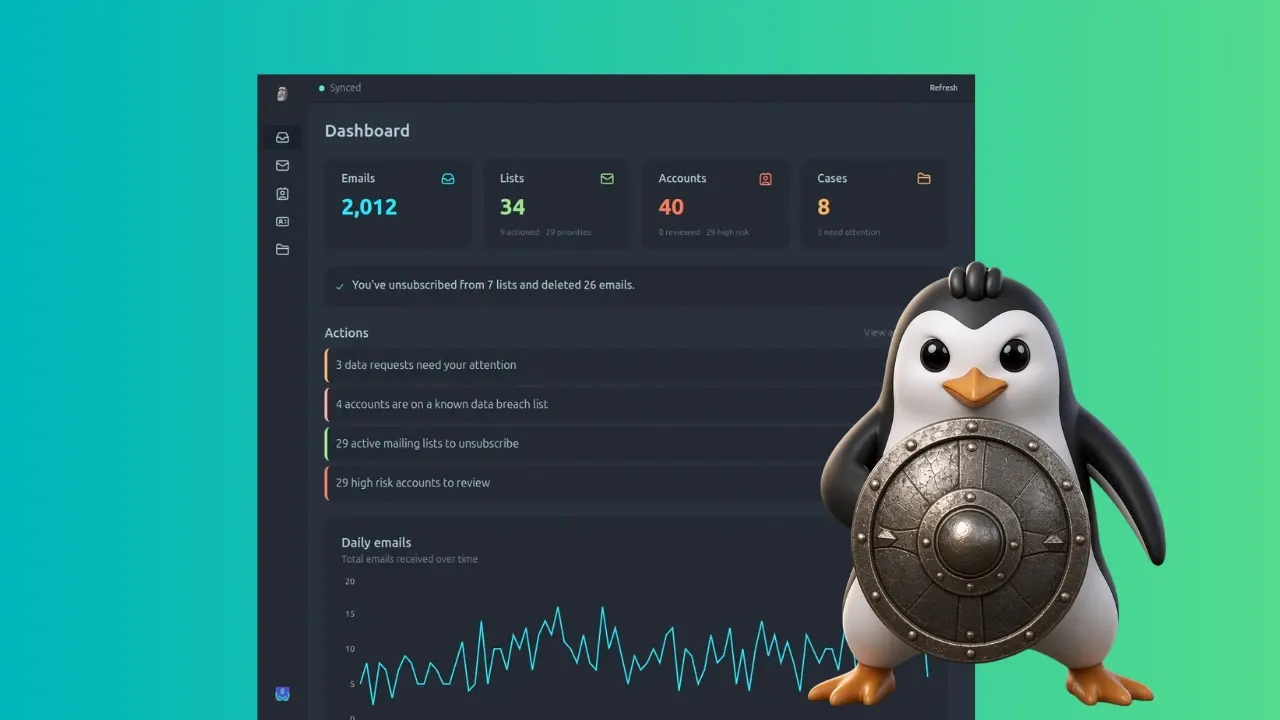
Paperweight scans your inbox locally to find mailing lists, forgotten accounts and breach risks, with bulk unsubscribe and GDPR request tools.
Rune, a GPU-rendered and keyboard-driven IDE for Linux and macOS built mainly in Go, is now open source under the GPLv3 license.
Debian 13.7 is out with 107 security updates and 106 bug fixes, plus installer, kernel ABI, Cinnamon, glibc, and package updates.
A misconfigured Advance Passenger Information System (APIS) database linked to Vietnam exposed more than 220 million passenger and crew travel records spanning 2017 to 2026, including names, passport numbers, nationalities, flight details, seat assignments, and baggage references. Researchers said the database was reachable through a chain of security mistakes and default credentials. It was later secured after the disclosure, but it's unclear whether the data had already been copied or abused. BleepingComputer reports: Kinryu Labs discovered the Elasticsearch cluster on June 3 while surveying exposed databases as part of research into ransomware activity. The cluster, named 'pax-info', contained 29 indices and roughly 107 GB of data. Its two principal indices held 210,318,069 passenger records and 10,465,631 crew records, for a combined 220,783,700 entries. According to Kinryu Labs, the cluster was hosted in Viettel-assigned IP space in Hanoi. BleepingComputer could not confirm which Vietnamese organization operated the system. The exposed information included passengers' and crew members' names, dates of birth, sex, nationalities, passport or travel-document numbers, document expiration dates, and issuing countries. Associated travel data included flight numbers and dates, airlines, departure, destination and transit airports, seat assignments, baggage references, and scheduled, estimated, and actual flight times, information typically carried by APIS and related airline systems. Sample records reviewed by BleepingComputer included travelers of Korean, Chinese, Canadian, and New Zealand nationality, among others. While the researchers could not provide a complete breakdown by nationality, the data covered numerous international airlines across Asia-Pacific, Europe, and the Middle East. As a result, the exposed records could relate to people from virtually anywhere who visited or transited through Vietnam over the nine-year period. Kinryu Labs expects to publish additional details on its blog later this week. Read more of this story at Slashdot.
The 309th installment of the 9to5Linux Weekly Roundup is here for the week ending September 13th, 2026, keeping you updated on the most important developments in the Linux world.
For those wanting the freshest Debian 13 "Trixie" install media, Debian 13.7 is out today in bundling up all the latest bug and security fixes...
Just a reminder that prices for LWN subscriptions will increase after September 15. Until then, the older rate still applies. See this article for details on this change. Thanks, yet again, to all of our subscribers for your support — that is what keeps LWN going.
The 7.3-rc3 kernel prepatch is out for testing. Linus said: "Another fairly large rc release, and again one with a bigger filesystem footprint that we usually see."
DietPi 10.7 has been released today as a new stable version of this Linux distribution for single-board computers, adding support for new SBCs, new images, and updates to DietPi-Software.
NASA and IBM have released an open-source AI model trained on a large collection of lunar observations to help scientists analyze the Moon at scale. "The NASA-IBM Lunar Foundation Model gives scientists a foundation to explore the Moon at scale, connecting observations across instruments, revealing patterns that are difficult to see in isolation, and providing an open platform the global research community can build on," said IBM director of research for Europe, Juan Bernabe-Moreno. The Register reports: It is claimed as the first AI model to integrate observations captured in a range of modalities (data formats), and at different viewing angles and spatial scales. Instead of sifting through maps and images by hand or using low resolution machine learning models, scientists can use this to analyze geographic features, the pair say. In particular, NASA and IBM hope researchers will be able to discover previously unidentified lunar ice deposits, analyze volcanic features called Irregular Mare Patches, and identify and classify craters. Lunar ice indicates the presence of water and oxygen, which may be useful for future manned missions. It is found in permanently shadowed regions, which are among the most difficult areas to observe. The NASA-IBM model combines multimodal and multi-resolution observations to better predict where ice may be present on the lunar surface. Alongside the model, IBM and NASA scientists compiled an open-source lunar dataset from over 30 spatially-aligned layers, using data from nine instruments across four missions. It combines tens of thousands of images and maps showing various geophysical properties of the lunar surface. Read more of this story at Slashdot.
Out today is the third weekly release candidate of Linux 7.3 as this next kernel version works its way toward a stable release in the second half of October...
The Linux Mint project today published their August 2026 development report, including some new applications added to their XApp collection...
Olimex has expanded its Neo6502 retro-computing platform with the Neo6502kbd, an all-in-one version that integrates the system into a USB keyboard enclosure. The design combines a real W65C02 processor with an RP2040 and adds four USB host ports, HDMI/DVI output, UEXT expansion, separate USB-C ports for power and programming, an integrated speaker, and a power […]
A union representing Uber and Lyft drivers was just certified by California's Public Employment Relations Board, officially recognizing them as the drivers' bargaining organization. The Sacramento Bee reports that this new bargaining structure : The move will allow the California Gig Workers Union to help drivers negotiate issues affecting working conditions and benefits. It comes as at least 30% of active drivers expressed support of the union... [California] Assembly Bill 1340 helped bring the union to fruition by allowing the independent contractor drivers to engage in collective bargaining. "The next step for the union is to negotiate a contract with Uber and Lyft that meets drivers' demands," reports the Los Angeles Times, "including health insurance, support for high gas prices and more transparency around pay: California is the third state to allow ride-hailing drivers to unionize, following Washington in 2022 and Massachusetts in 2024... The California Gig Workers Union was formed with the support of the Service Employees International Union... "Gig drivers shouldn't have to face the future alone," said SEIU 521 official Riko Mendez in a statement. "As autonomous vehicles rapidly expand, having a union gives the drivers the power to negotiate for fair pay and meaningful say in how new technology shapes their work and our communities' futures." Read more of this story at Slashdot.
A possible future enhancement being considered for Ubuntu Long Term Support "LTS" releases is the introduction of a linux-firmware-hwe package as part of their hardware enablement (HWE) stack...
Mecha’s Comet is a modular Linux handheld built around a 3.92-inch AMOLED touchscreen and offered with either an NXP i.MX8M Plus or i.MX95 processor, along with expandable storage, Wi-Fi 6, Bluetooth 5.4, and a magnetic 40-pin interface for keyboard, gamepad, and GPIO extensions. The handheld also provides USB-C connectivity, an 8MP camera, M.2 expansion, and […]
In addition to Usama Arif's recent Linux patches for addressing a major inefficiency within the Linux kernel's Zstd compression code, he also has a separate patch series destined for Linux 7.4 to further enhance the Zstd compression/decompression performance by avoiding redundant initialization...

It runs on an ESP32-S3, takes a real SIM for 4G calls and texts, snaps together without soldering. Code your own app, away from social media.
"This is what happened when we tried to record Flock installing a new camera on public roads," says Emmy award-winning reporter Brendan Keefe in a new video for InvestigateTV. In an accompanying article, InvestigateTV says their reporter "parked on the public street at a distance, donned a yellow safety vest and a hat emblazoned with the logo of InvestigateTV's Atlanta affiliate where he also works, displayed a press placard on his dashboard and then pulled out a camera to record the installation.... The installer saw him and immediately packed up his equipment and drove away, so Keefe also returned to his car and followed several cars behind, hoping to document the next stop." And then Flock's technician called 911. When asked "What's the address of your emergency" Flock's technician answered "I'm getting followed — harassed, pretty much. Taking videos and pictures!" Flock's worker said they'd been harassed multiple times that day, then stated incorrectly that "I know for a fact" that that was what the reporter wanted to do too. InvestigateTV reports that as a result of the Flock technician's call, "Three police cars ended up in the national investigative reporter's rearview mirror that Wednesday afternoon." Keefe told one of the three police officers who pulled him over, "There is an irony here that they're setting up these cameras that track all of our movements, that follow everywhere we go. But when I try to get video in public of him in public setting up a camera, he's afraid I'm following him?" InvestigateTV also reports that "About 17 minutes after the stop began, the responding officers returned to their vehicles and Keefe was allowed to drive away." But the call that brought three police cars to their reporter "was not the first time this summer someone working for Flock Safety summoned police over a camera. " About 17 minutes after the stop began, the responding officers returned to their vehicles and Keefe was allowed to drive away... [But the stop] was not the first time this summer someone working for Flock Safety summoned police over a camera. On June 5, police in Smyrna, Georgia, responded to a 911 call from a Flock employee after a group of YouTube creators began filming outside the company's distribution center located in the Atlanta suburb... The caller claimed the group filming had "been driving around the perimeter, basically harassing everyone" working at the facility. "Three young white males, probably mid-twenties, I'm not sure if they're armed. And they're carrying filming equipment as well," the caller said. Three times during the call he raised the possibility the people filming might be armed, though, when asked, he told the dispatcher he had not seen any weapons... [One of the protesters later told the caller "I think it's interesting, when you guys have this happen, you call the police and make us get stopped. But then you do it and it's okay?"] No one was charged in the YouTuber group, though the individuals were ordered to leave the premises under an official trespass warning. Keefe's video report ends with one final irony. "Every day on my way to work, I'm captured again by those same new shiny Flock cameras. We tried watching the watchers. Turns outs, it's a lot easier for them to watch us." Flock responded to the report by claiming "We do not object to members of the public or press photographing Flock cameras or personnel in public." But they added that employees working "in the field" must "prioritize their safety" and "may contact law enforcement when they believe they are being threatened, harassed, followed, or otherwise face a safety concern." Read more of this story at Slashdot.
A Void Linux maintainer has orphaned more than 100 packages he maintained over a dispute of the project's AI policy for LLM-generated text...
KDE Plasma 6.8 is shaping up with Union theming, Kup backup integration, lower remote desktop latency, and new Wayland-related improvements.
The latest upstream file-system to be removed from the mainline Linux kernel is... BFS...
Earlier this year ARCTIC published a fan controller driver for Linux. Besides being rare for an enthusiast-oriented company to publish a Linux driver themselves where typically it's left up to the open-source community for driver support for such peripherals, it was all the more interesting as they published the Linux driver and got it mainlined before the product was even released. In the end the ARCTIC Fan Controller is the best desktop fan controller for Linux and less than $10 USD. That open-source driver is now being dual-licensed to help with in bringing it to more operating systems...
It's been quite some time since hearing any news out of the Shotwell photo manager project for GNOME, but out today is Shotwell 33 with the long-awaited GTK4 port...