
An anonymous reader quotes a report from CNN: Elon Musk has said he will give every child in America a stake in SpaceX, his $2 trillion aerospace and artificial intelligence company, as tech firms face intensifying scrutiny over their impact on society. "Next year, I will give one of my SpaceX shares to every kid in America," he wrote on X on Monday. "This will be the first of many."
SpaceX only began trading publicly in June (and after the biggest initial public offering in history). The company's shares were trading for about $146 when the market closed on Friday. Musk's proposal was thin on detail. It is not clear how those shares would be distributed to the tens of millions of American children or whether all of them would even be eligible. According to the United States Census Bureau, there are roughly 73 million people under the age of 18, making Musk's potential giveaway worth about $10.7 billion at SpaceX's current share price. The move came in response to Anthropic's announcement on Sunday that it will commit at least 5% of its shares to a "Public Benefit Fund" that will donate money to social causes. "I recommend giving the shares directly to the public," Musk said in a reply to Anthropic's announcement. "This is what I will be doing."
Read more of this story at Slashdot.
Following below is review/verification approach to Thin XFS LVs provisioning and Libvirt hooks proposed by Google AI. In case of openSUSE Tumbleweed YaST Installer requires minimal manual CLI intervention due to GUI interface enables thin pools and thin LVs . In case Debian 14 network installation you have an option to associate vg_debian group with physical volume. All command stack is supposed to be executed manually upon instance reboot.
Wine has been successfully ported to OpenBSD, with developers reporting that dozens of 64-bit Windows applications now run on the operating system. "Even the Remaster of The Witcher 3 which released just last month runs, and runs well," writes Thomas Frohwein, OpenBSD developer and ports maintainer. OSnews reports: The biggest limitation seems to be the lack of support for WoW64, so 32bit Windows software won't work. Still, this is a massive milestone for OpenBSD, and makes especially gaming a somewhat viable option on OpenBSD.
Read more of this story at Slashdot.
An Intel engineer opened the pull requests today for adding Intel XeSS support to Valve's Proton for Steam Play along with associated changes to VKD3D-Proton and DXVK...
Last week I wrote about Linus Torvalds leveraging AI to come up with a hefty Linux kernel improvement using Claude Code. The code is for reading from the page cache without folio references to help workloads of small reads from a single file across many CPU threads. Meta engineer Kiryl Shutsemau has taken that code and reworked it and showing extremely promising performance results...
The Motorola 68000 "m68k" CPU support continues being maintained in the mainline Linux kernel and continuing to see new hardware support for these vintage systems from the likes of Commodore Amiga, Atari, and early Apple Macintosh models...
Linus Torvalds released
the 7.3 kernel, at the end of the usual nine-week development cycle, on
October 18. This cycle, abundantly fueled by LLM-assisted
contributions, broke just about every record imaginable. As usual, we have
compiled some statistics showing how this release, which is expected to be
the next long-term-support (LTS) kernel, came together. Also included is
an attempt to determine whether automated patch review is actually reducing
the number of bugs introduced into the kernel.

Trailblazers: Into the March is high up on my wishlist for the unique premise, with you building up a little colony on a walking landship.Read the full article on GamingOnLinux.
Nathan Fielder and Lance Oppenheim's Elizabeth Holmes documentary "You Can See Everything" earned more than $15 million in its limited opening weekend, making it one of the biggest documentary launches in decades and the strongest opening for a film on fewer than 1,000 screens since Borat in 2006. It was also "the biggest non-music documentary since 'Fahrenheit 9/11' in 2004," adds CNN. From the report: Many weekend screenings in cities like New York and Los Angeles were sold out despite the three-hour running time. The film's distributor, A24, called it "one of the largest limited-release openings of the 21st century." "You Can See Everything" opened on fewer than 900 screens following a jaw-dropping surprise premiere at the Telluride Film Festival last month.
Fielder and Oppenheim worked on the project in secret for years, filming with Holmes and her partner Billy Evans in the weeks before Holmes went to prison in 2023. Holmes was convicted of wire fraud and conspiracy to defraud Theranos investors, but she tried to convince the filmmakers of her innocence.
Fielder, who appears on camera interviewing Holmes and Evans, takes the film in unexpected directions, thrilling critics and theatergoers. The film has an extraordinarily high 99% "fresh score" on Rotten Tomatoes and a record-high 4.8 rating on Letterboxd. Further reading: Will New Documentary Make Theranos Founder Elizabeth Holmes More Sympathetic?
Read more of this story at Slashdot.
Rust has several ad-hoc mechanisms to allow user code to influence how the
standard library executes. For example, custom panic handlers and custom
allocators both involve registering functions that core standard library code
needs to call. With more similar features planned,
Jana Dönszelmann spotted the developing pattern and put together a
general solution, introducing a safer, checked analogue of C's weak symbol
linking. At Kangrejos 2026, she explained how this new language feature works,
and proposed using it to clean up the kernel's handling of integer overflows in
Rust code.
Canonical's Multipass software is used for orchestrating Ubuntu virtual instances with a single command to launch Ubuntu VMs across Windows, macOS, and Linux. Multipass 1.17 was released today and they are now offering direct support for enabling non-Ubuntu Linux distributions as well...
Security updates have been issued by AlmaLinux (idm:DL1, kernel, libsoup, perl-URI, python3.14-urllib3, and webkit2gtk3), Debian (apache2, cifs-utils, haproxy, jq, kernel, and xen), Fedora (aom, chezmoi, chromium, docker-buildx, freeipa, freerdp, GitPython, httpd, jfrog-cli, kernel, knot, libheif, log4net, mongo-c-driver, nant, NetworkManager, openssl, plasma-nm, python-cairosvg, python-django5, python-django6, qt5-qtbase, radicale, rust-faster-hex, rust-onefetch, SDL3_image, syncthing, thunderbird, tor, webkitgtk, and wordpress), Mageia (curl, libreoffice, mozjs140, mutt, nodejs-braces, parted, perl-Net-Whois-Raw, perl-XS-Parse-Keyword, and python-django), Oracle (kernel, kernel-uek, python36:3.6, and wireshark), Red Hat (gvfs, kernel, and kernel-rt), Slackware (libXtst), and SUSE (agama, ansible-core, bcel, bind, buildah, busybox, cadvisor, chromium, cosign, cups-filters, distribution-registry, fetchmail, gcc13, ghostscript, gimp, glib2, go1.26, go1.27, golang-github-lusitaniae-apache_exporter, golang-github-prometheus-alertmanager, google-osconfig-agent, grype-db, hauler, hawk2, helm, ImageMagick, iperf, kernel, libheif, libpng16, librsvg, libsoup, libsoup2, libthrift-0_25_0, libx11, libxi, libxpm, mutt, ntfs-3g_ntfsprogs, nvidia-open-driver-g07-signed, nvidia-open-driver-G07-signed-check, openssl-3, openvpn, p11-kit, pacemaker, perl-xs-parse-keyword, pgvector, php8, podman, psqlodbc, python-anyio, python-hpack, python-jwcrypto, python-oauthlib, python-pyjwt, python-tornado6, python-urllib3, python-virtualenv, python313-ruff, python313-social-auth-app-django, python313-urllib3, python313-urllib3_1, python313-validators, python313-waitress, python313-zipp, qemu, qsnapper, squid, strongswan, stunnel, swtpm, unbound, virtiofsd, webkit2gtk3, xen, and xwayland).

Paradox Interactive just announced a major expansion with Crusader Kings III: Silk & Silver now set to arrive on November 19th.Read the full article on GamingOnLinux.
The 314th installment of the 9to5Linux Weekly Roundup is here for the week ending October 18th, 2026, keeping you updated on the most important developments in the Linux world.
GNU Linux-libre 7.3 is now available following yesterday's Linux 7.3 release. The GNU Linux-libre downstream continues stripping out driver/hardware support where dependent upon firmware blobs or other proprietary elements deemed out of line with free software ideals...
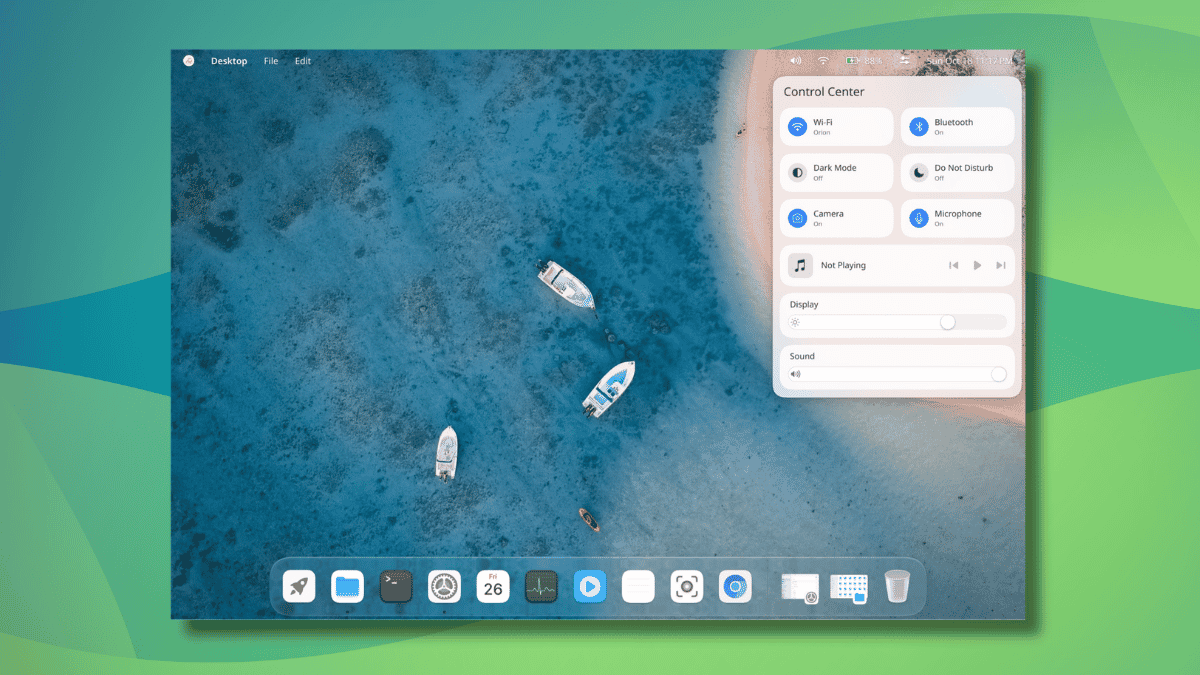
The project says the new desktop has its own Wayland compositor and graphics library.

The Mystery of Oak Island is a passion project from Visionaire Studio, who make the popular point and click game engine.Read the full article on GamingOnLinux.
Stemming from a bug report one month ago with GNOME 51 over high GPU usage while the monitor is sleeping, a set of 17 patches were merged today for addressing this issue...
Following the interesting SpacemiT K3 RVA23 RISC-V SoC, SpacemiT today announced the V100 server-class RISC-V processor...
America is "making an unprecedented attempt to revive three shuttered nuclear plants to meet rising energy demand," reports the Los Angeles Times,
"Two of the plants have contracts with Big Tech companies that will pay a premium to get large amounts of carbon-free energy for data centers..."
No commercial nuclear reactor is known to have resumed generating electricity after beginning the decommissioning process that takes one out of service, though some reactors have restarted after long outages. The Department of Energy is lending as much as $4.4 billion to restart the Palisades Power Plant in Michigan, the Crane Clean Energy Center on Pennsylvania's Three Mile Island and the Duane Arnold Energy Center in Iowa to restore a combined 2.25 gigawatts of electricity, which can power roughly 2 million homes and businesses. All three of the plants closed before their licenses expired, largely because the electricity they produced was considered too expensive... Restarting a reactor is a fairly quick way to get a lot of electricity, and it's cheaper than building a new, large reactor, said nuclear engineering expert Todd Allen...
Edwin Lyman, at the Union of Concerned Scientists, said the taxpayer money being used should go toward addressing safety risks. For example, most U.S. plants were built between 1970 and 1990 and were designed to withstand natural disasters of that era, said Lyman, director of nuclear power safety at UCS. But climate change is making extreme weather events more frequent and severe. "It's possible, if they set the right level of safety and spend the necessary funds to meet that, they could restore these plants to operable condition," he said. "That's not happening at this point...."
NextEra Energy and Google are collaborating to restart Duane Arnold by early 2029... Microsoft has a contract with the Crane Clean Energy Center on Three Mile Island just outside Harrisburg. The plant was the site of the nation's worst commercial nuclear power accident in 1979. The accident destroyed one reactor, leaving the plant with one functioning. In 2019, Constellation Energy's then-parent company Exelon shut down the functioning reactor, saying it was losing money and that Pennsylvania lawmakers had refused to subsidize it. Constellation Energy announced in 2024 that it would spend $1.6 billion to restart the reactor under a 20-year agreement with Microsoft. It hopes to bring the plant back online in 2027...
Palisades is expected to be the first nuclear plant in the world to resume generating power after beginning the decommissioning process.
Read more of this story at Slashdot.

Android TV owners are pointing Claude Code at their TVs over ADB to strip out ads, telemetry and bloat. Here's how it works and where it can go wrong.
There is yet-another-Linux-file-system attempt... An initial request for comments (RFC) patch series was sent out this morning for BeamFS. The proposed BeamFS is a Reed-Solomon protected file-system...
Gentoo is preparing to drop Chromium as maintaining the source-built browser becomes increasingly difficult. Google Chrome and Flatpak remain alternatives.
The ARM64 code for Linux 7.4 is stripping away its support for big-endian kernel builds for 64-bit ARM...
Going back to July 2025 the open-source Radeon RADV Vulkan driver has offered experimental host image copy support with the API's VK_EXT_host_image_copy extension. This has been for RDNA1 and newer GPUs while now GFX10 RDNA 1 GPUs have this extension enabled by default while also enabling experimental support for prior GFX9 era GPUs too...
Among the early pull requests sent out in advance of the Linux 7.4 kernel merge window opening were the driver core updates. Standing out here is the new TAINT_FORCED_BIND for dealing with the recent major fuzzing "attack" by AI agents/bots testing impractical driver/hardware combinations...

Dungeonbound is an upcoming first-person auto-battler dungeon crawler with some fun ideas and a mixture of modes that change how you play.Read the full article on GamingOnLinux.

Indie developers just keep coming up with absolute gems. Spin Tide is another survivor-like but it's the style and animations that hooked me in.Read the full article on GamingOnLinux.

Ready to fill up on some more games? The Double Fine Publisher Humble Bundle and Serenity Forge Emotional Impact Humble Bundle have some great stuff included.Read the full article on GamingOnLinux.
Adafruit has previewed Floppsy Rev D, an RP2350-based floppy disk archiver and emulator designed to preserve and access legacy computer storage media. The standalone device supports floppy drives used with PCs and Apple Disk II systems, offering disk imaging, flux-level data capture, and emulation capabilities alongside a touchscreen interface and removable storage. The board uses […]
"Mozilla reps tell me they've met with Microsoft about their concerns," reports PC Magazine, "but that the company wasn't responsive."
"They'll do the minimum the law requires to respect user choice," explains Kush Amlani, Mozilla's counsel overseeing global competition and regulatory work... Mozilla recently marked 100 days since it released an 87-page report detailing the ways in which Microsoft pushes Edge on Windows PCs.... One example is how Windows often displays a "Let's finish setting up your PC" pop-up after an OS update. This screen has an enabled-by-default option to "use recommended browser settings," which makes Edge the default web browser.
However, that screen doesn't appear in Europe. European laws now force Microsoft to make Windows more respectful of user choices. For instance, in European countries, the Start menu opens links in your default web browser rather than in Edge, as it does everywhere else. Amlani says Mozilla wants Microsoft to release the European version of Windows to the rest of the world. However, he thinks this will require government action. As he puts it, "Microsoft can do better when it's forced."
The last line of the article sums up Mozilla's main point. "No one should have to fight their OS this hard on something as simple as a browser preference."
Read more of this story at Slashdot.

Enshrouded is a solo and co-op survival action RPG where your freedom and creativity come first - with a big 1.0 release out now.Read the full article on GamingOnLinux.

Move over Tetris, it's time for some Hot Wax - an inventive new take on classic falling block puzzlers.Read the full article on GamingOnLinux.

A triple helping of community Proton builds to report on for you today with Proton-CachyOS 11.0-20261014, DWProton 11.0-15 and GE-Proton 11-10 released.Read the full article on GamingOnLinux.

Linux kernel 7.3 has officially been released, bringing with it plenty of improvements for Linux gaming.Read the full article on GamingOnLinux.
Catch up on the latest Linux news: Ubuntu 26.10, GNOME OS Preview, KDE Plasma 6.8, Firefox 158, Wine 11.20, Linus Torvalds rejects AI coding bans, and more.
"Anthropic says it's committing 5% of its shares to a 'public benefit fund'," reports TechCrunch, "structured as a wholly-owned entity within the company — with the option to contribute an additional 2% for every 50% increase in Anthropic's value."
Important context from CNBC:
The timing of Anthropic's public fund announcement is both mandatory to prepare for an initial public offering, and "beneficial from an image perspective," especially as AI reshapes the jobs market, Lise Buyer, partner at IPO advisory firm Class V Group, told CNBC...
Anthropic said it will share more about the fund structure and governance in the coming months, including valuation milestones that may increase the stake. It said it will also share progress on the fund in an upcoming public benefit report. In response to Anthropic's announcement, Tesla and SpaceX CEO Elon Musk said on X that he "recommend[s] giving the shares directly to the public."
Anthropic's announcement hints the fund could address job-market displacements. It says the fund "might" explore "large donations to traditional nonprofits" — or, that it "might" explore "direct distributions to specific populations. One example is labor market impacts."
It then argues AI could "cause instability" for many workers. And while Anthropic has already committed $200 million for "studying and addressing" this issue, Sunday's announcement says "bolder" approaches may be needed, and that the Fund "will have the versatility to pursue them."
"Combined with its co-founders' pledge to donate 80% of their equity and an employee donation matching program, roughly 20% of Anthropic's shares will be dedicated to public purposes," reports Reuters, "excluding any additional shares added later."
Read more of this story at Slashdot.
Linux kernel 7.3 is now available for download, as announced today by Linus Torvalds himself, featuring enhanced hardware support, filesystem and networking improvements, security enhancements, new drivers, and many other changes.

A fix for memory freezes lands alongside Zen 6 groundwork, and early Apple M3 support.
"A human defeated two of the three robots he faced in a cage fight recently held in San Francisco," reports the Los Angeles Times, noting that videos of the event drew more than 10 million views on YouTube.
But "the humans behind that fight could face a battle of their own — the legal type — if they want to hold another event like 'Human Vs. Robot,' the Sept. 18 competition that placed influencer Frankie LaPenna inside an octagon to battle three humanoid robots that were controlled remotely by a human operator in separate MMA-style fights..."
Wearing spiked gloves, a helmet and protective padding, the 5-foot-6, 205-pound LaPenna held his own against all three bots. He dominated his first opponent, referred to at the fight as "the child robot." Next came an imposing "Terminator"-inspired humanoid, which was listed on the fight video as 6-feet and 200 pounds with a kick force of 850 pounds. The robot landed several hard kicks, including one that knocked LaPenna across the mat and another with an impact that brought the humanoid to the ground and caused its head to come off — but the human seemed to gain strength as the match went on and eventually stood triumphantly with his foot on the machine's crumpled body.
LaPenna was dominant early in his final match, in which he faced a robot that resembled a "Predator" from the movies of the same name. After landing several punches and kicks and taking his opponent to the ground multiple times, LaPenna eventually became fatigued and called for the match to be ended. "He doesn't get tired. He doesn't stay down," LaPenna said in a postmatch interview.
"The crowd of about 100 (humans, not humanoids) was thrilled," writes the New York Times. (After beating his first robot opponent, LaPenna told his interviewer, "Clankers zero, humans one.")
But the New York Times adds that "Those who know humanoid robots best highly recommend against fighting them."
"It's very unfair to put a human in with a heavily motorized system that's only going to dominate," said Ken Goldberg, a professor who oversees the automation lab at the University of California, Berkeley. "There's nothing surprising about that...." He said he understood the appeal of the fights that Robot Entertainment Kombat (REK) was staging, noting that it tapped "into some of the fear and frustration with robots that people feel.... I mean, they love to see the human kick the robot's gearbox," he said. But the odds of that human fighter getting his gearbox kicked are much greater, Dr. Goldberg said, given that REK's humanoid robots can weigh several hundred pounds and are made of steel.
To be fair, it looked like sometimes the robot just fell over. (And the robots were human-controlled, not programmed with split-second reactions...)
But "Not everyone is a fan," adds the Los Angeles Times:
On Sept. 23, the California State Athletic Commission sent a cease-and-desist order to REK, its CEO Cix Liv and "all persons holding, promoting, advertising or sponsoring unsanctioned human versus humanoid robot cage fight." The letter states that "any boxing or mixed martial arts contest, match, or exhibition, involving any human in the State of California" requires the prior approval of the commission and that it is a misdemeanor to hold such an event without obtaining a license or permit from the state. A spokesperson for the California Department of Consumer Affairs, which oversees the CSAC, said in a statement emailed to The Times that the commission is "committed to protecting the safety of the public and integrity of combat sports."
"Unsanctioned activity puts the physical and financial well-being of all those involved at risk and such activity will not be tolerated," the statement said.
Read more of this story at Slashdot.
Linus Torvalds has released the 7.3
kernel, as expected.
It's Sunday afternoon, and this week I somehow kept my wits
together long enough to keep track of the day of the week, so the
release isn't randomly delayed. Will wonders never cease?
Anyway, nothing very special seems to have happened this last week,
so as expected the final 7.3 is out, and thus tomorrow the merge
window for 7.4 opens. Except I'm on my annual family vacation, so
instead of merging anything first thing in the morning, I'll spend
most of the day on a boat and under water. I'll get back to merging
in the afternoon, but I expect my schedule to be a bit unusual for
a while.
This release is a record-breaker on all fronts; it brought in 18,765
non-merge commits from 3,021 developers, 807 of whom were first-time kernel
developers.
Significant changes in this release include some significant binfmt_misc extensions, some group-scheduling work
aimed at improving performance on large systems, the new failfs
filesystem that fails all operations, the fchroot() system call,
global per-CPU data for BPF programs, the completion of the sched_ext subscheduler feature,
working-set tracking for virtual
machines,
alternative
data-stream support in the ntfs3 filesystem,
a long
list of SMB server improvements,
and much more. See the LWN merge-window summaries
(part 1, part 2) and the KernelNewbies 7.3 page
for details.
The Linux 7.3 kernel is out today for an on-time release of this next stable kernel version...
"When you pay for a game, you should own it," says U.S. Representative Ritchie Torres (D-NY), introducing a new bill to fight the practice of "a rental disguised as a sale".
Kotaku reports:
The fifth best-selling game of 2024 in the U.S. was NBA 2K25. Every year, fans dump hundreds of hours and hundreds of dollars into the grindy NBA basketball sim. But just a little over two years after its release, 2K Games confirmed it's already pulling the plug on it. The game will be delisted from digital storefronts on October 30. By January 1, 2027, online servers will go offline as well, making it impossible to play the most popular modes. A game millions paid $70 for will become mostly useless. Democratic Congressman Ritchie Torres wants to change that.
"I think there should be a simple rule: if you pay for it, you own it," Torres told Kotaku in a phone interview this week. To make that the law of the land, the U.S. representative for New York's 15th congressional district since 2021 plans to introduce legislation in Congress called the Power To The Players Act. The bill would direct the Federal Trade Commission to create regulations protecting ownership rights for video games. Companies selling digital games would need to grant players more than just a license that can expire at any time, and games with online features would need to provide offline modes that still work even when servers eventually shut down...
The Power To The Players Act noticeably leaves out other types of digital media like movies and music, though Terminator 2 and a bunch of other movie purchases were ripped from people's digital libraries earlier this year.
Representative Torres "did not confirm if the bill will have any cosponsors," the article acknowledges, "or whether any of his Republican colleagues will sign on to support it."
But players will see the bill's importance next month, the article points out, "when Grand Theft Auto 6 releases as just a download code in a box, giving fans no control over a purchase that starts at $80.
Read more of this story at Slashdot.
July: Nvidia-backed Nscale is building a £2bn data centre at Loughton in Essex, with Microsoft signed up as its anchor tenant. But it can't get the electricity to switch on, reported The Next Web:
Nscale's problem is not really Nscale's. It is Britain's. Grid-connection times have become the single biggest brake on new data centres. Some UK projects face waits stretching close to a decade for enough power. One estimate found more than a quarter of data-centre capacity slipped in 2025 alone.
"The data centre was due to receive its power supply at the end of the year," reports the BBC. "But as first reported by the Telegraph on Sunday, Nscale has been told this will not happen until the 2030s." (Though Nscale and Microsoft are still working together on other projects in Norway, Portugal and America.)
But now anchor-tenant Microsoft has pulled out of the Essex deal, reports the Telegraph, adding that Microsoft's move "leaves the site in apparent limbo. The company was its only announced customer, having agreed to rent 23,000 Nvidia AI chips at the facility..."
Microsoft's decision threatens to undermine Nscale's attempts to push ahead with a Wall Street flotation worth up to $35bn (£26bn), despite a brutal sell-off in AI computing stocks. Rival data centre developers have seen their share prices plunge over the last week on concerns that they will struggle to repay their debts as interest rates and inflation continue to rise.... Tech analyst Gartner said last week that $3.5 trillion could be written off by 2030 if the AI boom fails to deliver on its promises.
And "our research indicates that enterprise and consumer AI revenue will be insufficient to support profitable returns on all planned AI capital expenditures during this period," Gartner wrote:
"In 2026, AI providers are expected to spend nearly $1 trillion on AI infrastructure, and are forecast to invest an additional $6 trillion between 2027 and 2030," said Will Sommer, Sr Director Analyst at Gartner.... Failure to achieve sustainable return on investment capital (ROIC) on rapidly depreciating assets would almost certainly necessitate write-downs. Based on Gartner projections, a continued AI infrastructure investment trajectory could leave more than $4 trillion in asset value exposed to write-down risk through 2032. In this scenario, Gartner does not expect the 12% ROIC to be achieved until the end of 2032 at earliest...
Gartner estimates AI-optimized IaaS spending will grow from $66 billion in 2027 to $174 billion in 2030. "The growth in spending on AI-optimized IaaS will be too low for most AI compute providers to recover their AI investments before the current generation of AI semiconductors is replaced," said Sommer. By 2030, Gartner predicts that cost pressure and a lack of a differentiating business model will force over 80% of neocloud [AI-specialized infrastructure] providers to cease independent operations.
Read more of this story at Slashdot.
Gizmodo reports:
Roughly 84.4% of the world's coral reefs suffered bleaching-levels of heat stress during the last major marine heat wave from January 2023 to September 2025, with over half already lost compared to coral coverage in the 1950s... But there's some good news, thanks to a new study published this Wednesday in the journal Science Advances: Marine ecologists at Stanford have discovered that bleached corals can be revived via contact with a healthy coral neighbor, who (like a good neighbor) shares their photosynthetic, symbiotic algae (Symbiodiniaceae) with their peers.
"This incredible new result — that fast and full recovery is possible in bleached coral — can inspire solutions that eventually may be scalable," [Fiorenza Micheli, a marine ecologist with Stanford's Center for Ocean Solutions and study co-author, told the journal Nature]... Unlike their controls, bleached coral in contact with healthy coral recovered in just eight weeks... [T]he surprise discovery of this method alongside the other techniques that marine conservationists are now actively pursuing — including the successful deep-freezing and revival of at-risk coral sampled from Hawaii — could offer threatened reefs the lifeline they need. Coral contact could super-charge other efforts, like the selective breeding of heat-tolerant corals and the cultivation of protected coral nurseries
Read more of this story at Slashdot.
The GNOME project released GNOME 51.1 today as the first point release in the latest GNOME 51 desktop environment series to fix bugs, update translations, and add a few enhancements.
The Verge reports:
OpenAI, Meta, Google, Instinct, and others promise their agents can scour the internet on your behalf, doing anything from booking a dinner reservation and cleaning out your inbox to buying new shoes. But what happens when the rest of the internet won't play nice?
In recent weeks, users of services like Meta's Muse, xAI's Grok, OpenAI's Dots, and Instinct have reported blocks preventing their AI agents from performing tasks across top websites. Yelp told TechCrunch that it only allows AI agents that pay for its data licensing program, while Delta Air Lines is preventing them from booking tickets on behalf of users. JPMorgan Chase and Charles Schwab have also confirmed that they're blocking AI agents from accessing accounts due to security concerns. Some users say sites that previously worked with their AI agent are no longer accessible, including Cars.com and Amtrak, suggesting other companies could be quietly blocking them....
Muse, Meta's deceptively cute AI assistant, most recently faced the wrath of Amazon, which said its "continued access" violates its site policies. There are reports of xAI's Grok, Instinct's AI agent, and OpenAI's Dots being unable to use Amazon as well. xAI owner Elon Musk responded by saying that maybe he "should start a competitor to Amazon." The more places bots struggle to access, the greater the questions about how useful they are....
Instead of trying to fight Amazon, [Meta] has partnered with retailers like Walmart, Gap, Sephora, Best Buy, and others, allowing Muse to shop on their sites. At the same time, Shopify has also opened its network of storefronts to AI agents.
Read more of this story at Slashdot.
Fedora developers have postponed Fedora Linux 45 until October 27 after no suitable final release candidate was available for evaluation.
More details are emerging about Saudi OpenAI employee Abdulrahman Alfozan, who was arrested by the FBI for allegedly planting a recording device in an executive conference room. Previously Alfozan "was an engineer at Meta," notes the New York Times, "before joining a start-up that went through Y Combinator, the Silicon Valley start-up accelerator. He gained permanent residency status in the United States in 2020, according to court documents, and was hired by OpenAI in July 2025."
14 months later the conference room recording device was inserted in a USB port on the back of a television, and then concealed in toilet paper, according to a statement from America's Justice Department. (There's even a photo of a device — and a photo of Alfozan entering the executive conference room and appearing to look behind the television where the device was inserted.) The FBI's says a chatbot account associated with Alfozan's spouse showed prompts asking about installing and obfuscating a recording device. And the complaint alleges that OpenAI security personnel also found a bag Alfozan left in a different room which contained his wallet, his ID, and another recording device.
Discussions in that room included "highly confidential technical, commercial, and strategic information, including proprietary research," according to the FBI, "as well as nonpublic information about Open AI's technical progress and strategic decisions..."
"If convicted, Alfozan faces a maximum penalty of 5 years in prison and a $250,000 fine, followed by 3 years of supervised release."
Friday Alfozan's lawyersrequested his release from custody, saying Alfozan agrees to wear an ankle monitor, remain at home, surrender his passport and "not possess any covert audio or video recording or surveillance device." They argue that the one-way ticket he'd purchased to Saudi Arabia just continues a long-standing habit of buying one-way tickets over the years for air travel, since his tech career often involves last-minute changes to meeting schedules, and "70% of the airline bookings in his email since January 2021 (96 of 138) were one-way tickets."
His lawyers also presented 46 letters of support, including letters from former Meta colleagues, ten company founders and chief executives, and more than a dozen engineers and engineering managers.
Read more of this story at Slashdot.
This Week in Tech: AI Gets Bigger, Gadgets Get Smarter, and Security Risks Mount appeared first on TechRepublic.
"Even LinkedIn is getting tired of your AI-written posts," writes CNN, reporting that the Microsoft-owned, job-oriented social media site "is upping its fight against slop."
A report published in July by Pangram, a research firm that tracks AI content online, found that more than 40% of long-form posts on the platform were AI-generated, compared to around 30% on X and Medium and a smaller percentage on Reddit and Substack.... LinkedIn previously offered AI tools to edit or rewrite posts, although it recently scaled the offerings back. But low-quality AI posts are a business problem for LinkedIn. They all start to sound the same, [according to LinkedIn Editor-in-Chief Dan Roth Roth]. If users see too many generic AI posts, instead of content that really teaches them something or gives them a deeper understanding of a professional connection, LinkedIn risks losing them to other platforms.
In August, LinkedIn rolled out a button letting users flag when a post "seems like AI slop," which was clicked more than 1 million times within its first two weeks. Now, the company is trying to use its own AI systems to help weed out AI slop on the platform and to remind LinkedIn users how to post like humans. The company built a team largely made up of former journalists and social media experts who have an eye for recognizing generic, sloppy content. These experts help train LinkedIn's AI model on what authentic, useful posts look like. If the model flags a post as low-quality, AI-generated content, it'll be less likely to be distributed beyond that user's direct connections.
Also key to the strategy is a creator management team that acts as "content therapists" for executives, subject matter experts and other LinkedIn users, many of whom have gotten accustomed to the convenience of using AI to write what, on the surface, appear to be polished posts, Roth said. "A lot of times now today, they'll run it through Claude or Gemini or wherever, they'll post it on LinkedIn and it will perform poorly. And then they come to the team and they're like, 'Why did this do badly?'" Roth said. "And the best thing you can do is give it back to them and be like, 'Did you enjoy reading this? Do you see yourself in this?"
The efforts are showing early signs of success. Improvements to LinkedIn's detection systems have resulted in a 40% decline in views of content classified as AI slop, the platform said last month. That's not to say LinkedIn is entirely opposed to AI, Roth said, adding that "not everyone is a born communicator." But failing to edit or personalize content means it's less likely to reach a wide audience on the platform.
Read more of this story at Slashdot.
TechRepublic reports:
The TIOBE Index is a monthly indicator of programming-language popularity based on factors including skilled engineers, courses, and third-party vendors. The October 2026 rankings show a largely stable top 10, with R overtaking SQL and Julia returning to the top 20 for the first time in three years. [SQL has risen to #9 from #10 in October of 2025 — back when R ranked only #13.]
Python remains No. 1, followed by C, C++, Java, C#, and JavaScript, while Rust holds its No. 10 position. [A year ago Rust ranked only #16.] Outside the top 10, Julia climbs from No. 21 to No. 18, and TIOBE introduces Mandarin Chinese search terms into its methodology to broaden the index's geographic representation.
Dropping out of the top ten is Go, which fell from #8 in October of 2025 to #11. And Delphi/Object Pascal has plummeted from #9 to #19.
TIOBE CEO Paul Jansen argues that Julia's growing popularity "is largely driven by the demand for modern programming languages that combine high performance with ease of learning, particularly for numerical computing."
Python offers an accessible, high-level approach to numerical computing, but performance can become a bottleneck. C++, on the other hand, delivers excellent performance but comes with a steeper learning curve and a lower level of abstraction. Julia aims to bridge this gap by combining the best of both worlds...
Apart from Julia, two other languages are knocking on the door of the TIOBE top 20: Dart and OCaml. Dart jumps from #41 to #27 this month. Thanks to its popular UI toolkit Flutter, Dart has been hovering around the edge of the top 20 for quite some time. OCaml, on the other hand, might come as a surprise. It jumps from #38 to #26 this month, driven in part by its growing use in real-time trading systems and parsing technology.
Read more of this story at Slashdot.
LILYGO’s latest e-paper development board pairs an ESP32-S3 with a 4.7-inch display offering 960 × 540 resolution and 16-level grayscale. The board also includes battery monitoring, removable storage, and Wi-Fi and BLE connectivity for portable information displays and wireless embedded projects. The board is powered by an ESP32-S3 microcontroller with a dual-core Xtensa LX7 processor […]
Long-time Slashdot reader ardiri remembers his days writing applications for the Palm OS. And he's now released approximately 1.5 GB of historical Palm OS development resources, "accumulated during the early days of handheld computing and preserved on hard drive backups for more than 25 years... to preserve the tools and knowledge that helped define an important era of personal computing."
The collection includes historical SDKs, developer conference presentations, technical documentation, programming examples, limited source code, and development utilities. (ROM images, commercial applications, and simulator binaries have deliberately been excluded....) Making a broader collection of development resources available to the retrocomputing community, the archive is available at GitHub.com/ardiri/dev-palmos and is intended for historical preservation, education, and research, particularly as enthusiasts continue working to maintain, emulate, and revive the platform... Ardiri has also written an auto-biography and has started explored the engineering principles behind these systems in his books.
And somewhere along the way, Ardiri rediscovered the original source code for "The Palm OS Virus That Never Was — Lost for 25 Years, Found in 2026." Lurking on a CompactFlash card containing files dated June 2001, he found the self-replicating Palm OS virus that he'd developed and tested in June 2001, months before the planned PalmSource developer conference in San Jose.
Named 'Virii,' the virus intercepted Palm OS system calls to progressively infect legitimate applications while preserving their original functionality. Infected applications could then spread between handheld devices through infrared beaming, potentially allowing an infection to propagate among hundreds of developers exchanging software at the conference. The virus also included a date-triggered payload designed to interfere with system time reporting between October 23 and 27, 2001, potentially causing erratic clocks, unreliable alarms, and missed appointments.
He promises the functional source code and binaries will remain private.
Read more of this story at Slashdot.
Intel Trust Domain Extensions (TDX) for confidential computing with VMs has assumed the need to perform cache flushing when transitioning memory between KeyIDs used by the total memory encryption (MKTME) for unique AES encryption keys. But it's turned out to be unneeded and the Linux kernel is working now to reduce the excessive cache flushing...
Omarchy 4.0.5 ships with Linux kernel 7.2.8, Qt 6.12 compatibility fixes, desktop performance improvements, and better support for NVIDIA laptops and audio devices.
The Linux 7.3 kernel is expected to be released as stable later today and with that version there are many exciting changes and improvements. However, the Linux 7.4 kernel merge window will then open up and there are even more exciting changes expected to be merged for this follow-on kernel cycle. Here is a preview of some of the many exciting feature changes expected for Linux 7.4...
Omarchy 4.0.5 released this weekend as the newest version of this Arch Linux based distribution built around the Hyprland desktop. Omarchy 4.0.5 pulls in the latest Linux 7.2 stable kernel with BORE scheduler, updates against the Qt 6.12 toolkit, and a variety of smaller improvements...
Servo's August status report has finally appeared for outlining progress made on this open-source, Rust-based browser engine. This follows the recent release of the Servo 0.6 software, including the Servoshell demo browser...