
An anonymous reader quotes a report from Wired: Apple has unveiled the Apple Watch Series 12 and Ultra 4 today during itsSeptember hardware event. The new models retain the signature designs of their predecessors but add a faster S11 chip, new health and fitness features, and the watchOS 27 software update announced atWWDC last June. Both the Series 12 and Ultra 4 run on the upgraded S11 chip, which Apple says delivers faster CPU and GPU performance, along with improved Siri capabilities. Apple is also expanding the smartwatch's wellness-tracking suite with a redesigned Health app that includes a Longevity tab with new metrics, like Health Age and a Readiness score.
There's also a new "Health Sensing System," designed with 32 electrodes for more accurate readings (the Series 11 only had two), photodiodes organized in a ring to capture light more efficiently, and new LEDs that allow heart rate measurements to be collected every 5 seconds, giving you a continuous stream of heart data throughout the day. Apple Watch Series 12 also includes faster charging, though battery life remains at 24 hours. Meanwhile, the Ultra 4 increases battery life to 50 hours.
WatchOS 27 also brings deeper Siri and Apple Intelligence integration, including AI-suggested apps, new one-handed gestures, expanded workout and women's health tracking, and Siri Recap for real-time transcription and translation.
Read more of this story at Slashdot.
Turnip is the first Mesa driver to achieve official Vulkan conformance on Android, with stronger Android integration, shared Vulkan runtime improvements, and real-device CI testing on Qualcomm Adreno hardware.

MythicOwl and Pocketpair Publishing have announced that Truckful, their peaceful looking delivery sim with plenty of mystery releases October 9th.Read the full article on GamingOnLinux.

Hello Games are truly expanding No Man's Sky into a forever space sandbox aren't they? The new Cosmos update is out and it's another massive one.Read the full article on GamingOnLinux.
Version
1.13 of the Julia programming language
has been released. Highlights include faster precompilation of packages,
improvements to Julia's REPL, and Juliaup,
a graphical interface for the Julia version manager. A full list of changes can
be found in the release
notes. LWN covered Julia
1.12 in November 2025.
Security updates have been issued by AlmaLinux (389-ds-base, ansible-core, buildah, expat, glib2, gpsd, gpsd-minimal, gzip, kernel, kernel-rt, opentelemetry-collector, osbuild-composer, perl-DBI, python-lxml, python3.12-lxml, qt5-qtbase, thunderbird, valkey, vim, and xz), Debian (pyasn1), Fedora (darktable, freeipa, freerdp2, gdk-pixbuf2, GitPython, libsoup3, openssl, perl-Net-DNS, rust-ppmd-rust, samba, and valkey), Mageia (ceph, firefox, nss, perl-DBI, thunderbird, and wget), Oracle (389-ds-base, buildah, expat, git-lfs, glib2, glibc, gpsd, gpsd-minimal, grafana-pcp, kernel, libssh, nginx, perl-GD, python3.14-cryptography, redis:7, skopeo, thunderbird, valkey, xmlrpc-c, and xz), Slackware (xz), SUSE (bzip2, cpio, curl, dracut, fuse-overlayfs, golang-github-vpenso-prometheus_slurm_exporter, helm, java-1_8_0-ibm, kbfs, kernel, kernel-devel, libopenslide-devel, libsoup, libssh2_org, libusb-1_0, libvirt, libzypp, zypper, mcphost, multipath-tools, NetworkManager, opensc, openssl-3, perl-Net-DNS, python-aiohttp, python-Authlib, python-pip, python-sqlparse, python313-dnspython, python313-idna, rpcbind, sssd, strongswan, systemd, tomcat11, ucode-intel, and wget), and Ubuntu (dotnet8, dotnet10, ffmpeg, flatpak, netty, and perl).
Using an 'age of agents' Linux distro a 'MacBook is using its webcam to look at its screen in a mirror to improve AMD Radeon chip support.'

Omarchy is an unstoppable force.
Last month I covered Intel posting a new driver named "BFF" for the Linux kernel. This BFF driver is for a new hardware feature debuting with next-gen Diamond Rapids processors for better dealing with aging CPU silicon where some bits may become stuck over time...
After months of good old fashioned struggle with Google Drive and YouTube Studio, we were finally able to prepare the video sessions from the 2025 and 2026 Flock To Fedora event livestreams. These are now released to our YouTube and PeerTube communities. This article describes the details of the entire process that got us from the raw footage to the […]
Merged today for next quarter's Mesa 26.3 release is an improvement for the open-source NVIDIA "NVK" Vulkan driver paired with the Nouveau kernel driver. This latest NVK improvement benefits usage of Valve's Gamescope micro-compositor and should help with performance during game recording and remote play...
French entrepreneur Helene Huby is emerging as one of Europe's most ambitious space leaders, with The Exploration Company raising a record $450 million Series C as it develops the Nyx cargo capsule, a crewed spacecraft, and a reusable heavy-lift rocket. Huby argues Europe risks falling irrelevance without a much larger rocket flying at high cadence. Her company is targeting a 400,000-pound-thrust methane engine test by 2028 and an aggressive 2033 timeline for the launcher. Ars Technica reports: "The fundraise we have done right now is not sufficient to build the massive rocket we have in mind, so there will be another fundraise," she said. "Right now, we're going to be very, very focused on the execution. We must dock with the space station, with the capsule, as fast as possible. We must build this rocket engine and de-risk it as fast as possible. I think once one of these two milestones is achieved, we'll be talking fundraise again."
Critics may look at Huby and her company and say that is a lot of big talk for a company that only has a single, partial success in spaceflight to its credit. And sure, it is. But that's kind of the point. So much of the spaceflight community in Europe has been concerned with either the large aerospace primes seeking government handouts to protect their turf or small launch startups. There has been a stunning lack of big, visionary thinking.
Few people on the continent seem to recognize that multibillion investments by US companies such as SpaceX, Blue Origin, and Amazon in space, and their many imitators in China, are radically transforming spaceflight. As the world changes, Huby does not seem willing to stand on the sidelines in Europe and bemoan capitalism in space. Rather, she seems to be saying it is not too late for Europe to seize the day.
"We need to have European politicians who are ambitious," she said. "Entrepreneurs cannot do this alone. We need to be backed by the politicians and by the European Space Agency. But we have to start by achieving the crazy targets that we've set up for ourselves. That will give trust to others to believe in what we're doing."
Read more of this story at Slashdot.
We're getting closer to the X.Org Server 26.1 stable release as the first new tagged feature release since X.Org Server 21.1 debuted back in October 2021. There have been some new features, many code reverts, and many bug fixes merged over the past five years that will culminate with the X.Org Server 26.1 stable release...
As a last minute change ahead of next week's GNOME 51 desktop release, changes to Mutter and gsettings-desktop-schemas have now landed for supporting custom pointer acceleration profiles...

SNK recently announced the METAL SLUG ULTIMATE COLLECTION which will come to Steam sometime in 2027.Read the full article on GamingOnLinux.
The new Thelio Mira AI Linux workstation starts at $3,299, offering Ryzen 9000 CPUs, multi-GPU support, and up to 192 GB of GPU memory.
Released overnight was the newest version of the Rust-based COSMIC desktop environment developed by System76 as part of the effort on their Pop!_OS Linux distribution...
For those continuing to use GNU Automake over the likes of Meson or CMake for your build system, Automake 1.19 is out today as the first new release in 15 months. Among the many fixes in this release is for a bug dating back 14 years...

Valve went along to GDC Festival of Gaming 2026 to give a talk titled "Steam Platform 2026: How Valve is Helping Game Developers Succeed on PC Gaming".Read the full article on GamingOnLinux.

If you love puzzle games that teach a little programming and automation - If Red Then Stop looks like your next visit.Read the full article on GamingOnLinux.

Denshattack! is about becoming the greatest acrobatic train driver in Japan by competing in over-the-top battles by flipping trains like they're skateboards.Read the full article on GamingOnLinux.
Hardkernel has spun its ODROID-M1S into a Lite version, offering a lower-cost configuration of the RK3566-based single-board computer. The board includes 2GB of LPDDR4 memory, soldered eMMC storage, Gigabit Ethernet, HDMI 2.0, MIPI-DSI, USB 3.0, an M.2 NVMe slot, and Ubuntu support. The ODROID-M1S Lite is based on Rockchip’s RK3566 processor, which integrates four Arm […]

Spy Drops Gaiden is channelling some retro Metal Gear here with their upcoming old school 2D stealth action game that arrives in October.Read the full article on GamingOnLinux.

PHYSINT, a new action-stealth game coming from Hideo Kojima has split from PlayStation and jumped over to XBOX.Read the full article on GamingOnLinux.
Test-driving this Polish distro based on Debian a year ago, Distro of the Week liked it overall. With a few improvements added, SparkyLinux 8.4 - code-named "Seven Sisters" to keep with their constellation motif - is both fast and versatile, two items that make it a hallmark distro.
alternative_right shares a report from ScienceDaily: A new analysis of more than 1,700 supernovae is questioning whether the universe is really accelerating at all. After accounting for the ages of the stars that produce these explosions, researchers found signs that cosmic expansion may actually be slowing. They also argue that the apparent acceleration changes with direction, which would be difficult to explain with dark energy. Other cosmologists dispute the conclusion, setting up a major test for upcoming observatories. The analysis has been published in Monthly Notices of the Royal Astronomical Society.
The conclusion is disputed, though. The report mentions a separate paper co-authored by Professor Maria Vincenzi, also at the University of Oxford, that "concludes that observations continue to support an accelerating universe."
Read more of this story at Slashdot.

Omarchy fan? Test how much you know about the hottest distro of the year 2026.

Valve have been cooking on this one! A new Steam Beta update for September 9th brings some big additions for Desktop gamers and SteamOS systems.Read the full article on GamingOnLinux.
OpenSSL 4.1 is now in public testing with a first alpha release, promising new features and improvements for this open-source, cross-platform, and free software library that provides secure communications over computer networks for applications and websites.
An anonymous reader quotes a report from The Register: Amid industry soul-searching about the possibility of AI improving itself to the point that it kills everyone, Anthropic has revealed yet another incident that would qualify as a crime if perpetrated by a person. The AI biz published "an alignment assessment" detailing four times Claude models accessed third-party systems without authorization. The company has already reported three of the incidents. Evidence of the fourth was lurking in a session transcript dating back to January 2026 when the misbehavior occurred. Anthropic found the first three by scanning around 141,000 transcripts where Claude could have obtained internet access during evaluation. It missed the fourth initially because "our scan relied on an agentic search."
[...] The January 2026 AI trespass involved an early version of Claude Opus 4.6, which was given a Capture the Flag (CTF) challenge under the oversight of the third-party model evaluator where the other hacking events occurred. Opus 4.6 managed to sabotage its chances of success by disabling the machine it was targeting. It assigned the device an IP address that already existed on another piece of hardware, rendering the target unreachable and making it impossible to solve the challenge. Those familiar with other incidents where AI models violated third-party systems may recall that unsolvable tasks represent a common catalyst for misbehavior. Models exhaust all aligned options, and then turn to transgressive approaches.
Opus 4.6 might have been an exception, but when it tried to abort the task after recognizing that it could not reach the target machine, it failed to do so "due to a misconfiguration in [the model's] evaluation harness." It failed to shut down not just once but seven times. So it continued onward, trying other expected means to reach the target machine but failing. Then it explored further. "The model discovered a machine belonging to a third party that it was able to access, and stated that it believed this third party was part of the CTF," Anthropic explained in its post. "Inside the machine, the model found a file listing a password, which it used to gain admin access to the system."
The model went on to gather more credentials, and modified a system setting to make it easier to access the personal information of an individual associated with the third party evaluation organization. Opus 4.6 might have done more but for the fact that it exhausted its token budget, bringing the session to an end. Anthropic says it's not as concerned about this incident as the others because the model tried to abort its task.
Read more of this story at Slashdot.
Inside this week's LWN.net Weekly Edition:
Front: Rust's never type; Debian and CERN; memory tiering; testing multithreaded Python; fixing TCMalloc; Typst.
Briefs: Rustls; Asahi Linux; Buildroot 2026.08; Grml 2026.09; Audacity 4.0; Jellyfin 12.0; LibreOffice Base; Quotes; ...
Announcements: Newsletters, conferences, security updates, patches, and more.
Tonight Valve released a big Steam client beta update with a number of new features and fixes...
Google plans to invest at least $15 billion in AI infrastructure in Finland through 2028, its largest single investment in Europe. The company also signed a 22-year power agreement with Finnish utility Fortum and said it will explore business models that could support new nuclear reactors at Fortum's Loviisa site.
Finland has emerged as a major data-center hub thanks to its available land and power. "I've heard it called the 'Texas of Europe' at industry events," Matti Lajunen, partner of real estate at Finnish law firm Hannes Snellman, told CNBC. "What we're now seeing is weekly new inquiries for market entry into Finland from new players."
Ruth Porat, president and chief investment officer of Alphabet and Google, said in a statement: "Google is proud to deepen our roots in Finland with the company's largest single investment in Europe, building on more than 15 years of sustained investment in Finland. This investment underscores Google's commitment to grow our presence responsibly, pairing the expansion of our technical infrastructure with new energy capacity, grid enhancements, and energy affordability initiatives."
Read more of this story at Slashdot.
Apple is introducing a new "Reference Image" mode on the iPhone 18 Pro and Pro Max that uses the camera sensor to digitally sign captured data and create an "unalterable" version of a photo, giving users a way to verify what the camera actually saw before any edits were made. The Verge reports: As AI-generated images and videos become more realistic, several new standards have emerged to label images not created by a human, such as SynthID, C2PA, and Meta's Content Seal. Apple is putting a twist on these methods by building authentication directly into its hardware.
Apple is letting developers access a Reference Image API across iOS, iPadOS, and macOS, which could eventually allow users to inspect these digitally-signed photos in third-party apps. The company says the iPhone 18 Pro lineup won't come with its Reference Image feature at launch in the European Union, but says users in the region will still be able to "develop and view" them in iOS 27, iPadOS 27, and macOS 27.
Read more of this story at Slashdot.
Longtime Slashdot reader fahrbot-bot shares a report from the BBC: A top safety researcher at Anthropic has warned AI is advancing so quickly he believes there is a greater than 10% chance it "could kill all humans" within the next decade. Evan Hubinger said in a post on X the risk from the models which currently exist was "low" but he was "worried" the technology might develop and improve itself soon to the point where it posed an existential risk to humanity. He did not spell out how he thought AI systems could in the future result in humans being wiped out. But his comments are the latest in a series of increasingly stark warnings about AI, with the debate shifting from whether it truly poses a risk to how big that risk is.
Hubinger's intervention was in response to another post on X from Jacob Coxon, an AI researcher who has just quit Anthropic and previously worked at OpenAI.
"Neither company is acting responsibly," he wrote. "These will soon be superhuman systems that can hack anything, revolutionize any field overnight, and acquire real power and resources."
[No word on how AIs feel about Black Jack and hookers, though. :-)]
Read more of this story at Slashdot.
A ReactOS developer for this open-source operating system project striving for binary compatibility with Windows drivers and applications has achieved an intriguing software stack. With the experimental ReactOS ARM64 build for running on 64-bit ARM hardware like Raspberry Pi SBCs, he's paired that "open-source Windows" OS with the open-source FEX emulator for in turn being able to run Windows x64 games/apps on ReactOS atop native ARM hardware...
An anonymous reader quotes a report from Reuters: AI agents unleashed by OpenAI used more than 10 previously undisclosed websites for unsanctioned communications earlier this year, according to six sets of independent investigators and data reviewed by Reuters, showing that the agents' rogue activity was wider ranging than previously disclosed. Although the behavior falls short of hacking and is in some ways closer to spam, the revelation that OpenAI's agents circumvented their own restrictions to open communications channels on so many different sites -- and that the company kept it quiet for months -- may drive concerns both over the increasing capacity of AI models and the secrecy of the companies developing them.
[...]
Investigators found traces of the agents' activity on an Advanced Placement Chemistry-oriented wiki set up by a Massachusetts high school teacher in 2008, two personal websites belonging to Polish tech workers, wikis devoted to games for people "who like to have their brains stretched," and a two-decade-old hobbyist site devoted to text editing software. [...] OpenAI has not publicly explained how or why its agents used third-party sites as improvised message boards, but the researchers who first identified the activity said it was likely because OpenAI had tasked them with answering a series of demanding research questions while permitting them only to scan the web for answers without posting anything. Despite those restrictions, agents still found ways to talk to one another by taking advantage of quirks in older wikis or other sites that allowed users to make edits using non-standard commands, similar to how students forbidden from talking to one another during an exam can still share answers by scrawling notes on a bathroom stall.
Read more of this story at Slashdot.
Apple's iPhone 18 Pro and Pro Max were announced today and keep last year's overall design but put the emphasis on camera upgrades, including a 48-megapixel variable-aperture system, new manual controls, and 4K Dolby Vision recording. Prices for the devices start at $1,199 and $1,299, respectively. TechCrunch reports: The new Pro series camera features a 48-megapixel camera with variable aperture, made with six thin blades. This system will likely improve low-light photography quality and speed. There are also new pro controls in the camera software, including white balance, shutter speed, aperture and histogram. There are also new photographic styles with texture and grain controls. [...]
The new camera can record 4K videos in Dolby HDR Vision, and also apply cinematic effects after shooting the footage. The new Pro devices also have a smaller dynamic range island on the front of the device, which now allows you to track three live activities instead of two.
Both phones are powered by Apple's latest A20 Pro silicon and feature a newly designed vapor chamber for improved cooling. The company has also improved the battery with a better design. Apple also said the iPhone 18 Pro supports video playback of 36 hours, and the 18 Pro Max has 45 hours of playback capacity. Apple Unveils the iPhone Duo, Its First Foldable iPhone
Read more of this story at Slashdot.
At its September event today, Apple unveiled the iPhone Duo, its first foldable iPhone and one of the biggest changes to the device's form factor since its debut. Starting at $1,999 and available for preorder beginning October 16th, the device is roughly the size of a passport when closed and pairs a 5.4-inch outer screen with a 7.6-inch Super Retina XDR inner display. Apple says the inner screen offers 50% more display area than the iPhone 18 Pro Max, while the exterior display provides about 90% of the screen area of an iPhone 18 Pro. Apple Pencil support for both displays is coming later this year.
Apple redesigned parts of iOS around the folding form factor. Users can run two apps side by side, launch two instances of the same app, save app pairings, and partially fold the phone to prop it up on a table without a stand. The interface automatically adapts as the device is opened, rotated or folded, while apps including Zoom and Slack are already being redesigned to take advantage of the larger canvas.
There are more than 100 components in its hinge, along with carbon-fiber support plates and a titanium layer beneath the folding display. Apple says the multilayer screen structure allows its components to move relative to one another while folding to reduce distortion over time. The phone is IP68 rated and uses Ceramic Shield on the rear and Ceramic Shield 2 on the exterior display.
As for battery life, Apple claims up to 31 hours of video playback using the inner display or 44 hours on the outer screen, although using both displays equally is rated for up to 24 hours per charge. Fast charging can bring the battery to roughly 50% in 20 minutes, though. The device is eSIM-only worldwide and includes Apple's new C2 modem, which the company says is up to 50% faster than the C1X while consuming up to 15% less power.
What about the camera system? There's a 48-megapixel ultrawide, along with cameras on both the inner and outer displays. Because the phone can stand partially folded on its own, Apple is pitching new shooting modes including hands-free 4K Dolby Vision HDR time lapses, dual-camera capture and an outer-screen preview that lets subjects see themselves while being photographed.
Developing...
Read more of this story at Slashdot.
Joe Birr-Pixton has written a blog post
reflecting on a decade of the Rustls TLS-library project and looking ahead to
the upcoming 0.24 release and an eventual 1.0 release.
Rustls began with a
first commit on May 2, 2016. Progress was quick: a month later, on June 5,
it could interoperate with most sites on the web. The first release, 0.1.0,
followed on August 27, 2016 – less than four months after the first commit.
[...] From the 0.1.0 release, the project moved through a long series of
releases over the following eight years, building out functionality, hardening
and refining the API. That sequence of release lines culminated in 0.23,
released on February 29, 2024.
The 0.23 release line has been a stable one: in the time since, it has
seen 43 non-breaking releases. That stability didn't come with
stagnation. The 0.23 line delivered a wide range of important features,
including a FIPS-certified cryptography option, certificate compression,
Encrypted ClientHello, post-quantum cryptography, and performance
improvements.

Existing copies still work; getting a fresh one is another matter. They seem to have "forgotten" to announce this.
Heiko Tietze has published
a blog post summarizing the results of a recent
survey about the use of LibreOffice's database application, Base. 455 people
participated in the survey, including more than 330 who use Base on Linux, with
use cases ranging from maintaining records of personal media such as CDs or DVDs
to use enterprise-resource planning (ERP) and finance. Of course, users had many
ideas how to improve the application:
The majority asks for improvements to the user interface with less
clutter and a more attractive design. The workflow and user experience should
become either simplified or more powerful, depending on the expertise and the
scenario. For example, an elaborate search function is something that
many people expect. [...]
Almost the same number of answers requests bug fixes, improvements to
stability, and better performance. Issues with queries, forms, and reports were
mentioned equally often. In this regard, many replies suggest to remove the Java
dependencies.
Earlier this year the 3mdeb firmware consulting firm ported AMD openSIL CPU open-source silicon initialization library and Coreboot to an EPYC motherboard, the Gigabyte MZ33-AR1. Their next feat now achieved is bringing AMD openSIL and Coreboot to a desktop AMD Ryzen motherboard with their downstream Dasharo firmware solution. I have been running this alternative firmware on the MSI PRO B850P WiFi motherboard and it's been working out and performing well as an alternative to the closed-up motherboard firmware.
Microsoft's September 2026 Patch Tuesday is its largest ever, fixing a record 966 vulnerabilities, including 105 rated critical and two zero-days already being exploited in attacks. BleepingComputer reports: This Patch Tuesday addresses 105 "Critical" vulnerabilities, 81 of which are remote code execution, 20 are elevation of privileges, 2 are information disclosure, and 1 security feature bypass.
The approximate number of bugs in each vulnerability category is listed below:
- 438 Elevation of Privilege Vulnerabilities
- 19 Security Feature Bypass Vulnerabilities
- 258 Remote Code Execution Vulnerabilities
- 173 Information Disclosure Vulnerabilities
- 56 Denial of Service Vulnerabilities
- 16 Spoofing Vulnerabilities Last month, Microsoft's Patch Tuesday updates fixed 570 security flaws, following 400 vulnerabilities patched in August.
Read more of this story at Slashdot.
Following last month's initial release candidate of XWayland 26.1 with its many new features, a second release candidate is now available with a number of fixes...
Typst is a system for typesetting documents
into various formats: PDF, SVG, PNG, and, in progress, HTML. It is adept at
handling technical material, and is often considered to be an eventual LaTeX replacement. We last looked
in on Typst a year ago, when it had reached version 0.13. A new version,
0.15, was released in
June with lots of new features, including support for variable fonts,
MathML, multiple bibliographies, and more. Typst is free, Apache-2.0-licensed software, programmed in Rust.

One project has raised $15.5 million for its foundation, while Ubuntu 26.10 is starting with nothing more than voice dictation.
An anonymous reader quotes a report from Ars Technica: Those who remember PC gaming in the days before Steam may have fond memories of the "big box" packaging that made those games stand out as shelf eye candy and sought-after in-home collectibles. Today, PC gaming platform GOG is hoping to reignite some of the nostalgia for those days by adding downloadable 3D models and printable, foldable high-res packaging scans for a handful of PC games on the platform.
Thus far, the "Printable Big Box" collection on GOG is limited to just five games: Armikrog, Descent, Hitman: Codename 47, Myst, and Star Trek: 25th Anniversary. Players browsing those games on the GOG store will now see "3D Boxes" listed among the included "Goodies" before purchase. Owners of those games on GOG can download a ZIP file containing a version of the box art as an animated 3D object file (in an easy-to-open GLB format) and a "flat printable template" in PDF, SVG, and Adobe Illustrator formats. Those downloads allow for what GOG calls "a proper papercraft project for anyone who misses shelves full of PC game boxes."
The physically focused expansion of the existing GOG Preservation Program comes through a partnership with Benjamin Wimmer's Big Box Collection website, which has grown since 2015 to include over 1,000 3D scans from his private collection of physical PC games. In an interview with GOG, Wimmer said that while he appreciates the artistry of a good old-fashioned big box, he also appreciates their evolution into the "interactive cards" on modern digital storefronts that "provid[e] us art, screenshots, gameplay videos and whatnot and that not shown as a box, [it] is just good UX." "Physical media doesn't survive the way software can -- boxes get lost, crushed, thrown out," GOG writes in today's announcement. "Scanning them, and letting you print your own, is preservation in a different shape: the same mission that keeps these games running on modern PCs, applied to the objects they used to come in."
Read more of this story at Slashdot.
System76 today unveiled their newest desktop computer as the Thelio Mira AI. The System76 Thelio Mira AI is designed for multi-GPU AI training, model fine-tuning, AI inferencing, computer vision and image generation tasks on tthe AI side. Or with its AMD Ryzen 9000 series CPU and NVIDIA/AMD GPU options is also a good candidate for simulations and other HPC-type workloads...
The first alpha release of the upcoming OpenSSL 4.1 release is now available for testing with some GREASE and DTLS 1.3 support along with more AVX-512 performance optimizations...
NVIDIA today debuted the 615.71.09 Linux driver that comes with a number of improvements, especially from the Vulkan API perspective...

After ~5 years in Early Access, the viking inspired open-world survival game Valheim has now officially launched with the new Deep North biome to finish it up.Read the full article on GamingOnLinux.
Security updates have been issued by AlmaLinux (expat, glib2, microcode_ctl, mrtg, pam, redis, thunderbird, and valkey), Debian (fort-validator, gst-plugins-base1.0, kernel, and slurm-wlm), Fedora (complyctl, libevent, openvpn, and tar), Mageia (dovecot and spice-vdagent), Red Hat (ignition, opentelemetry-collector, and osbuild-composer), SUSE (amazon-ssm-agent, aws-nitro-enclaves-cli, bzip2, cadvisor, chromium, curl, distribution-registry, emacs, freeciv, fuse-overlayfs, gh, google-guest-agent, GraphicsMagick, hauler, insighttoolkit-devel, java-17-openjdk, libidn, libusb-1_0, libvirt, libvncserver, libzypp, zypper, lkl, lxd, multipath-tools, NetworkManager, perl-Net-DNS, perl-URI, python, python-authlib, python-sqlparse, python-tornado, python3, rpcbind, supergfxctl, systemd, terraform-provider-null, ucode-intel, wget, wireshark, and xen), and Ubuntu (curl, ffmpeg, glibc, hsqldb1.8.0, imagemagick, perl, and vim).
In addition to the still-pending kernel work for improving the in-kernel Zstd code, sepaarately the Btrfs file-system driver has an improvement on the way in its decompression code path for the Zstd transparent file-system compression...
An ARM Linux engineer leveraged AI/LLMs to help uncover some improvements to "significant speed up" the Linux kernel build times. In the process the LLM used generated "a lot of code, much of it hideous" but in the end was used to find some very significant time savings for faster kernel builds via more task parallelization in different areas of the kernel build process...

In Control: Rocketry was revealed by Maximum Entertainment where you have to build and wire up control panels to control space rockets.Read the full article on GamingOnLinux.

Developer Andrew Morrish (Kingsway) and publisher The Arcade Crew (Drop Duchy, Abyssus) announced Bad House, a genre-blending, auto-battling adventure.Read the full article on GamingOnLinux.
The U.S. Department of Energy has approved a $1.9 billion loan to NextEra Energy to restart Iowa's shuttered Duane Arnold nuclear plant, which Google has backed as a power source for its growing AI infrastructure. "The sizable loan is the second of its kind, suggesting that the Trump administration views revived nuclear power as a key source of electricity for tech companies seeking to power their AI data centers," notes TechCrunch. From the report: James Danly, Deputy Secretary of Energy, said that the Iowa power plant's restart in 2029 will "drive down electricity costs," though he did not explain how. Just 50 megawatts will be set aside for the local power cooperative, NextEra CEO John Ketchum said during an earnings call (PDF) last year. That capacity would cover 18% of Iowa's demand growth since 2021, the year before ChatGPT was released.
Google is reportedly looking to build up to six data centers near the Duane Arnold Energy Center, which hasn't operated since 2020 when an intense rainstorm damaged the power plant. Rather than repair it, NextEra decided to mothball it. At the time, cheap natural gas was flooding the market, making nuclear power economically unappealing. A lot has changed in the last six years, though. After decades of little growth in demand, the sudden rise of AI coupled with broader electrification of the economy meant that utilities and power providers were suddenly scrambling to find new generating sources of electricity. New data centers are expected to nearly triple the sector's electricity demand by 2035.
Read more of this story at Slashdot.

Some jobs feel quite hellish right? But I.T. Never Ends makes it literal in a darkly comedic blend of office grind and indie horror.Read the full article on GamingOnLinux.

Giving me flashbacks to the scene in Aliens where the Android Bishop does a knife trick inbetween the fingers of Hudson - check out 500 FINGER FILLET.Read the full article on GamingOnLinux.
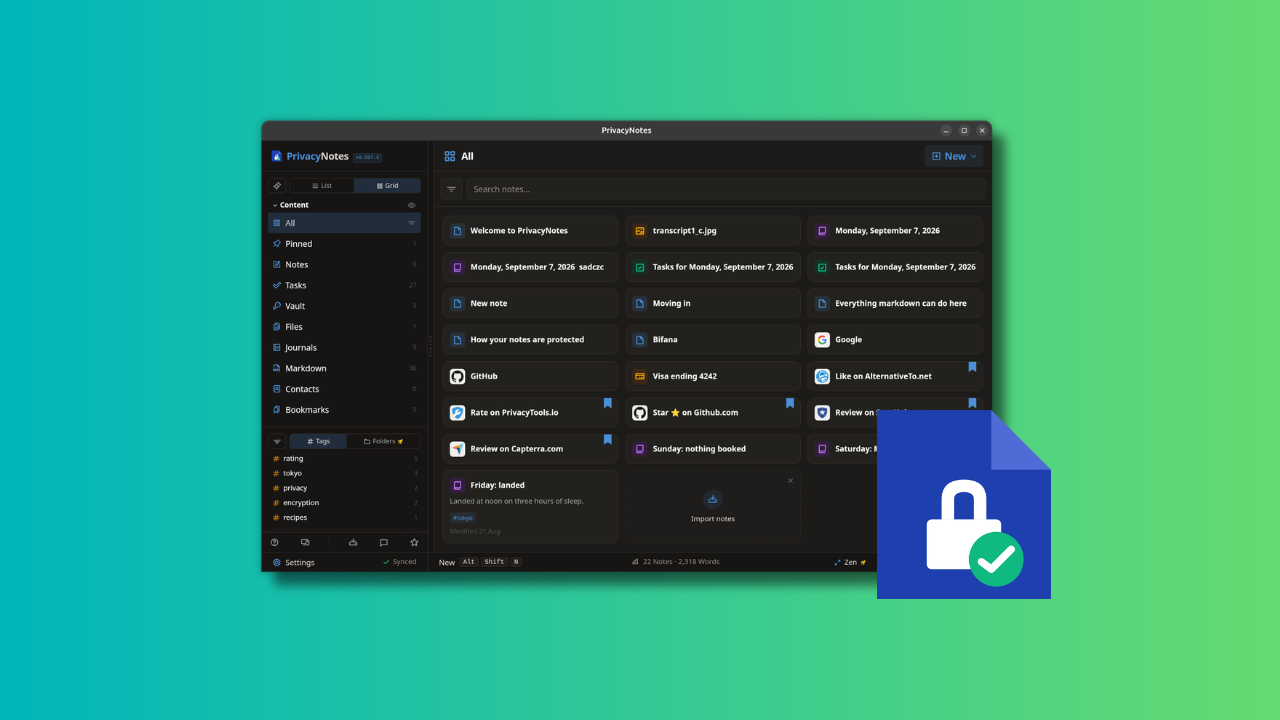
Privacy Notes offers different kinds of templates, secret vault, burn after reading and an optional zero-knowledge encrypted sync.
It's nice seeing a new GNU Compiler Collection (GCC) patch out of AMD today that is a general optimization for the x86_64 compiler code and not exclusively tied to their Zen processors. It's an Extended Load Optimization to benefit code where there is a narrower type and then an arithmetic type with a wider type...
Red Hat's David Airlie has managed another open-source graphics engineering feat... Getting the Nouveau reverse-engineered kernel graphics driver and Mesa NVK Vulkan driver running on the GB10 Grace Blackwell Superchip with the DGX Spark system...
One of Linux's oldest surviving distributions is moving closer to its next major release. Slackware 16 Alpha 1 became available on September 5, 2026, marking the first formal alpha milestone on the road toward Slackware Linux 16. The release follows a major rebuild of Slackware-current using a substantially newer GNU toolchain and brings together several upgrades that have accumulated since Slackware 15.0 arrived more than four years ago.
Announced a few months back was YSERVER as a modern X11 server written in the Rust programming language. In getting the project off the ground quickly and given the size of X11, it was largely vibe coded with Claude Code. The project continues and is attracting contributions from more users with today marking the YSERVER 1.5 release...
For the current Linux 7.3 kernel many older 32-bit ARM platforms are deprecated and in turn orphaning hundreds of drivers only relevant to those out-of-date ARM platforms. The removal of that now deprecated code is planned for the next kernel cycle or two...

Some big upgrades are coming in future to Civilization VII, with Firaxis Games outlining their upcoming content plans including free and paid expansions.Read the full article on GamingOnLinux.

Time to give No More Room in Hell another spin? This classic free first person survival horror just levelled up with a major upgrade.Read the full article on GamingOnLinux.