All of the SoC updates have been merged for the Linux 7.3 kernel that include adding some new SoCs as well as deprecating several older 32-bit ARM platforms. In turn with those platforms deprecated, "hundreds" of drivers are now orphaned in the process...

RetroSpace is an upcoming immersive sim that really looks like one to watch blending the worlds of disco-punk and space horror.Read the full article on GamingOnLinux.

Car Park Capital allows you to live out your grey dream of bulldozing entire neighbourhoods as you've convinced everyone they need another car park.Read the full article on GamingOnLinux.

Valve contractor Natalie Vock blogged about work to improve VRAM management on Linux, and we're set to see some improvements with kernel 7.3 and more after.Read the full article on GamingOnLinux.
Following the release of Mozilla Firefox 154 today, the Mozilla Thunderbird 154 open-source email, calendar, news, chat, and address book client has been released with various new features and improvements.

A study of more than 64,000 people born around the end of Britain's postwar sugar rationing found that those exposed to less sugar during their first 1,000 days had lower rates of five cancers decades later, including roughly 69% lower liver cancer risk and 36% lower breast cancer risk. They also "showed signs of slower biological aging" and "continued to consume less sugar and had healthier diets overall," according to the authors of a new study published in The Conversation. From the report: After the second world war, sugar remained rationed in Britain for several years. But in September 1953, rationing ended and people started eating a lot more sugar. Consumption nearly doubled. This meant that children born just a few months apart had very different levels of sugar exposure both in the womb and during early childhood. For our study, we used data from over 64,000 people born in Britain between 1951 and 1956. Those born earlier spent a larger share of their first 1,000 days under sugar rationing, while those born later experienced progressively less of it.
[...] What is most surprising, however, is not the cancer results or the biological markers of ageing. It's how early-life sugar exposure continued to affect people's diets even 50 years later. We found that people who experienced sugar rationing early in life still consumed less sugar in adulthood, around age 50. They also ate less overall, and their diets were healthier and more diverse. This suggests that the level of sweetness people are exposed to very early in life may shape their taste preferences for a long time.
Read more of this story at Slashdot.

Valve just launched the latest Proton Experimental update to improve gaming on Linux / SteamOS, Steam Deck and Steam Machine - here's all that's changed.Read the full article on GamingOnLinux.
A Phoronix Premium supporter recently relayed a request to see some fresh PHP performance benchmarks. So here are some fresh numbers of PHP 7.4 through the latest PHP 8.5 code plus the current Git state of PHP 8.6 ahead of the official PHP 8.6.0 release later in the year. With PHP 8.6 is also a fresh look at the JIT performance enabled too...
The exciting set of scheduler updates have been merged for the Linux 7.3 merge window...
Covered first on Phoronix back in June was an AMD Linux patch for introducing a new "low power" CPU core type to complement their typical "performance" cores and their "efficiency" cores like with Zen 4C/5C. That low power core is presumed for some Zen 6 clients and that integration is now merged for Linux 7.3 as well as unifying the Intel/AMD CPU core type handling...
The newest Raspberry Pi product to launch is the Raspberry Pi Compute Module 5 Programming Jig...
Mozilla Thunderbird 154 is now available with optional system tray support, Microsoft Graph integration, improved search behavior, and more.
alternative_right shares a report from Phys.org: Optical fibers are already the backbone of global communication systems. Recently, however, physicists have started to explore how their functionality could be boosted further by conveying information via entangled quantum particles -- potentially enabling instantaneous exchanges of information across vast distances. Such a system could eventually be the basis of a future 'quantum internet,' offering a level of security and computing power beyond anything possible today. In new research published in Physical Review Letters, a team led by Xi-Yu Luo at the University of Science and Technology of China in Hefei has pushed that vision further than ever, entangling two quantum memories across 420 kilometers (261 miles) of optical fiber -- more than four times the previous record.
Read more of this story at Slashdot.
Nordic Semiconductor’s nRF93M1 Development Kit is now available through multiple distributors, providing a platform for evaluating the company’s nRF93M1 LTE Cat 1 bis cellular module. The board combines the modem with an nRF54L15 host MCU and includes USB-C, onboard J-Link debugging, power-measurement support, and a preloaded SIM card. The nRF93M1 DK pairs the nRF93M1-LABA modem […]
An anonymous reader quotes a report from The Guardian: The release of a new album by Taylor Swift might be a cause for celebration among her fans, but such events have also been linked to a more sombre phenomenon: an increase in fatal car crashes. The team behind a new study say it sheds light on the impact of distracted driving. Writing in the journal Jama Network Open, [Vishal Patel, first author of the study based at Harvard Medical School] and colleagues report how they focused on the release of 10 major albums, launched between 2017 and 2022, selected for having the highest number of Spotify streams over a single day. [...] The team found streaming volume for the top 200 songs in the US was 43% higher on the date of major album releases compared with the days surrounding the releases -- although such data does not reveal whether the music was being streamed in a car.
[...] The researchers used data from a population-based registry of fatal US motor vehicle crashes to look at the number of traffic fatalities on the dates these albums were released, as well as for the 10 days either side. After taking into account the day of the week upon which the album was released, as well as federal holidays, and time of year, the researchers found the number of US traffic fatalities showed a relative increase of 15.1% on the date of major album releases, compared with similar days either side. "This is equivalent to approximately 182 fatalities in the US attributable to the release days of the 10 included albums," the team writes.
Patel said the release of a new album could distract drivers because accessing music is a search task, not a single button press. "You unlock the phone, open the app, find the release, read down a tracklist, tap the right song. That's several seconds of looking at a screen," he said, adding unfamiliar music also demands more attention, while research has suggested listening to new, high-energy music measurably degrades driving performance. The researchers add the rise in traffic fatalities was greater among certain groups -- such as younger drivers, male drivers, people who were driving alone, and people driving cars with a built-in infotainment platform. The authors say the results suggest that "online music streaming through smartphones may significantly contribute to distracted driving and traffic fatalities."
Read more of this story at Slashdot.
With the release of Firefox 154 rolling out to all supported platforms, Mozilla promoted the next major release, Firefox 155, to the beta channel for public testing, so it’s time to take a look at the new features and improvements.
Modular, the AI startup founded by Chris Lattner of LLVM and Swift fame, has open-sourced their Mojo systems programming language! This comes following the recent acquisition of Modular by Qualcomm...
COSMIC Epoch 1.6 was released this evening as the latest milestone for this open-source, Rust-based desktop environment led by System76 as part of the work on their Pop!_OS Linux distribution...
Cursor has launched Origin, a GitHub-style code hosting platform built directly into its AI coding environment. The company is initially positioning Origin as a low-risk layer on top of GitHub, keeping GitHub as the "source of truth," but the launch landed just as a major GitHub outage highlighted growing concerns about reliability in the age of AI-generated code. VentureBeat reports: Cursor began rolling out Origin, its own code hosting platform, to paid users on Monday morning. Roughly three and a half hours later, GitHub's status page lit up with what became a six-hour-and-forty-two-minute global degradation -- error rates near 20% across pull requests, issues and the API, and near 50% on archive and raw file downloads, according to GitHub's incident log. Enterprise single sign-on went down with it: SAML, OIDC, SCIM provisioning and Team Sync all failed. So did Copilot.
The developer internet did what the developer internet does. "You can now host your repos in Cursor Origin and deploy to Vercel via Cursor Origin which is itself hosted on Vercel," Vercel chief executive Guillermo Rauch posted on X. "And unlike GitHub, it's online [smile emoji]" Asked why he was smiling, Rauch replied: "trying to make light of the situation. We ourselves are stuck because of github rn!" Matt Palmer, who works at Cursor, quote-tweeted his own company's launch with the day's best line: "We were going to ship this earlier, but GitHub was down." A GitHub outage, in other words, delayed the launch of a GitHub competitor.
Product launches get locked weeks in advance, and no evidence suggests Cursor timed this one. But the coincidence did the company an enormous favor, because it dramatized the argument Origin exists to make. For eighteen years, choosing where to host your team's source code has been the least interesting decision an engineering organization makes. Cursor is betting that AI agents have made it interesting again -- and for technical decision makers, that is the real news here. Not a new product, but a new procurement question with a governance problem attached.
Read more of this story at Slashdot.
Configuring Fedora Rawhide Server using a combination of Btrfs and OverlayFS creates a secure testing environment. This configuration isolates critical for tracking rapidly evolving Rawhide packages from developers allowing the server to load read-only Btrfs base snapshots while using the OverlayFS layer as a storage layer for writing and temporary data. If an update disrupts the OS, the base snapshot remains intact, allowing for rollback after a single reboot. Same configuration may also work and vice versa way. Btrfs-assistant running inside Overlay instance booted via corresponding option of Grub Submenu allows to recover from crash main instance via selection required "ro" snapshot using it's own GUI.
Comcast is activating Wi-Fi motion sensing on millions of compatible Xfinity gateways, allowing the routers to detect movement by measuring disruptions in signals between the gateway and connected devices. The free feature, part of Xfinity Shield, can send activity alerts through the Xfinity app and offers Home, Away, and nighttime monitoring modes without requiring separate motion sensors. The Verge reports: Wi-Fi motion sensing is a technology that has been around for a while, but it's only recently that it's become accurate and reliable enough to catch on. Linksys launched a similar service in 2021, but discontinued it a few years later. Lighting company Wiz launched a line of Wi-Fi-sensing smart bulbs in 2023, and more recently Philips Hue deployed a similar radio-frequency sensing technology in its products (using Zigbee rather than Wi-Fi). Comcast's motion sensing pairs with new modes in the Xfinity app -- Home Watch, Away Watch, and Dark Watch (a night/sleep mode) -- allowing you to turn sensing on or off based on your activities.
Read more of this story at Slashdot.
Oracle released VirtualBox 7.2.16 today as the eighth maintenance update to the latest VirtualBox 7.2 series of their open-source, free, and cross-platform virtualization software for Linux, Solaris, macOS, and Windows.
Version
154.0 of the Firefox browser has been released. Changes include
extending local network access protections to WebSocket connections, more
flexible, per-site configuration of cookie and data clearing, and more.
Disney and ABC are suing the FCC to block an early review of eight station licenses, arguing the Trump administration is using the agency's regulatory power to punish the network over programming and editorial decisions it dislikes. Reuters reports: In a lawsuit (PDF) filed in U.S. District Court in Washington, Disney said the FCC was seeking to coerce and retaliate against "a network that refuses to bow to the administration's demands," calling the agency's actions an "extraordinary assault on free speech."
Trump has waged an aggressive series of attacks on the news media and the latest move follows a two-year-long battle between Trump and Disney. Last month, Trump again called for ABC stations to lose their licenses because the network refused to air a prime-time speech on elections. The court case will pose a key test of the free speech rights of media outlets. Disney and ABC asked the court (PDF) to quickly issue a temporary restraining order halting the license renewal proceedings and preventing the FCC from scheduling a hearing. The company said the public comment period ended earlier this month and the FCC could act at any time.
The lawsuit alleges that the administration is violating the company's First Amendment free speech rights, saying that the FCC "is using its regulatory power to retaliate against (Disney and ABC) for programming and editorial decisions the administration dislikes." The FCC said the move stemmed from a year-long investigation into whether Disney's diversity policies amounted to unlawful discrimination, an allegation the company denies. U.S. District Judge Loren AliKhan issued an order on Tuesday directing the company and the FCC to propose a schedule for considering the request for a temporary restraining order and told the agency to notify her if it moves to start the process of revoking the ABC licenses.
Read more of this story at Slashdot.
RAM prices have exploded over the past year, with some DDR5 kits approaching 500% year-over-year increases and a 128GB kit now selling for $3,399, which is more than 10 times its previous low. Tom's Hardware reports: Things improve as you step down the memory capacities and speed tiers, but not as much as we'd like. You're still looking at $392 for a memory kit that was just $72 last year. To reinforce the point, I pulled the latest average price data from PCPartPicker, comparing where we are today (August 2026) to exactly one year ago. This data is somewhat approximate, but it should be broadly accurate. [...] A standard 64GB (2x32GB) DDR5-5600 kit that would have cost you under $200 last summer is now demanding over $1,100. It is a 5x multiplier on a component that used to be a fairly boring and predictable line item in a PC build budget.
If you plan to just wait it out on an older AM4 or LGA1700 motherboard with DDR4, you'd better hope your memory holds out too, because DDR4 isn't safe from the fallout. With DDR5 entirely out of reach for most builders, the resulting scramble for older platforms running DDR4 memory has created a massive knock-on effect, and as a result, DDR4 kits are up anywhere from 120% to nearly 180% across the board. Nowhere near as bad as DDR5 pricing, but it still stings when a kit that was $105 last year is $281 this year.
This phenomenon is by no means exclusive to the US, either. German tech site ComputerBase have also been tracking this global trend, reporting just this week that average RAM prices in Europe have skyrocketed by 345% compared to September 2025. Their data shows the squeeze is bleeding into other components too, with hard drive and SSD prices both climbing over 125% in that same timeframe. In fact, the situation is so severe that hyperscale buyers have reportedly already locked in almost all of the global DRAM production capacity for 2027, handing over advance deposits to guarantee their supply of precious DRAM, which is now among the highest-value commodities in the world by weight; mainstream DRAM chips are worth over half as much per kilogram as solid gold.
Read more of this story at Slashdot.
Merged earlier this year for Linux 7.1 was extended attributes on sockets support as a feature sought after by the likes of GNOME and systemd for helping with Varlink IPC usage and other purposes. A limitation though of the functionality has been no efficient means for a BPF program to read those user extended attribute labels back. But with Linux 7.3 that's being addressed with the new bpf_sock_read_xattr() kernel function...
An anonymous reader quotes a report from Wired: Your iPhone, SamsungGalaxy, andGoogle Pixel have a 1-year warranty. Unless you cough up extra dough for an extended service plan, you'll pay a hefty fee if you damage the screen and need a replacement (around $329 for an iPhone 17 done directly from Apple). But it doesn't have to be this way. What if you could order the part from the manufacturer and do the repair yourself? That dream is finally being realized for American consumers, thanks to Fairphone.
The Dutch company is bringing its repairable and sustainably built Android smartphone -- the Fairphone (Gen 6+) -- to the US. Each one comes with a screwdriver. A replacement screen from Fairphone costs just $90. A new USB-C port is $20. A fresh battery is $40. In all, there are 12 modular elements you can swap yourself. It remains the only smartphone series with a 10/10 repairability scorefrom iFixit, not to mention an unmatched 5-year warranty and software updates through 2033.
The new Fairphone (Gen 6+) is a small upgrade over the Gen 6 that the company launched last year. It has a newer Qualcomm Snapdragon 7s Gen 4 processor and double the RAM at 12 GB, but is otherwise largely the same device (hence the "plus" in the name). It now comes in Cobalt Blue, a nod to the miners who extract the cobalt used to make phone batteries, and the company's efforts to improve working conditions in mines in the Democratic Republic of Congo. The new Fairphone is available on Amazon and at Fairphone.com for $650, and it's officially certified to work on T-Mobile and AT&T's networks. While this will mark the U.S. debut of its flagship smartphone, the company first entered the stateside market last year with its repairable earbuds and headphones. It also plans to launch its next-generation Fairbuds 2 wireless earbuds later this year.
Read more of this story at Slashdot.
Google has agreed to pay $10 million for a massive trove of anonymized Spirit Airlines data following the carrier's shutdown, including internal communications, spreadsheets, booking and frequent-flyer records, transactions, and employee information. CNN reports: Did you ever fly on Spirit Airlines? Or work there? Or send an email to someone who worked there? Then your information will soon be feeding Google's artificial intelligence model. The discount airline halted all operations in May, and it's been selling off its remaining assets through the bankruptcy process ever since. While most of that is planes, equipment, and real estate, there's other things that are valuable, too.
It was disclosed late Monday that the company agreed to sell its data to Google for $10 million. That includes emails and internal communications, spreadsheets, transactions with the public including bookings and frequent flyer information as well as human resources information on its employees. The data has been stripped of anything that would allow individuals to be identified, according to the court filing. But it is still a massive amount of useful intelligence.
Read more of this story at Slashdot.
As part of the VFS pull requests now merged to the Linux 7.3 development kernel was an improvement to the IOmap framework used by various file-systems for mapping logical file byte offsets in memory to their physical locations on storage. With the now-merged code, this modern block mapping framework is allowing better performance at least for the EXT4 file-system...
Apple is overhauling its EU App Store fees to settle its Digital Markets Act dispute, simplifying the fee structure and "[resolving] Apple's disagreements with the Commission over business terms and alternative distribution." Developers can sign the new terms starting today, and the changes go into effect on October 1. MacRumors reports: The initial acquisition fee and store services fee are being removed for apps distributed outside of the App Store, and Apple will now charge a 5% Core Technology Commission on digital purchases that replaces the prior per-install Core Technology Fee. Commission rates are changing for App Store apps, alternative payments, and apps distributed through alternative app marketplaces or the web.
Developers can offer in-app purchase options alongside alternative payment options in the EU, which is something Apple did not allow before. Apple says there will be presentation requirements so users have a consistent, transparent experience. Developers distributing apps in the EU must select their payment options and maintain those options for 12 months before making changes to "provide consistency and clarity for users." Apple will still use a Notarization process for apps downloadable through the web and through alternative app marketplaces.
Apps in the Kids category or being used by children under 13 will not include links to websites to complete transactions. All apps that use alternative payment processing or link to a website for transactions have to include a parental gate if the user is under 18. Apple is relaxing the rules for operating an alternative app marketplace.
Read more of this story at Slashdot.

Oh my gosh, finally. Such a simple issue that has been a problem for years is finally fixed. Bethesda just updated Fallout 4 and here's what's changed.Read the full article on GamingOnLinux.
Last year Framework Computer launched the Framework Laptop 12 as an upgrade-friendly and Linux-compatible 2-in-1 laptop. The Framework Laptop 12 was originally powered by Intel Core 13th Gen "Raptor Lake" low-end processor while now Framework is adding Core Series 3 "Wildcat Lake" as an upgrade or for new Laptop 12 orders...
Microsoft MVP Loryan Strant has created the Microsoft Rebrand Registry, cataloging 72 Microsoft products and the 158 names they've had over the years. His analysis finds that Microsoft product names survive an average of two years and eleven months. The site even predicts which products are most likely to get renamed next, "by considering the amount of time the current name has applied, prior names, and the frequency with which Microsoft changes names of products in the same family," reports The Register. "That methodology led him to suggest an 'elevated' likelihood of name changes for the Azure App Service, Azure SQL Database, Azure DevOps, and Microsoft Dynamics 365 Field Service." From the report: Readers may remember that Strant has also created the site Let Me Correct That For You, which lists the exact names of Microsoft products -- an effort he told The Register he thinks is useful because Microsoft in its wisdom uses Camel Case for names like PowerPoint but went with conventional capitalization for Copilot.
Another of his sites immortalizes Microsoft cloud product logos. He's also created HumbledandHonored.com, a site that generates social media posts MVPs can use to announce they have earned or retained Microsoft's awards.
Strant told The Register that the Rebrand Registry came about after some banter between himself and other MVPs, during which the topic of Microsoft's many product name changes came up. He decided to do something about it.
Read more of this story at Slashdot.

Nice to see an expansion of Linux on devices, with the Framework Laptop 12 getting support for pre-builts to ship with Fedora KDE 44 and Intel Core Series 3.Read the full article on GamingOnLinux.

Digiphile just launched the RTS Renaissance Bundle giving you an opportunity to build up your collection of strategy games for a good price.Read the full article on GamingOnLinux.

NVIDIA GeForce NOW finally adds official Firefox support. On Windows, that is. Sadly, any mention of Linux was left out of the announcements today.Read the full article on GamingOnLinux.
An anonymous reader quotes a report from the BBC: For most Indians, paying by Unified Payments Interface (UPI) has become almost absurdly routine. Scan a QR code, tap a few buttons and the money moves instantly. There is no card machine, no cash, and -- most importantly -- for the user, no visible fee. That may be about to change. India has paved the way for banks and payment companies to charge merchants a fee on UPI transactions, potentially ending a decade-long experiment in free digital payments.
The government has yet to decide the rate or exactly where it will apply, but proposals under discussion include a merchant discount rate (MDR) of 0.3-0.5% -- a small fee paid by a business to the banks and payment companies that process its UPI payments -- on larger transactions at big businesses. The government says consumers and person-to-person UPI payments will remain free. If merchant fees are introduced, they will apply only to some transactions above a set threshold, at a nominal rate, meaning most UPI payments will remain free. The question is whether putting a price on UPI could weaken the network that made it such a success.
The stakes are enormous. Launched in 2016, UPI has grown into one of the world's biggest real-time payment networks. According to official data, in July alone, there were 23.6 billion UPI transactions worth 29.87 trillion rupees ($313.5 billion). Fintech apps such as PhonePe and Google Pay account for most UPI payments. In the financial year just ended, the figure was about 241.6 billion transactions -- almost 12,000 times the volume in UPI's first full year. More than 550 million people now use it, and the system is now available in some form for payments in 11 countries outside India. India's UPI became ubiquitous partly because it made digital payments almost frictionless for merchants, including small vendors who can accept payments with little more than a QR code. New research suggests that merchant acceptance was "not just a result of UPI growth, but one of its key drivers."
As RBI governor Sanjay Malhotra put it, "Someone will have to pay the cost." The challenge will be making UPI sustainable without weakening the merchant network that helped it take off.
Read more of this story at Slashdot.
Crowd Supply recently featured the USBridge-KVM 2.0, a compact IP-KVM designed for remote system administration, debugging, and bare-metal recovery. The device provides HDMI video capture, USB keyboard and mouse emulation, virtual media, hardware power control, BIOS text recognition, and an integrated display while operating independently of the target computer’s operating system. The USBridge-KVM 2.0 is […]
Recently I looked at the performance of Ubuntu 26.04 LTS vs. Windows 11 on the Intel Xeon 678X running within the HP Z4 G6i workstation. Linux performed admirably as one would expect. With this Intel Xeon Granite Rapids WS workstation from HP though commanding a retail price more than $46,000 USD, you likely want nothing but the utmost performance out of it. So for those looking to maximize the OS performance, here are some numbers from the HP Z4 G6i workstation when running not only Ubuntu 26.04 LTS but also Fedora Workstation 44, AlmaLinux, and the performance-optimized CachyOS.

Developed in collaboration with mathematics education specialists at IREM Lyon, Néro & Sci ∫ Integral Edition is a colourful educational time.Read the full article on GamingOnLinux.

You Are Empty originally released in 2006, and now it is returning thanks to ZOOM Platform with You Are Empty: Absolute Edition.Read the full article on GamingOnLinux.
The Linux kernel's user-space interface
(AF_ALG) to the Crypto
API has been linked to a number of recent high-profile security problems,
including Copy Fail and successor
vulnerabilities. It was deprecated
earlier this year. Eric Biggers, and other kernel developers,
have been working to remove it
from the kernel. With that in mind, the Fedora Project is planning to
restrict use of AF_ALG in the next Fedora release in the hopes of nudging
remaining users of the API to prepare for its eventual removal.

Prince of Persia: The Sands of Time is now being kept up to date for modern platforms in the GOG Preservation Program.Read the full article on GamingOnLinux.
In addition to the POWER/PowerPC code adding Rust kernel support, the main set of Rust programming language updates for the Linux 7.3 kernel have now been submitted. Most notable are early fixes toward eventually allowing the experimental Rust GCC back-end to be used as an alternative to the official rustc compiler with LLVM code generation...
A new month, a new LTM dose for you! It may not be perfectly monthly, but it keeps coming, and as always, it’s a carefully cooked roundup with ingredients ranging from migrating from Windows to Linux, desktop customization, and user-friendly Hyprland tools to critical security fixes and more. So, I’m sure you’ll find at least one section in this newsletter that you’ll enjoy.
Security updates have been issued by AlmaLinux (.NET 8.0, 389-ds:1.4, bind, haproxy, kernel, kernel-rt, libXfont2, nghttp2, and unbound), Debian (calibre, expat, ironic, and linux-6.12), Fedora (coturn, linux-firmware, php-phpseclib, and sqlite), Red Hat (fence-agents, osbuild-composer, pam, resource-agents, and sg3_utils), SUSE (ffmpeg, jetty-minimal, open-iscsi, python, python313-h2, python313-pysaml2, redis, redis7, rsync, sccache, texlive, and wasm-bindgen), and Ubuntu (engrampa, linux-aws-7.0, and linux-azure-fde-5.15).
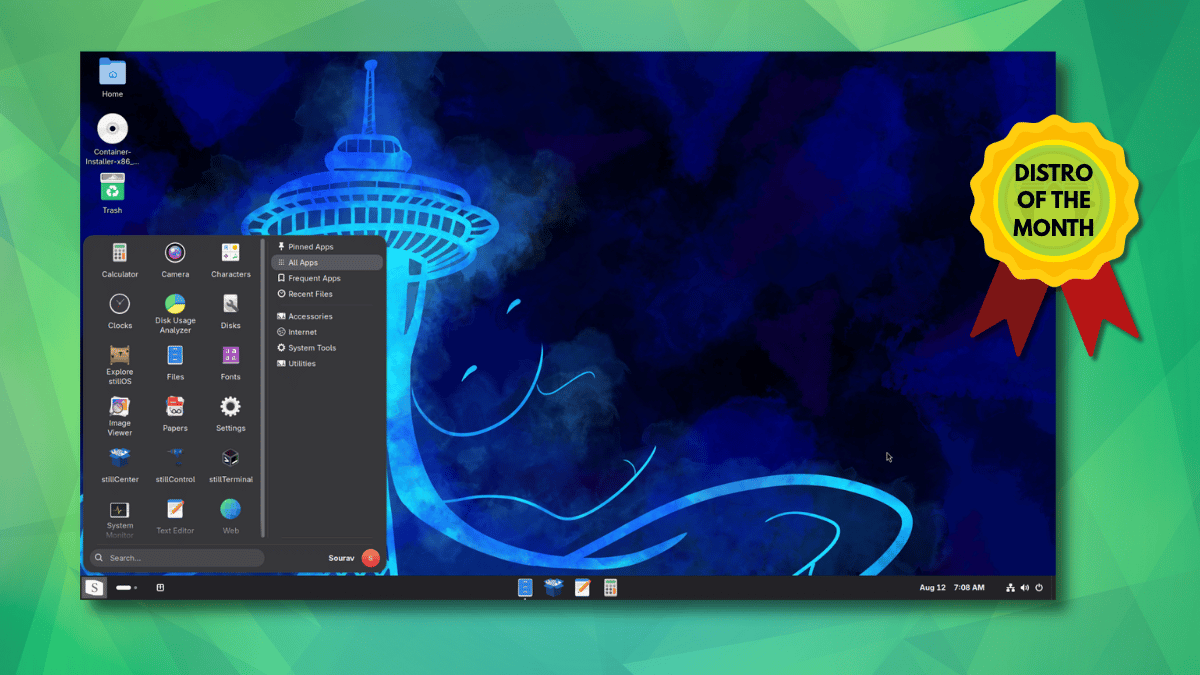
Built on AlmaLinux with bootc, it promises atomic updates and zero manual upkeep.
It's not too often that the Linux FAT driver for FAT12/FAT16/FAT32 format support receives updates worth mentioning. For Linux 7.3 there is one patch though and it's due to the driver until now lacking an upper-bounds check on the length of the filename, which could lead to some unexpected situations with extremely long filenames...
Among the early pull requests merged today by Linus Torvalds for the Linux 7.3 kernel cycle were removal of some ancient file-systems while adding in a new pseudo file-system...
Bruce66423 shares a report from The Guardian: Sainsbury's has paused the use of AI face scanning in one of its stores after a customer was wrongly identified as a shoplifter and ejected from the shop. "I was embarrassed, mortified even, and felt quite humiliated and powerless," Matt Arnold, 46, said of his ordeal. The comedy promoter was buying supplies in the store in East Dulwich, in south-east London, for a standup event at Dulwich Hamlet football club when, after scanning his items and a Nectar card, he was approached by two managers who told him he could not be served owing to an earlier incident. He was then asked to leave and they tried to escort him from the store.
As he left, he saw an overhead CCTV monitor alert with a red circle surrounding his face. He asked the shop staff to keep his shopping in the trolley so his friend could come and pick up the supplies for the comedy night happening soon next door. "I think they were quite confused by this, understandably, but agreed and my colleague Dave went in to pay for and pick up the shop about five minutes later. There was no pause for thought from the staff, no suggestion that they understood this is not how a shoplifter would behave. Just blindly following the machine's orders." Sainsbury's head office apologised to Arnold the next day and has paused use of its AI-assisted Facewatch technology in the store while an investigation takes place. Arnold says the facial recognition tech should be paused in all stores. "Anyone could be falsely accused and at some point that will be someone vulnerable, someone with mental health issues like anxiety. It's inevitable," said Arnold. "Also, I would worry about the confidence-destroying effect of it happening to a younger person or someone less willing or able to stand up for themselves as I have done."
A Sainsbury's spokesperson said: "We have contacted Mr Arnold to apologise for his experience at our Dulwich superstore. The incident was caused by human error, not the facial recognition technology. Customers can be reassured that the Facewatch system has a 99.98% accuracy rate, and every match is reviewed by a trained manager." A Facewatch spokesperson said their technology was not at fault in this case. "A correct alert was sent to the retailer, but was subsequently subject to human error in the way it was handled in store," they said.
Read more of this story at Slashdot.

Love silly physics as much as I do? Spectacular Team: Assemble is a hilarious looking solo and co-op brawler where you make a hero to fight villains.Read the full article on GamingOnLinux.

Founding members AMD, EPAM, and Renesas already put in the groundwork, and there's a new Premier Plus membership tier to go with it.
There was a proposal under discussion the past few months on building x86-64-v3 packages for Fedora 45 while retaining x86-64-v1 packages. The hope was building the Fedora packages with x86-64-v3 where AVX/AVX2, FMA, BMI2, and other newer ISA features can be assumed in the name of better performance. Unfortunately, the x86-64-v3 plans are now delayed but may be reconsidered next year with Fedora 46...

This is just a Normal Golf Game, nothing to see here. Except you're in a lot of debt, and you're trapped. What's going on? I guess we'll find out soon.Read the full article on GamingOnLinux.
Linux kernel developers made a significant last-minute graphics change for Linux 7.2, reverting the DRM GPU scheduler back to its previous FIFO policy by default after the newer fair scheduling implementation caused serious performance regressions. The revert was submitted just before the final Linux 7.2 release after users reported severe slowdowns and desktop freezes under sustained GPU workloads.
When it comes to the watchdog driver changes for Linux 7.3, standing out is the new Lenovo driver for their upcoming ThinkEdge AI edge computing systems...
Merged today to Mesa 26.3-devel is a nice performance boost for Intel graphics with Valve's Steam Play when using DXVK for Direct3D 8 / 9 / 10 / 11 over the Vulkan API. The open-source Intel ANV driver is seeing up to 5% better performance with DXVK...
The XFS file-system improvements have been merged for Linux 7.3. For end-users the only notable change for this file-system on the new kernel is adding support for FALLOC_FL_WRITE_ZEROES...

Build a deck and burn it all away for power? Burn With Me has a fun idea and the full game is now set to arrive on October 12.Read the full article on GamingOnLinux.
Mozilla Firefox 154 strengthens local network privacy, adds a Manage AI shortcut, improves PDF handling, and expands web platform support.
AleRunner writes: "Solar has been doing the 'heavy lifting' to help Europe meet its energy needs amid a string of blistering heatwaves," Euronews tells us. Meanwhile, as Europe's energy demands rise with the heat, jellyfish have been causing shutdowns and reduced power output at multiple reactors at French nuclear plants, as we already discussed. Euronews reports: A new analysis from energy think-tank Ember found that solar output in European countries rose by up to 17 percent on heatwave days in June and July. Researchers say that this helped power the grid as electricity demand increased by as much as a quarter on hot days. Heatwaves often trigger a spike in electricity consumption due to the sudden need for cooling, mainly from energy-intensive air conditioning (A/C) units.
The International Energy Agency (IEA) estimates that space cooling, which is mostly A/C units and fans, consumed around seven percent of the world's electricity in 2022. Even in countries where A/C ownership is low, countries experience energy demand spikes when scorching temperatures hit. During the early summer heatwaves of 2025, France, for example, recorded an evening electricity peak that was 25 percent above the off-season average due to air conditioning.
Ember's analysis found that during the late-June heatwave this summer, daily electricity demand rose byup to 28 percent in Italy, 23 percent in Hungary, 14 percent in France and 13 percent in Spain compared with pre-heatwave days. It says as heatwave-driven demand increased, solar was the only major power source to perform "better than usual." Compared with other days in June and July, average daily solar generation during the heatwaves was 17 percent higher in France and Hungary, five percent higher in Spain and the same in Italy.
Read more of this story at Slashdot.
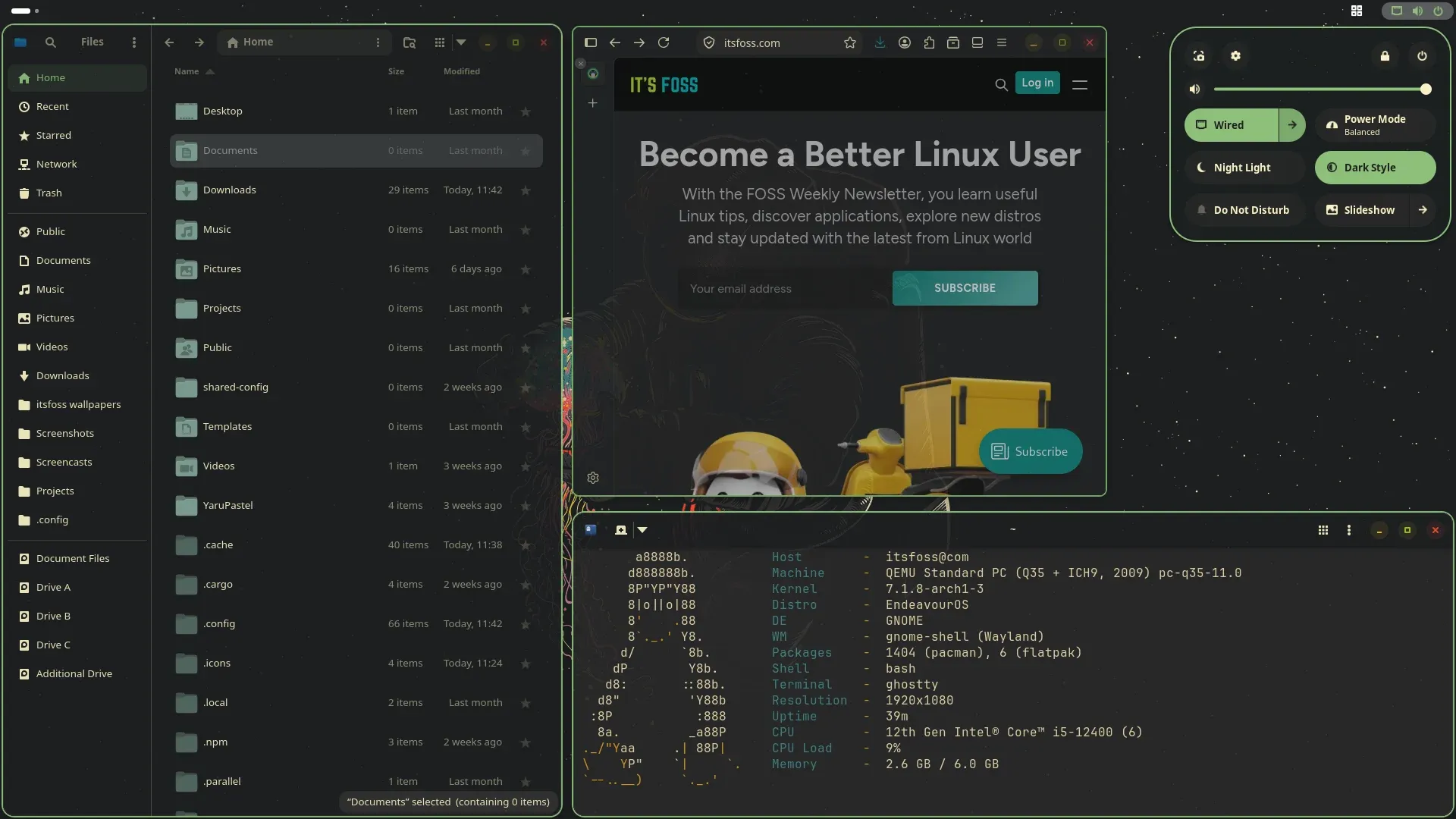
Rewaita makes it easy to recolor GTK and Libadwaita apps with popular palettes, custom colors and a few extra visual effects.
Firefox 154 is now available as the newest monthly update bringing a few new features, enhancements, and other alterations to this open-source web browser...
The GNU Linux-libre project announced today the release and general availability of the GNU Linux-libre 7.2 kernel for those who seek 100% freedom for their GNU/Linux computers and software freedom lovers.