
Going right into my list of must-haves for co-op gaming with my partner, Coastless is a fresh survival crafting game blending Raft and Don't Starve.Read the full article on GamingOnLinux.

LULULOOK sent over the LULULOOK Gaming Pillow for Steam Deck and it has become my go-to when I want to be truly lazy.Read the full article on GamingOnLinux.
With Linux 7.2 expected to see its stable debut Sunday, here is a look at what I have been monitoring as changes expected to be submitted during the Linux 7.3 merge window that will open on Monday...

Astronomers using JWST have found three actively feeding supermassive black holes in the distant galaxy J0148-4214, seen as it existed about 1.2 billion years after the Big Bang. Two sit just 620 light-years apart near the galaxy's center and are expected to merge within a few hundred million years. Phys.org reports: Theories of galaxy evolution -- based on observations -- suggest that, early in the history of the universe, galaxies came very close to one another and merged. In the process, black holes at their centers also merged, giving rise to even more massive black holes at the centers of the merged galaxies. The analysis yields black hole masses of approximately 80 million, 0.6 million and 2 million solar masses. The most massive black hole is accreting at a lower rate than the nearby black hole with a mass of 0.6 million solar masses, which is actively feeding and even exceeding the maximum accretion rate predicted by basic theories of black hole growth (the Eddington limit).
"The JWST data allowed us not only to identify the three black holes, but also to estimate their masses, accretion rates and the stellar mass of the galaxy," says Dr. Giovanni Mazzolari, second author of the study and researcher at MPE. "We find a total stellar mass of about 1.3 billion solar masses, and the black holes represent a significant fraction of that."
The central black hole pair is expected to merge within the next few hundred million years. "These results are extremely exciting," adds Roberto Maiolino, professor at the University of Cambridge and co-author of the study. "They suggest that black hole merging may be an additional, fast route for their rapid growth in the early universe." The third black hole, located off-nucleus, may be the remnant of a previous merger, be displaced from the center by a gravitational recoil kick, or be currently migrating inward. The findings have been published in the journal Astronomy & Astrophysics.
Read more of this story at Slashdot.
Rsync 3.5 is now available with 33 security fixes, including a critical vulnerability, plus extensive hardening across daemon and path handling.
Ahead of the Linux 7.2 kernel release expected out on Sunday, the Direct Rendering Manager (DRM) subsystem was forced to revert their "fair" scheduler policy default new for this kernel. Due to a last minute user-reported regression, FIFO returns as the default DRM scheduler policy for Linux 7.2. But patches are now available for addressing that regression and thus hopefully for Linux 7.3 there will be the fair scheduler becoming the default...
Ahead of the Linux 7.2 kernel release expected on Sunday, a new release of the exFAT file-system user-space programs was released overnight...

The tactical online shooter Hell Let Loose: Vietnam from Expression Games / Team17 has now officially launched and it does thankfully work on SteamOS / Linux.Read the full article on GamingOnLinux.
It's been a long time since hearing much out of the Zenwalk project, the Linux distribution built off Slackware. It's still around though and with their latest kernel work are hoping for a "true low latency desktop experience" by employing the BORE scheduler...

We're getting some fun VR treats that were announced during the recent VR Games Showcase - now I just need Valve to release the damn Steam Frame.Read the full article on GamingOnLinux.

Kubuntu Focus, Techpaladin Software, and KDE e.V. together announced the "bullet-proof KDE Software initiative" with funding for a true KDE Plasma LTS release.Read the full article on GamingOnLinux.

Epic Games recently did an AMA (Ask me anything) in the community Discord server, confirming that a Linux / SteamOS version of the Epic Games Store is coming.Read the full article on GamingOnLinux.
Nitrux unveils its new modular Workspace Environment built around Hyprland, QML, and MauiKit, while officially retiring the Maui Shell project.
alternative_right shares a report from ScienceDaily: Researchers have found a clever new way to map a part of Earth's upper atmosphere that is notoriously difficult to observe. Using orbital data from roughly 1,200 Starlink satellites, they reconstructed changes in atmospheric density about 500 kilometers above Earth. [...] The resulting density patterns also showed strong consistency with observations from the European Space Agency's SWARM satellites, which measure changes in atmospheric density along their orbital paths.
The work expands on an earlier study by the same team. In that research, scientists estimated how thermospheric density changed over time and altitude using general orbital information called Two-Line Element, or TLE, data from Starlink satellites. The new analysis adds another dimension by examining how density varies horizontally across latitude and longitude, revealing more of the thermosphere's geographic structure.
The findings could have practical benefits as the number of objects orbiting Earth continues to grow. More accurate information about atmospheric density can improve predictions of satellite motion, helping reduce the chance of collisions between satellites and between satellites and space debris. The technique could also eventually support near-real-time measurements of atmospheric density around satellites. Such monitoring could improve space weather forecasting and contribute to safer, more dependable satellite operations in the future.
Read more of this story at Slashdot.
The KDE Project, Kubuntu Focus, and Techpaladin Software announced today a new project for those who need long-term support (LTS) for the KDE Plasma desktop environment and related KDE applications called the “bulletproof” KDE suite.
It took years of silence, new maintainers, and a release to bring LightDM back.
An anonymous reader quotes a report from The Guardian: Miniature human organs and other tissues are to be grown from NHS patients' cells in a drive to improve medicine testing and reduce the number of animals used in drug development. Scientists will use the clumps of tissue to learn how diseases vary between patients, helping them identify which treatments are best for different people based on the particular pathology underlying their condition. The move marks a shift away from the traditional use of animals as models for human disease, towards what researchers believe will be more accurate and reliable tests based directly on human tissues.
Researchers have been growing tiny clumps of human organs, known as organoids, for more than a decade. Tests show that pieces smaller than a millimeter can mirror key features of full-scale organs and tissues, including how they falter with disease and respond to drugs. Armed with organoids grown from diseased human tissues, scientists can investigate whether new drug candidates reverse pathological changes in all or a subset of patients, and quickly identify ineffective drugs early in the process. Historically, more than 90% of drugs that clear animal testing go on to fail in human trials, raising questions about the value of the tests. US and European medicines regulators now encourage other approaches if available. "It's going to have a major impact on the numbers of animals used and the way we develop new drugs in the future," said Matthias Zilbauer, a clinical professor of paediatric gastroenterology at the Cambridge Stem Cell Institute. "We're not saying there won't be any animal use in the near or foreseeable future, because there are still certain issues that cannot be tested in these new models, but the reduction is very real."
"A lot of human diseases either do not occur in animals or occur in a different way because they're not human," added Zilbauer. "We want tests and models that can tell us which treatments work, and in what patients, and a mouse cannot tell us that."
Read more of this story at Slashdot.
AMD's GAIA open-source AI software built atop Lemonade for serving as an AI companion for emails, a Bash coding agent, and other AI agent skills is out with a new version today with more features while also improving security and making other improvements...
Microsoft has been steadily scaling back its China presence, closing at least 15 branch offices and joint ventures over the past five years as Beijing favors domestic software. U.S. export controls also make it harder to grow its cloud and AI businesses, leaving the market with relatively little economic upside. Reuters reports: Microsoft took a major hit from the erosion of trust between Washington and Beijing, the five people said. China has since 2017 pushed the use of domestic software, which Beijing sees as more secure and whose quality is increasingly competitive with Windows and Office. U.S. restrictions, including export controls on advanced technology, have meanwhile hindered efforts to scale Microsoft's lucrative AI and cloud businesses in China.
[...] Microsoft ultimately decided to remain because it had carved out a profitable business servicing Chinese companies like TikTok owner ByteDance, which need Western technology to manage overseas operations, according to three people familiar with the matter. The company also believed that it needed a presence to maintain access to China's world-class engineering talent, two of them said. Microsoft had also cultivated a relationship with the government that is among the deepest of any tech company, its former China head Alain Crozier told Reuters. "Because of the geopolitics ... some days it's a little bit harder, but we never had a crisis," he said.
A Microsoft spokesperson did not address questions about the firm's deliberations on its China business but said it operates in a regulatory "environment that applies to every international supplier" and that it remains committed to the Chinese market. The state of Microsoft's China business reflects market competition, regulatory demands and technological trends, the company said.
Read more of this story at Slashdot.
Google has released Gemini 3.7 Flash just three weeks after 3.6 Flash, focusing on better coding, agentic workflows, and enterprise automation while temporarily cutting API prices in half through the end of 2026. VentureBeat reports: For enterprise developers, the more consequential story may be the combination of those intelligence gains with lower inference costs: through the end of 2026, Gemini 3.7 Flash costs $0.75 per million input tokens and $3.75 per million output tokens.
Starting Jan. 1, 2027, pricing rises to $1.50 per million input tokens and $7.50 per million output tokens. That means the current discount is temporary, but it gives teams deploying high-volume coding and business agents several months to evaluate whether Google's claimed reductions in retries and manual oversight translate into lower total operating costs. The launch also underscores Google's rapid iteration on its Flash line while its next flagship Pro model remains absent. [...]
Google describes Gemini 3.7 Flash as its "most intelligent workhorse model yet for coding and agents." The company says the model is better at adapting when it encounters roadblocks, clarifying intent when necessary and following instructions with greater fidelity. [...] Google's benchmarks show a large generational improvement in several software engineering tests. [...] Google's own results do not show 3.7 Flash universally displacing higher-priced competitors. They instead suggest a model that has become substantially more competitive in coding and agent workloads while occupying a lower price tier.
Read more of this story at Slashdot.
Microsoft is merging its consumer Copilot and Microsoft 365 Copilot apps ahead of a broader "super app" launch later this year. "Both personal and work accounts will be moved to the new unified app, which recycles the 'Microsoft Copilot' name but features an updated app icon," reports The Verge. "The single app also means there won't be two annoying Copilot icons in the system tray or taskbar anymore." From the report: The updates are intended to be a technical milestone in preparation of the "super app" Microsoft is planning to launch later this year, so this is laying the foundations of what will be changing for Copilot products. A worldwide rollout for the mobile and web apps will start in "mid-August," according to Microsoft, with a rollout to Windows and Mac apps set for "mid-September." Mobile app users will be prompted to download the new Copilot app, and the updates will start appearing for some Windows Insiders this week.
What changes you'll see will depend on which Copilot apps you're already using. Existing Microsoft Copilot users will be moved to the updated version, along with your chats and content, while Microsoft 365 Copilot app users will see "minor navigation changes," the updated Copilot icon, and gain access to Copilot chat. If you already use both apps, Microsoft says your chats and content will be merged to a single updated Copilot app, but notes that chats, content, and data will remain separate between account types within the app. Microsoft says enterprise security, compliance, and government controls will remain unchanged and core Copilot features will remain free, though usage limits may vary. Podcasts, Deep Research, and Group Chat content will, however, be discontinued after August 18.
The company also says Shopping and Copilot Health "may be temporarily unavailable" during the transition.
Read more of this story at Slashdot.
KDE e.V. along with Linux PC vendor Kubuntu Focus and KDE-aligned consulting firm Techpaladin Software have announced a collaboration of the "bullet-proof KDE Software initiative" for providing at least three years of bug fixes and security updates to KDE Plasma 6.6 LTS and related software...
Twitch will begin allowing Amazon to use streamers' content to train generative AI models by default, requiring creators to manually opt out if they don't want their videos and audio included. The decision has drawn backlash from creators, with Twitch's own product chief acknowledging that an opt-in system would likely attract almost no participants.
"Why is it not opt-in? That's what everybody is spamming in chat. I get it. 'Let me opt in versus making me opt out,'" said Twitch Chief Product Officer Mike Minton. "Well, there's an honest answer... If this was opt-in, nobody would opt in. That's honestly the answer." TechCrunch reports: For Amazon, these stream recordings are incredibly valuable, offering thousands of hours of audio and video content to help train AI models. But Twitch users worry that since creators have to manually opt out, they might be surrendering their content to train Amazon's AI content models without even knowing it. This is especially concerning on a platform like Twitch, where creators are often recording livestreams of themselves and their voices for many hours per week.
[...] Twitch knows that its community of streamers is largely opposed to the use of generative AI, since the most prevalent generative AI products are trained on books, images, videos, and other materials scraped from the internet without consent. Even Twitch's approach to breaking this news shows that the company is braced for backlash. Instead of telling the community that Amazon would begin training on Twitch users' content, Twitch framed this change as "[adding] a setting that lets you opt out of having your channel content used to train generative AI content models across Amazon."
In some cases, this created confusion among streamers about whether their content had already been fed to Amazon without their knowledge. When one user asked if their videos had already been used for training, Minton responded, "I don't actually know the answer to that question because I don't know what Amazon [...] has done in terms of model training and what they've used and not used."
Read more of this story at Slashdot.
With the Linux 7.2 kernel expected to be released on Sunday, 16 August, here is a look at some of the most interesting new features and changes to find with this next kernel version to be used by Ubuntu 26.10 and other upcoming Linux distribution releases...
Rsync as the widely-used, open-source remote sync software for synchronizing files and directories across networks is out today with a very important update...
In addition to 3mdeb providing their Coreboot-based Dasharo built atop AMD openSIL on a Gigabyte EPYC server motherboard and recently making their first Dasharo release for an AMD Ryzen AM5 platform with the MSI PRO B850-P WIFI, the firmware consulting firm today released updated versions of their MSI PRO Z690-A and MSI PRO Z790-P Dasharo ports to those Intel Core motherboards...
Christopher Domas has
published a proof of concept with a description showing how to use AMD memory controllers' bank swizzle mode to bypass memory protection and read or write arbitrary data, including CPU microcode definitions and memory belonging to the
platform security processor. Among other things, this allows code running at the kernel level to directly manipulate the meaning of processor instructions, potentially bypassing other security measures such as memory encryption and virtual machine isolation.
This is not, strictly, unexpected behavior: it is
documented in AMD's manual (on page 113 of that PDF). But the fact that it can be used to access arbitrary memory and thereby rewrite supposedly immutable parts of the computer's firmware without crashing the host machine seems like an unintentional side-effect of the design. Fortunately, since enabling bank swizzle mode requires kernel-level privileges, the vulnerability is not an immediate problem for most software. Still, it seems likely that this technique will end up being used for nefarious purposes eventually.
An anonymous reader quotes a report from the Financial Times: Anthropic investors expect the AI startup to float at a valuation of $2 trillion or more in October, a dizzying figure that would eclipse SpaceX and make the AI lab's debut the largest-ever initial public offering. Half a dozen of the company's backers told the FT that Anthropic's rapidly rising revenue would enable it to more than double its current valuation in a planned autumn float. A listing at that level could unlock billions of dollars in gains for the five-year-old company's early investors but would also test public markets that are growing more nervous about the AI boom.
Anthropic's backers say booming demand for the lab's advanced AI models and tools justifies their lofty expectations. Investors expect the Claude maker's annualized revenue to be between $100 billion and $120 billion by the end of 2026 -- using the startup's preferred measure, which infers full-year sales from recent performance -- up by more than 10 times over the course of 2026. "If Anthropic is growing 800 percent a year, you'd think at the incredibly low end they would trade at 30 times [revenue]," said one investor in the group. "That would make them a $3 trillion company." According to Bloomberg (paywalled), Anthropic is currently in talks to acquire Decart AI for roughly $6 billion.
"Decart develops world models alongside software designed to lower AI training expenses by improving how efficiently chips are utilized," reports Quartz. "That capability could allow Anthropic to get more out of its current infrastructure as demand grows. If the deal closes, Decart's team would join Anthropic's inference and performance organization."
Read more of this story at Slashdot.

Hooded Horse picked another good one to publish here from developer Lantto Games. Sandustry is a factory automation game where every pixel is a resource.Read the full article on GamingOnLinux.
Shuttle’s XPC slim DH810S is a 1.35-liter barebone PC supporting Intel Core Ultra 200 “Arrow Lake-S” processors with up to 24 cores and a 13 TOPS NPU. The system is intended for digital signage, POS/POI, healthcare, industrial, and edge AI applications. The DH810S joins the previously released DH810 while retaining the same Intel H810 platform, […]
Heart Aerospace's X1, billed as the world's largest battery-electric aircraft, completed a 27-minute maiden flight in New York using more than 1 MW of power and only about $5 worth of electricity. The 106-foot-wingspan demonstrator is a precursor to the company's 30-seat hybrid-electric ES-30 regional airliner, targeted for service in 2031. Interesting Engineering reports: Developed by Heart Aerospace, the X1 demonstrator lifted off from Plattsburgh International Airport in New York on Wednesday, August 12. The piloted aircraft remained in the skies for about 27 minutes and made it to a 1,100-foot altitude above ground level (AGL). According to the Swedish aerospace company, the aircraft has a wingspan of 106 feet (32 meters). It's additionally 76 feet (23 meters) long and has a takeoff weight exceeding 25,000 lbs (11,340 kilograms). "With the first flight of X1, Heart Aerospace has demonstrated electric flight at the scale of a commercial airliner," said Anders Forslund, Heart Aerospace founder and CEO. "Electric commercial aircraft have the potential to fundamentally reshape airline economics and, ultimately, lower the cost ofÂair travelÂfor passengers."
"This is at the heart of our vision for abundant air travel, with electrification enabling more affordable, frequent, and cleaner air service to and from airports closer to home."
You can watch the first flight on YouTube.
Read more of this story at Slashdot.

OVERKILL / Starbreeze Entertainment announced that PAYDAY 2 has dropped support for their Native Linux version with a big update to the game with 64bit support.Read the full article on GamingOnLinux.
Apple is reportedly negotiating multi-year deals with news publishers to give its redesigned Siri access to current news and other information, with payments potentially tied to how often publishers' content is used. The talks come as Apple prepares to launch its long-delayed Siri AI later this year, after partnering with Google to use distilled Gemini models. Engadget reports: [The Wall Street Journal] did not reveal the specific publishers Apple reached out to, but did note the company has proposed structuring payments around a variable compensation plan, which would see it pay those organizations when their content is used. By contrast, most large AI labs like OpenAI have typically offered guaranteed fees in exchange for broad access. According to the The Journal, Apple has paid publishers for access to their content in the past as part of earlier agreements that saw the company secure AI training rights.
Read more of this story at Slashdot.
Wireshark 4.6.8 has been released today as yet another minor update in the Wireshark 4.6 series of this popular open-source, free, and cross-platform network protocol analyzer.
OpenSSH 10.5 ships with several security fixes, as developers say growing AI-assisted vulnerability research is prompting more frequent releases.
"In order to salve the mental health of freshman students, the University of Michigan has implemented a Pass/No Credit system for new students to improve their mental health," writes Slashdot reader Ol Olsoc. "The process, called 'Grade Covering,' is aimed at helping with the mental health crisis that students face by lessening grade pressure." Axios reports: U-M's College of Literature, Science and the Arts plans to replace first-semester letter grades on freshmen's transcripts with pass/no-credit marks, tentatively beginning in fall 2027. Professors would still assign grades, but they wouldn't appear on external transcripts or count toward students' GPAs.
U-M says the idea, known as "grade covering," could help students adjust to college, take academic risks and "embrace the joy of learning." University spokesperson Chris Sebastian tells Axios that LSA faculty, staff and students will continue shaping the pilot, with more details to come this fall. "While I am sure that there is some pressure on freshman students, one of the best ways of dealing with pressure is enduring it and overcoming it, not attempting to shield people from it," comments Ol Olsoc.
Read more of this story at Slashdot.

Blending the very different worlds of typing games with survivor-like bullet heavens, Typomagical will make you sweat as you frantically type spells.Read the full article on GamingOnLinux.
The recently launched Framework Laptop 13 Pro powered by Intel Core Ultra Series 3 "Panther Lake" runs well on Ubuntu 26.04 LTS and other modern Linux distributions. In the case of Ubuntu 26.04 with Linux 7.0, while everything works, if upgrading to Linux 7.1 or the upcoming Linux 7.2 kernel is even better performance. Here are benchmarks of the Framework Laptop 13 Pro with Core Ultra X9 388H across the Linux 7.0, 7.1, and 7.2 kernels.
Version
3.5.0 of rsync has been released with a huge
number of security fixes:
This release fixes 33 security issues found during a focused audit of
rsync's path handling and daemon protocol, a companion daemon-protocol
fuzzing pass, and reports from external researchers -- plus several
robustness hardenings. CVE IDs were assigned by VulnCheck (CNA); the
precise "introduced in" version ranges accompany each advisory, and
many are much narrower than "everything before 3.5.0". Every fix ships
with a regression test in the test suite that fails on the unfixed
tree.
The size of a processor's page-table entries directly limits how much
physical memory that processor is able to access. Back in the 32-bit days,
that limit was 4GB, an amount of memory that once seemed nearly infinite,
but which would now struggle to hold a basic AI-enabled "hello world" app.
The expansion to 64 bits on most popular architectures would seem to
have removed those limits now; some Arm systems, for example, can use
56 of those bits to access up to 72PB of memory. So it might be
surprising that the Arm architecture is evolving to support even larger
page-table entries (PTEs). This
patch set from Anshuman Khandual adds support for 128-bit PTEs, but
who will benefit from this capability is not entirely clear.

VLC got blamed for Microsoft's clumsiness.
At the beginning of the year NVIDIA released a native build of GeForce NOW for Linux using Flatpaks. Today their native Linux build has exited beta to reach official production status for this cloud gaming solution from NVIDIA...
Security updates have been issued by AlmaLinux (abrt, dhcpcd, edk2, freerdp, gegl04, grafana, gstreamer1-plugins-good, iscsi-initiator-utils, isns-utils, kernel, kernel-rt, keylime, libarchive, libyang, nodejs-nodemon, opencryptoki, osbuild-composer, pacemaker, postgresql-jdbc, postgresql18, python-idna, python3.9, udisks2, valkey, vim, xorg-x11-server-Xwayland, and yggdrasil-worker-package-manager), Debian (flatpak, lemonldap-ng, neutron, python-django, spip, xdg-dbus-proxy, and xorg-server), Fedora (apr-util, cri-o1.34, libcupsfilters, linux-firmware, sqlite, and vaultwarden), Gentoo (FreeType), Oracle (dovecot, evince, fence-agents, gnutls, gstreamer1-plugins-bad-free, gstreamer1-plugins-good, isns-utils, java-1.8.0-openjdk, kernel, libarchive, osbuild-composer, pipewire, postgresql, ruby, ruby:3.3, sudo, and udisks2), Red Hat (bind, bind9.16, gnome-remote-desktop, grafana, opentelemetry-collector, python-pillow, python3, python3.12, python3.14, python3.9, and rhc), SUSE (chromium, clusterctl, dracut, gd, git-cliff, gleam, govulncheck-vulndb, graphicsmagick, gzip, kernel, kubevirt, libheif, librest0_7, nodejs22, nodejs24, openssh, openvpn, python3, python313-scikit-learn, rpm, stunnel, and zk), and Ubuntu (kernel, libgit2, linux, linux-aws, linux-aws-fips, linux-azure, linux-azure-6.8,
linux-azure-fde, linux-azure-fde-6.8, linux-azure-fips, linux-fips,
linux-gcp, linux-gcp-6.8, linux-gcp-fips, linux-gke, linux-gkeop,
linux-ibm, linux-ibm-6.8, linux-nvidia, linux-nvidia-6.8,
linux-nvidia-lowlatency, linux-realtime, linux-realtime-6.8, linux-xilinx, linux, linux-aws, linux-aws-fips, linux-azure, linux-azure-fde,
linux-azure-fips, linux-gkeop, linux-ibm, linux-ibm-5.15,
linux-intel-iot-realtime, linux-intel-iotg, linux-intel-iotg-5.15,
linux-kvm, linux-nvidia, linux-nvidia-tegra, linux-nvidia-tegra-5.15,
linux-oracle-5.15, linux-realtime, linux-xilinx-zynqmp, linux, linux-aws, linux-aws-fips, linux-azure-4.15, linux-azure-fips,
linux-fips, linux-gcp-4.15, linux-gcp-fips, linux-kvm, linux, linux-aws, linux-azure, linux-azure-fde, linux-ibm, linux-oracle,
linux-raspi, linux-realtime, linux-azure, linux-azure-6.17, linux-gcp-6.17, linux-hwe-6.17, linux-oem-6.17,
linux-realtime-6.17, node-follow-redirects, and yelp).
The MSI Claw Gamepad driver is set to be merged for the upcoming Linux 7.3 kernel for enabling RGB lighting and controller configuration support with the mainline kernel...

Cloud gaming on Linux levels up officially today with the full release of the NVIDIA GeForce NOW app for Linux after being in Beta since January.Read the full article on GamingOnLinux.

The developers behind the upcoming grand-scale FPS WARDOGS have confirmed they're working to support Proton so it's playable on Linux / SteamOS.Read the full article on GamingOnLinux.
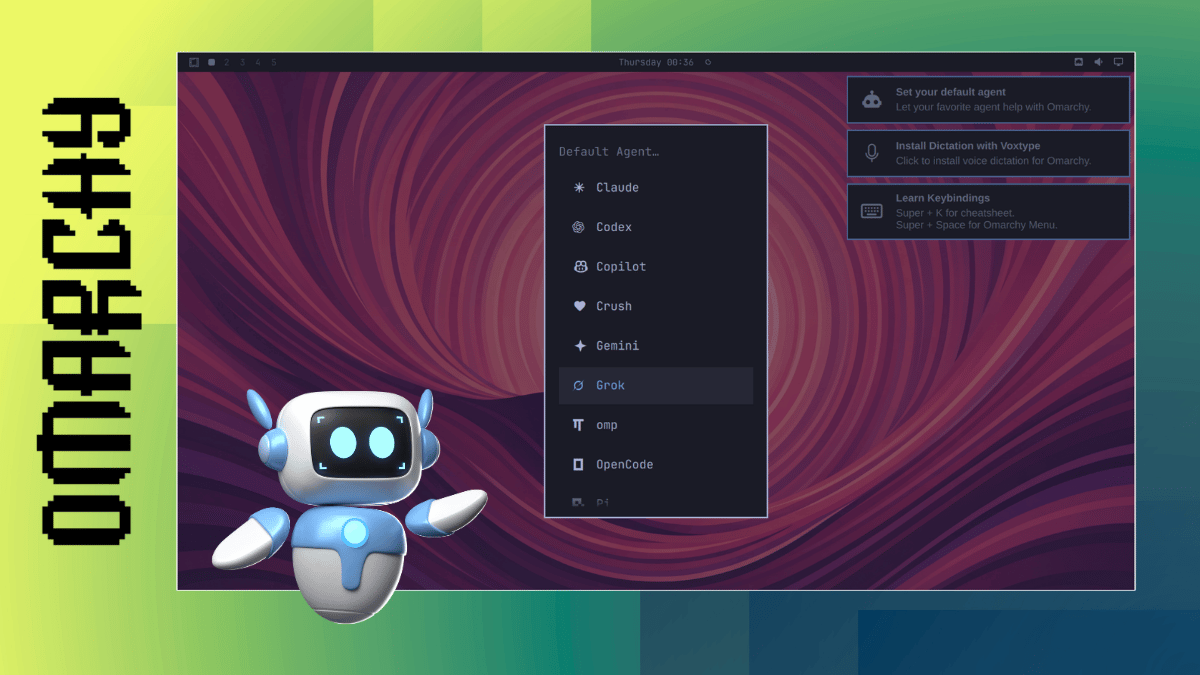
While some open source projects are locking AI out of their codebases, Omarchy's upcoming v4 release treats AI as part of the system.
While the Apple M4 SoCs aren't yet supported by the mainline Linux kernel and the Apple M3 series hardware isn't yet ready for end-users, there are some early elements of the Apple M4 support beginning to come together by open-source developers working on the Apple Silicon support. Sent out to the Linux kernel mailing list were patches for enabling NVMe solid state drive support with the M4...

Version 1.18.1 and 1.19.0 pre-release rolled out for Flatpak, due to some security issues that were found so it's an essential update for all Linux systems.Read the full article on GamingOnLinux.
Longtime Slashdot reader sbinning shares a press release: The U.S. Department of Veterans Affairs announced the launch of a new clinical trial to evaluate the effectiveness and safety of psilocybin to treat major depression in Veterans, including those with concurrent PTSD. The new trial comes after a recent executive order on "Accelerating Medical Treatments for Serious Mental Illness," which aims to increase clinical trial participation and accelerate innovative research models and drug approvals for psychedelic drugs.
[...] The randomized, controlled trial will enroll Veterans diagnosed with treatment-resistant major depressive disorder, with or without concurrent PTSD, and will compare outcomes between two psilocybin dosage levels. The study will also assess participants' levels of depression before and after treatment, tolerability of side effects, and overall patient-reported depression. [...] In addition to this trial, VA is involved in 20 active clinical trials focused on psychedelic therapies for mental health conditions. All VA research -- including research into psychedelics -- is conducted under strict safety protocols and in full compliance with federal guidelines.
Read more of this story at Slashdot.

Pathogenic is a top-down roguelike shooter where you control a customizable lone pathogen infecting a human host.Read the full article on GamingOnLinux.
While Microsoft continues working on Azure Linux 4.0 as its overhauled Linux distribution built atop Fedora, Azure Linux 3.0 remains the current stable production series. Released overnight was Azure Linux 3.0.20260809 and it comes with more than 233 security patches for recent CVEs in the AI era...
Intel XPU Manager 2.1 is now available as the latest version of this open-source tool for Linux and Windows systems for the monitoring and management of Arc Pro graphics cards. The Intel XPU Manager helps in keeping an eye on device utilization and other metrics via the xpu-smi command and other components...

OpenTESArena 0.18.0 the open-source re-implementation of The Elder Scrolls: Arena is out now, bringing many gameplay enhancements.Read the full article on GamingOnLinux.

One game we have to wait a bit longer on is Warhammer 40,000: Dawn of War IV, which has moved from September to December 3rd.Read the full article on GamingOnLinux.
After 13 years of observations and data processing, astronomers have released the largest two-dimensional map of the universe ever assembled, "offering a sweeping new view of nearly 4 billion celestial objects across roughly three-quarters of the sky," reports Space.com. From the report: The new map, created by the Dark Energy Spectroscopic Instrument (DESI) Legacy Imaging Surveys team, contains a staggering 5.6 trillion pixels and combines more than 263,000 telescope exposures collected over more than a decade. The observations span visible and near-infrared wavelengths, providing an enormous portrait of stars, galaxies and other cosmic phenomena across the sky, according to a statement from the National Science Foundation (NSF) NOIRLab. "It's part of the fabric of astronomy research now," David Schlegel, co-lead of the Legacy Surveys and a scientist at the U.S. Department of Energy's Lawrence Berkeley National Laboratory, said in a statement. "When you're working with astronomical objects today, you often start by pulling up the Legacy Imaging Viewer to see what you're looking at."
Read more of this story at Slashdot.