
Bruce66423 shares a report from The Guardian: Sainsbury's has paused the use of AI face scanning in one of its stores after a customer was wrongly identified as a shoplifter and ejected from the shop. "I was embarrassed, mortified even, and felt quite humiliated and powerless," Matt Arnold, 46, said of his ordeal. The comedy promoter was buying supplies in the store in East Dulwich, in south-east London, for a standup event at Dulwich Hamlet football club when, after scanning his items and a Nectar card, he was approached by two managers who told him he could not be served owing to an earlier incident. He was then asked to leave and they tried to escort him from the store.
As he left, he saw an overhead CCTV monitor alert with a red circle surrounding his face. He asked the shop staff to keep his shopping in the trolley so his friend could come and pick up the supplies for the comedy night happening soon next door. "I think they were quite confused by this, understandably, but agreed and my colleague Dave went in to pay for and pick up the shop about five minutes later. There was no pause for thought from the staff, no suggestion that they understood this is not how a shoplifter would behave. Just blindly following the machine's orders." Sainsbury's head office apologised to Arnold the next day and has paused use of its AI-assisted Facewatch technology in the store while an investigation takes place. Arnold says the facial recognition tech should be paused in all stores. "Anyone could be falsely accused and at some point that will be someone vulnerable, someone with mental health issues like anxiety. It's inevitable," said Arnold. "Also, I would worry about the confidence-destroying effect of it happening to a younger person or someone less willing or able to stand up for themselves as I have done."
A Sainsbury's spokesperson said: "We have contacted Mr Arnold to apologise for his experience at our Dulwich superstore. The incident was caused by human error, not the facial recognition technology. Customers can be reassured that the Facewatch system has a 99.98% accuracy rate, and every match is reviewed by a trained manager." A Facewatch spokesperson said their technology was not at fault in this case. "A correct alert was sent to the retailer, but was subsequently subject to human error in the way it was handled in store," they said.
Read more of this story at Slashdot.

Love silly physics as much as I do? Spectacular Team: Assemble is a hilarious looking solo and co-op brawler where you make a hero to fight villains.Read the full article on GamingOnLinux.

Founding members AMD, EPAM, and Renesas already put in the groundwork, and there's a new Premier Plus membership tier to go with it.
There was a proposal under discussion the past few months on building x86-64-v3 packages for Fedora 45 while retaining x86-64-v1 packages. The hope was building the Fedora packages with x86-64-v3 where AVX/AVX2, FMA, BMI2, and other newer ISA features can be assumed in the name of better performance. Unfortunately, the x86-64-v3 plans are now delayed but may be reconsidered next year with Fedora 46...

This is just a Normal Golf Game, nothing to see here. Except you're in a lot of debt, and you're trapped. What's going on? I guess we'll find out soon.Read the full article on GamingOnLinux.
Linux kernel developers made a significant last-minute graphics change for Linux 7.2, reverting the DRM GPU scheduler back to its previous FIFO policy by default after the newer fair scheduling implementation caused serious performance regressions. The revert was submitted just before the final Linux 7.2 release after users reported severe slowdowns and desktop freezes under sustained GPU workloads.
When it comes to the watchdog driver changes for Linux 7.3, standing out is the new Lenovo driver for their upcoming ThinkEdge AI edge computing systems...
Merged today to Mesa 26.3-devel is a nice performance boost for Intel graphics with Valve's Steam Play when using DXVK for Direct3D 8 / 9 / 10 / 11 over the Vulkan API. The open-source Intel ANV driver is seeing up to 5% better performance with DXVK...
The XFS file-system improvements have been merged for Linux 7.3. For end-users the only notable change for this file-system on the new kernel is adding support for FALLOC_FL_WRITE_ZEROES...

Build a deck and burn it all away for power? Burn With Me has a fun idea and the full game is now set to arrive on October 12.Read the full article on GamingOnLinux.
Mozilla Firefox 154 strengthens local network privacy, adds a Manage AI shortcut, improves PDF handling, and expands web platform support.
AleRunner writes: "Solar has been doing the 'heavy lifting' to help Europe meet its energy needs amid a string of blistering heatwaves," Euronews tells us. Meanwhile, as Europe's energy demands rise with the heat, jellyfish have been causing shutdowns and reduced power output at multiple reactors at French nuclear plants, as we already discussed. Euronews reports: A new analysis from energy think-tank Ember found that solar output in European countries rose by up to 17 percent on heatwave days in June and July. Researchers say that this helped power the grid as electricity demand increased by as much as a quarter on hot days. Heatwaves often trigger a spike in electricity consumption due to the sudden need for cooling, mainly from energy-intensive air conditioning (A/C) units.
The International Energy Agency (IEA) estimates that space cooling, which is mostly A/C units and fans, consumed around seven percent of the world's electricity in 2022. Even in countries where A/C ownership is low, countries experience energy demand spikes when scorching temperatures hit. During the early summer heatwaves of 2025, France, for example, recorded an evening electricity peak that was 25 percent above the off-season average due to air conditioning.
Ember's analysis found that during the late-June heatwave this summer, daily electricity demand rose byup to 28 percent in Italy, 23 percent in Hungary, 14 percent in France and 13 percent in Spain compared with pre-heatwave days. It says as heatwave-driven demand increased, solar was the only major power source to perform "better than usual." Compared with other days in June and July, average daily solar generation during the heatwaves was 17 percent higher in France and Hungary, five percent higher in Spain and the same in Italy.
Read more of this story at Slashdot.
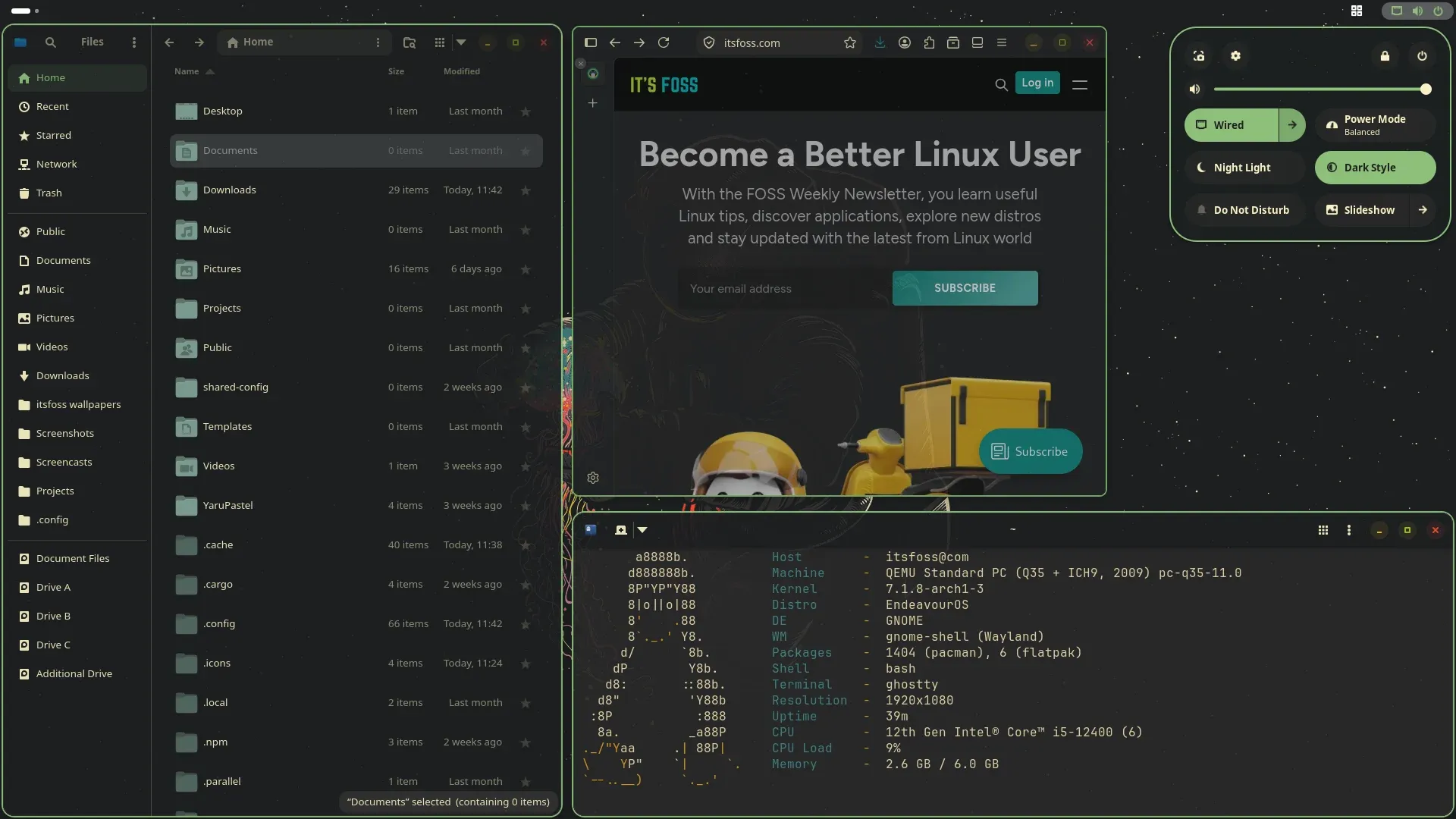
Rewaita makes it easy to recolor GTK and Libadwaita apps with popular palettes, custom colors and a few extra visual effects.
The GNU Linux-libre project announced today the release and general availability of the GNU Linux-libre 7.2 kernel for those who seek 100% freedom for their GNU/Linux computers and software freedom lovers.
Catch up on the latest Linux news: Manjaro 26.1, Omarchy 4.0, GNOME 51 Beta, OpenSSH 10.5, Podman 6.1, KDE Plasma 6.6 gets three years of LTS support, and more.
An anonymous reader quotes a report from The New York Times: Buy now, pay later" loans took off during the pandemic as a way for online shoppers to go on retail splurges without using a credit card. Now, lenders are offering the loans as a means for people to finance basic households needs. The lending apps Flex and Zip allow customers to take out loans to pay for their broadband, electricity, health insurance, mobile phone service, mortgage and water bills. Affirm, one of the most popular pay-later apps, has started providing some tenants loans to extend their monthly rent payment for a few weeks. Many dentists, veterinarians and medical clinics now often offer instant pay-later financing, and Intuit this year started promoting "File Now, Pay Later" loans to TurboTax users who owe money in their tax return.
Pay-later loans are becoming the "working capital for the modern middle class," said Karen Webster, the chief executive of Pymnts, a news and market research company for the payments industry. "Consumers are using it more for essential, everyday things." Americans spent $160 billion last year through pay-later loans, according to research released recently by Federal Reserve economists -- nearly twice what consumers spent two years earlier, in 2023. That's still a fraction of the more than $3 trillion U.S. shoppers spend annually on consumer credit cards. But the industry continues to expand by double-digit rates each year.
How much of that growth reflects consumer preferences, versus desperation, is a question economists and industry analysts are trying to unravel. The rise in pay-later financing comes as many households are leaning more on debt to keep up with their daily expenses. Paying interest -- to afford basic needs -- adds to the overall cost of living, which has already been rising amid higher medical, housing and fuel costs. For many borrowers, the loans have become their only option: Half of those using them said they could not make ends meet otherwise, according to the latest edition of a survey that LendingTree, a loan marketplace, has compiled for years.
Read more of this story at Slashdot.
The website pairs proprietary programs with free and open-source replacements, then provides useful details to help users compare their options.
Among the early pull requests merged today by Linus Torvalds for the Linux 7.3 kernel cycle were removal of some ancient file-systems while adding in a new pseudo file-system...
An anonymous reader quotes a report from Ars Technica: The Supreme Court today rejected Verizon's attempt to get a $47 million refund from the Federal Communications Commission. In a list of orders (PDF) issued by the court, Verizon's petition was denied without explanation. The denial apparently ends any possibility of Verizon asking a lower court to review the fine and order the FCC to issue a refund. However, AT&T and T-Mobile are continuing to challenge similar fines on grounds that selling device-location data did not violate US telecom law.
AT&T, T-Mobile, and Verizon were fined a total of $196 million in 2024 for selling mobile users' real-time location data without their customers' consent. The carriers sold device-location information to data aggregators, who resold it to other firms. The carriers paid the fines and sought to have them overturned in courts, claiming their Seventh Amendment right to a jury trial was violated. Challenges by AT&T and Verizon were combined into a single case, and the Supreme Court ruled against the carriers in June of this year.
The court ruled that the FCC penalty process does not violate the Seventh Amendment because the carriers could have obtained jury trials if they refused to pay the fines and waited for the government to try to collect. The ruling (PDF) against the carriers was 8-1, with Justice Clarence Thomas dissenting.
Read more of this story at Slashdot.
Apple Wallet's driver's license and state ID feature is set to expand to North Carolina, Oklahoma, Utah, and Virginia, bringing the total to 18 states plus Puerto Rico. The digital IDs can be used at participating TSA checkpoints and businesses without handing over or unlocking an iPhone, though users are still generally advised to carry a physical ID because acceptance remains limited. MacRumors reports: A few days ago, North Carolina's DMV announced that it plans to launch a mobile ID program later this year. As reported by WRAL, North Carolina residents will be able to set up a digital ID through a new NC Wallet app starting in December, with Apple Wallet, Google Wallet, and Samsung Wallet support to follow in "early 2027." As mentioned, you do not need to unlock, show, or hand over your device to present an Apple Wallet ID in person, ensuring user privacy.
Apple Wallet IDs are generally not accepted by law enforcement, so carrying a physical ID is still legally required for traffic stops. In addition, the number of businesses that accept Apple Wallet IDs is still quite small. At least for now, Apple Wallet IDs are designed to be a convenient alternative where they are accepted. "Your mobile ID is a valid form of identification in North Carolina," the DMV said, in a FAQ on its website. "However, as retailers, restaurants and other businesses transition to mobile IDs, some may not be set up to accept them right away. For now, carrying your physical card gives you a backup when needed." According to code seen by MacRumors, Apple Wallet IDs are also coming to Oklahoma, Utah, and Virginia, but there is no timeframe for availability.
Read more of this story at Slashdot.
Earlier this year Natalie Vock of Valve's Linux graphics team laid out some patches for improving the Linux gaming experience for systems with limited vRAM. The kernel work for improving that video memory management is set to be introduced in the Linux 7.3 kernel. While that's a celebration on its own, Vock is pursuing more improvements still for bettering the Linux GPU driver video memory management behavior...
District Court Judge Eric Elliff has ordered Iron Mountain to cooperate with Nine PBS in recovering roughly 50TB of archival material stored through now-defunct vendor OSS. "He found that the station is the rightful owner of the materials and entitled to recover them from OSS' storage systems," reports Current.org. Nine PBS must identify a third party to help retrieve the files, pay outstanding storage fees, and ensure that data belonging to other OSS customers isn't disturbed or accidentally recovered. From the report: Under his order, Nine PBS is to identify a third-party vendor, such as a former OSS employee, who can assist in accessing and retrieving the data from the infrastructure that's housed in Iron Mountain's center within 30 days. Elliff acknowledged the complexities of Iron Mountain's position as a vendor to OSS, which, according to Nine PBS' complaint, is in delinquency. Iron Mountain is the "custodian" of Nine PBS' data, but it isn't the vendor that contracted with the station to store and preserve its data. That obligation remains with OSS. Under the order, Nine PBS will pay Iron Mountain current and past-due fees for data storage, starting from when OSS stopped paying Iron Mountain for use of its data storage facility.
During the hearing, Gregory Rich, an attorney representing Nine PBS, said the station seeks access to a physical cage where the data is housed within Iron Mountain's facility. The station is in contact with a former OSS employee who is willing to help obtain the data. The attorney noted that the data could potentially be stored in physical form, such as tapes that could be easily retrieved. But if the materials are on a server, Nine PBS could lose the materials forever if Iron Mountain shuts it down. William Cravens, the attorney representing Iron Mountain, told the judge his client doesn't know the format of Nine PBS' materials that were stored by OSS. He expressed concern about whether Nine PBS' archival material is lumped together with data from other OSS clients. Iron Mountain wants to avoid potentially corrupting the other data, Cravens added.
Elliff ordered the immediate return of any physical devices that hold Nine PBS' data once access to OSS' storage system is granted. If data retrieval turns out to be more complicated -- if it is encrypted, for example -- he will schedule another hearing to determine how to proceed. Once Nine PBS retrieves its data, the station must work with a third party to ensure that no data from other OSS customers is among those materials.
Read more of this story at Slashdot.
The FFmpeg multimedia library can now enjoy faster H.265/HEVC video encoding with the Vulkan-powered encode path. With the optimizations merged today, the H.265 encode performance should be roughly at parity to the H.264 encode speed...
Meta is heading to trial in a case brought by dozens of states accusing it of deliberately designing addictive features, misleading users about safety, and illegally collecting data from children under 13. Meta says the states are seeking penalties as high as $1.4 trillion, though the judge has already called that figure "unreasonable." The case could, however, influence thousands of similar lawsuits against the company. Engadget reports: The trial kicks off Tuesday in federal court in Oakland, California, after Meta lost a last-ditch attempt to get the case dismissed last week. It could see testimony from top officials at Meta, including Mark Zuckerberg, and could result in record-breaking penalties for the company. The case stems from a 2023 lawsuit brought against Meta from dozens of states, which accused Meta of intentionally creating addictive features and violating consumer protection laws. The action came after a multi-state investigation into the company's safety practices that officials said revealed serious harms to children and teens.
During the trial, federal Judge Yvonne Gonzalez Rogers will hear claims from California, Colorado, Kentucky and New Jersey that Meta violated state consumer protection laws by intentionally misleading the public about the safety of its apps. Those four states and 25 others are also suing Meta over alleged violations of the Children's Online Privacy Protection Act (COPPA). The states allege Meta broke the law because it knew Instagram and Facebook had users under the age of 13 and collected data about them without permission. [...] For Meta, the stakes are especially high because the company is currently facing thousands of other lawsuits that accuse it of harming users. Juries in Los Angeles and New Mexico have already ruled against Meta in high-profile trials that deal with similar issues. (Meta has said it will appeal in both cases.) Another loss could not only be a financial blow, it could give other lawsuits an easier path forward. And while Meta isn't exactly hurting for money, its legal costs are adding up. The company said it spent $2.4 billion on legal costs in the second quarter of 2026 alone.
The jury in the case has already been selected and opening arguments are set to begin Tuesday, August 18. The trial is expected to last about six weeks. Unlike in a standard jury trial, the eight-member jury will serve in an "advisory" role, as Law360 explains. The judge will have full power over the final verdict and penalties. Along the way, the trial could also see testimony from some of Meta's most visible executives, including CEO Mark Zuckerberg and Instagram chief Adam Mosseri. Both men are likely to testify, according to Reuters. [...] Audio from the trial will be live streamed on the court's YouTube channel. A spokesperson for Meta issued the following statement: "The State AGs may call this a landmark case, but their limited claims are unsubstantiated and their financial demands are vastly disproportionate. The AGs offer no proof anyone in their states was misled, claim benign features like having an additional Instagram account somehow harmed their residents, and attempt to penalize Meta for industry-wide challenges like age verification," the spokesperson continued. "Rather than sticking to the facts or the law, the states have instead decided to chase an outlandish payout. We stand by our record of creating strong protections for teens, and look forward to making our case in court."
Read more of this story at Slashdot.
A new research paper published on LLVM offloading to GPU accelerators using the Rust programming language is talking up the prospects of making use of safe Rust code for GPU kernels while retaining Rust's memory safety and other advantages over C++ / CUDA / HIP...
An anonymous reader quotes a report from Reuters: PJM Interconnection, the biggest U.S. grid operator, proposed on Thursday a new framework that would force data centers to use back-up generators when electricity supply on the grid approaches dangerously low levels. The grid operator's proposal dovetails with President Donald Trump's Ratepayer Protection Pledge, a non-binding initiative to protect residential customers from getting saddled with costs related to data center power consumption, PJM said.
A new emergency procedure would notify utilities to reduce or transfer the electricity demand from data centers and other large power users ahead of any action that would shut off traditional consumers such as households. PJM said it does not, however, currently have the authority to curtail power to those sites and would require the cooperation of individual state governments.
PJM manages the electricity for 67 million people in a territory that stretches from Washington, D.C. to Chicago. Its proposal highlights a growing tension between the rapid expansion of data centers and the ability of the nation's power grid to keep up. If PJM cannot close its supply gap, millions of residents and businesses face an increased risk of blackouts, and the cost of new generation could be passed on to other power consumers. At its recent capacity auction, PJM hit its $325-per-megawatt-day price cap but still came up about 6.8 GW short of its projected reliability needs.
With rapidly expanding data centers adding pressure to the grid, PJM has also proposed creating a registry to track their locations and power consumption.
Read more of this story at Slashdot.
OpenAI has signed a 10-year lease for an enormous Ohio data center that will eventually provide 8 gigawatts of computing capacity and require at least 10 gigawatts of new power generation. According to OpenAI, Nvidia will be supplying the chips and guaranteeing up to $105 billion in lease and power obligations. From the report: The facility -- which will be built and owned by SoftBank's SB Energy -- illustrates the immensity of the computing and power needed to fuel the growth of the AI economy. The data center will have 8 IT-gigawatts of computing capacity, powered by 10 gigawatts of new energy generation, on private land and federal property formerly used for uranium enrichment.
Nvidia -- which will be the exclusive provider of chips to the site -- agreed to guarantee up to $105 billion in conditional lease and power payment obligations to SB Energy, according to an SEC filing (PDF). The so-called "land, power and shell" deal structure could allow for multiple upgrade cycles for new generations of Nvidia infrastructure at the site, Nvidia CEO Jensen Huang said on X.
A massive 9.2 gigawatts of new gas-fired power is ultimately envisioned for the Ohio project, which U.S. officials say Japan is funding under the 2025 trade and investment deal. SB Energy and SoftBank "will build at least 10 GW of new energy generation," a joint announcement from Nvidia, OpenAI and SB Energy states. Nvidia also said today that it's investing $1.5 billion in SB Energy to back its "continued evolution into a leading AI infrastructure developer."
Read more of this story at Slashdot.
alternative_right shares a report from 404 Media: Amazon is buying massive quantities of books, scanning them for AI training data, and destroying them in the process. A 404 Media investigation was able to reveal Amazon's book buying operation, which hasn't been previously reported, by placing a tracking device in a rare book we suspected would be acquired by an AI company for training data, and following it around the country to its final destination. That final destination was an Amazon warehouse in Las Vegas, Nevada.
Amazon employees who work at this location say all they do is receive massive shipments of printed books which they then cut the bindings off in order to scan the books more quickly. The printed book is destroyed in the process. The logo of the Amazon team that works at this warehouse, called VGT3, is a dinosaur, brandishing its teeth and with a book in its hands. "Amazon purchases books through commercial channels to help develop and improve the products and services our customers use," an Amazon spokesperson told 404 Media in a statement.
Read more of this story at Slashdot.
Back in March were patches posted by ARCTIC Cooling for an ARCTIC fan controller driver for Linux. Typically we aren't used to seeing desktop/enthusiast focused vendors providing such Linux drivers for peripherals directly but the sad fact is most often it's left up to the open-source community to reverse engineer and create such drivers for Linux. Making it all the more surprising besides it coming from ARCTIC Cooling directly was that at the time they didn't even have a fan controller product with USB interface. Well, now it's launched and in turn is a great USB fan controller for Linux systems and retails for just $9 USD.

Now being published by Devolver Digital - HYPERDROP: A Pachinko Roguelite is a game that looks worth keeping on your wishlist with a demo out now.Read the full article on GamingOnLinux.
Linus Torvalds released
the 7.2 kernel on August 17, after noting that the number of fixes
coming in was still "bigger than I would have wished for". In fact,
7.2 was one of the busiest development cycles in the kernel's history,
adding nearly 600,000 lines of code. It's time to look at some statistics
to get a handle on how the kernel's development community is changing.
The company's VP of Engineering expects WSL users to outnumber native Ubuntu desktop users within months.
This year's edition of the Free and Open
Source Software Yearly conference, better known as "FOSSY", moved north to the
beautiful (and enormous) campus of the University of British Columbia (UBC)
in Vancouver, Canada from its home for the three previous editions:
Portland, Oregon, in the US. There were many different types of talks at
FOSSY, from deeply technical kernel-track topics, through talks on legal
and community issues, to the "FOSS in Daily Life" talks. In the "Toolchains
and Other Development Tools" track, Timothy Sample gave a presentation
about bootstrappable builds,
which is somewhat less well-known than its cousin, reproducible builds, though LWN
did look at the topic just over two years
ago. In short, a bootstrappable build is one that starts with a tiny
program that can build another slightly larger program, which can build yet
another, and so on, until the entirety of a modern Linux user space is
built from a small seed. Ultimately, it results in code with a
completely understood origin—unlike a typical Linux user space today.
Anthropic CEO Dario Amodei says the growing backlash against AI is less about executives sounding alarms and more about a broader "crisis of trust" in companies, governments, and the tech industry. TechCrunch reports: Amodei's comments came in response to investor Gavin Baker, who argued -- both on the All-In podcast and on X -- that Amodei's warnings about the dangers of AI have helped to fuel a backlash in the United States, particularly against data centers.
Claiming that Amodei has "lost the argument" when it comes to AI regulation (Anthropic has advocated for some regulations, including a California bill that imposes transparency requirements on large AI companies), and given that "he is about to be the CEO of one of the most important companies in the world," Baker wrote, "I respectfully think he should make an effort to be a more positive advocate for his own industry."
Baker is far from the only one arguing that AI skepticism and even government crackdowns are a natural response to the dire warnings of some AI executives. But in a series of posts, Amodei disagreed with the idea that his "messaging has been disproportionately negative." Instead, he said that his writing has been "about equally balanced between risks and benefits," and that he wrote his essay "Machines of Loving Grace" because he "didn't feel the AI industry was painting an inspiring enough picture of how the technology could radically transform the world for the better."
Nonetheless, Amodei acknowledged that "the public has a negative view of AI" and he agreed that "this is a big problem." Where he disagreed was with the idea that this negativity is "primarily caused" by Amodei "or any other AI leader warning about AI's risks." "I think it is fundamentally a crisis of trust," Amodei said. "I think that ordinary people don't trust companies, governments, or the tech industry and always suspect that we are cooking up some new way to screw them over."
Read more of this story at Slashdot.
AMD engineers are working on enhancing the open-source ROCm compute stack for better handling GPU virtualized compute under QEMU...
An anonymous reader quotes a report from The Register: If you want to record whatever you do on a computer, send those records to OpenAI, use more ChatGPT tokens, and increase your vulnerability to prompt injection, then OpenAI has something for you. It's called Computer History, an opt-in way to record your computer interactions across apps and websites as memories organized on a timeline.
Why would you want to do so? Maybe you found Chronicle, the predecessor of Computer History which compiled similar histories using screenshots, a bit too intrusive but don't mind Computer History's approach -- recording input events and storing them unencrypted locally for 48 hours (or more), with a brief visit to OpenAI's servers. Maybe you're not bothered by the warning OpenAI includes in its documentation: "Computer History files can contain sensitive information. They are not encrypted by Computer History, and other programs running as your macOS user may be able to access them."
Perhaps, having given OpenAI's Codex and GPT Work the run of your computer, you're already sold on the suggestion that storing your computer activity in memory files and arranging those interactions in a timeline will improve ChatGPT responses, surface opportunities for automation, and make it easier to resume prior work. Computer History is, to put it bluntly, a keylogging and event capture system. "Computer History creates an interaction-event stream from allowed apps and websites," OpenAI's documentation explains. "Events can include clicks, typing, keyboard shortcuts, app switches, and context that macOS exposes through its accessibility system. Computer History periodically turns these events into text summaries and local memory files." OpenAI says the feature doesn't capture screen images, microphone input, or system audio. It also doesn't record private-mode browsing.
"Turn it off during communications with other people unless you have their prior express consent," the company advises, perhaps in acknowledgement of legal risk. "Consider pausing it or excluding apps that contain sensitive health, financial, or personal information." ChatGPT and Codex delete locally stored Computer History interaction events after 48 hours, but data sent to OpenAI to generate memories may be retained locally longer and reused in future chats.
Read more of this story at Slashdot.
Among the pull requests sent out today now that the Linux 7.3 merge window is open are the SMP improvements for this next kernel version. Standing out among the SMP code are some enhancements for helping reduce latency and ultimately enhancing real-time Linux performance...
Version 5.0 of GNU Poke,
a binary-data editor, has been released. This release includes a
number of improvements to the Poke compiler, additions to the Poke
language, as well as runtime and standard library updates. See below
for the full list of changes.
The Software Freedom
Conservancy has announced
that Mark J. Wielaard has been honored with the second annual
Distinguished Service Award in Software Freedom for his many years of
service to software freedom.
Mark is one of many key FOSS developers who has designed his career so
that his employers have funded much of his FOSS work. Nevertheless,
Mark continues his volunteer work after hours as a key contributor who
maintains Sourceware — the
oldest FOSS collaboration and developer infrastructure hosting site in
history.
In addition to his work on Sourceware, Wielaard is a member of the DWARF Debugging Standard Committee,
the maintainer for Valgrind and elfutils, as well as a contributor to
various other GNU projects.
Security updates have been issued by AlmaLinux (.NET 8.0, .NET 9.0, bind, dracut, freerdp, gnome-remote-desktop, kernel, and nghttp2), Debian (apr-util, docker.io, ironic, neutron, postgresql-15, unzip, and util-linux), Fedora (chromium, jfrog-cli, jrnl, libgsasl, libsoup3, pdns, pdns-recursor, perl-Archive-Tar, php-pear-PHP-CodeSniffer, rust-bat, rust-git-delta, rust-git-interactive-rebase-tool, rust-lsd, rust-pretty-git-prompt, rust-tokei, and stunnel), Gentoo (haveged, HTTP-Daemon, nginx, NTFS-3G, Portage, PostgreSQL, and X.Org X server, XWayland), Oracle (.NET 10.0, .NET 8.0, .NET 9.0, bind, dhcpcd, dracut, grafana, iscsi-initiator-utils, kernel, nodejs:24, openssh, osbuild-composer, python-idna, ruby, and ruby4.0), Slackware (proftpd), and SUSE (7zip, afterburn, ansible-lint, bouncycastle, cargo-audit, cargo-c, chromedriver, chromium, containerized-data-importer, dnsdist, dracut-112, ffmpeg-9-libavcodec-devel, firefox, freetype2, git-cliff, glib2, go1.25, go1.26, google-guest-agent, google-osconfig-agent, gzip, himmelblau, java-1_8_0-openjdk, kernel, kernel-devel, kubeshark-cli, kubevirt1.9-continer-disk, libkrun, libXfont2, molecule, net-tools, nginx, nodejs22, nodejs24, open-iscsi, perl, pgadmin4, php-composer2, php8, python-httplib2, python-sh, python-ujson, python3-ansible-compat, python313-nltk, rrdtool, rsyslog, samba, spice-vdagent, sssd, webkit2gtk3, wireshark, and wpa_supplicant).
Firefox 154 is now available as the newest monthly update bringing a few new features, enhancements, and other alterations to this open-source web browser...
In advance of the Linux 7.3 merge window opening, Linux power management subsystem maintainer Rafael Wysocki of Intel submitted all the power management, ACPI, and thermal control code. As not too much of a surprise, Intel and AMD driver updates dominate the power management changes for Linux 7.3...
Some take their criticism even further. Reacting to Flock's changes, an EFF statement calls it "Too little, too late," while calling it Flock's admission that their technology needs reforms. But...
To be clear, our position has long been that police, at a minimum, need to get a warrant, signed by a judge, in order to search for historic ALPR data regarding specific vehicles. For us, it's common sense: if police want to dip into historic ALPR data like they were going back in time to retroactively follow your comings and goings, they need a warrant.
There's also nothing stopping Flock from rescinding these latest reforms.
This all leads to the bigger and more important issue: We should not be letting companies decide how much privacy we deserve... It shouldn't be up to Flock or any other ALPR vendor to decide how long police can collect and retain data on millions, if not hundreds of millions, of innocent people. We need lawmakers to step up and pass laws that restrict police's use of surveillance technology.
After all, the surveillance business model is the problem, and a few company-imposed slapdash reforms aren't going to change that.
Read more of this story at Slashdot.
KTransformers as the framework for heterogeneous LLM inference and fine-tune optimizations is out today with its v0.7 feature release...
Earlier it was screen and now a days tmux. But there are many more terminal multiplexers out there worth exploring.

I foresee a great many hours being lost to this one - inspired in part by Warcraft 2, Orc Incremental is an incremental auto-battler with RPG elements.Read the full article on GamingOnLinux.
Huge surprise this morning! Longtime Linux users may recall the out-of-tree work done years ago by open-source developer Con Kolivas... And as part of that his work on the Brain F*** Scheduler that evolved into the MuQSS scheduler, all in the name of working to improve Linux desktop and mobile responsiveness. While a number of years ago he decided to retire from this out-of-tree Linux kernel work, out of the blue he announced a new -ck patch series today with updated MuQSS code...
The PowerPC pull request has already been sent in for the now open Linux 7.3 merge window. The headline feature this cycle on the POWER side is Rust kernel support for PowerPC 32-bit PPC32BE big endian and PowerPC 64-bit PPC64LE little endian architectures...

One for fans of clever puzzle games, Hazard Pay is releasing with Linux support on September 10th - built with Godot Engine.Read the full article on GamingOnLinux.
AI/LLM patch craziness hurt ARM64 development for the Linux 7.2 cycle that no real features landed for that kernel version on AArch64. Fortunately, the ARM Linux developers are more prepared now and for Linux 7.3 are introducing some new ARM64 features...

He Who Watches is an upcoming first-person puzzle game where you can walk on walls, manipulate gravity and more - looks like it will confuse every part of me.Read the full article on GamingOnLinux.
Following yesterday's release of the Linux 7.2 kernel, GNU Linux-libre 7.2-gnu is now available for this kernel downstream that strips out support for drivers depending upon non-free-software microcode/firmware, the ability to load closed-source kernel modules, and other restrictions in the name of software freedom...

Some really nice picks for a good price here in the Builder Games Humble Bundle with a varied selection across city building, vehicle building and more.Read the full article on GamingOnLinux.

KINGDOM HEARTS IV was properly revealed during D23: The Ultimate Disney Fan Event 2026 with a release year and an extended look trailer.Read the full article on GamingOnLinux.

The much loved unsettling supernatural adventure Sally Face is getting a sequel, with the post-apocalypse Sally Face 2 formally announced.Read the full article on GamingOnLinux.
Amazon has "reintroduced a clause in its user agreement that seeks to prevent shoppers from filing class-action lawsuits against the online retailer," reports Bloomberg, "inserting a legal buffer between itself and plaintiffs attorneys that it removed five years ago."
In an email sent to customers on Friday, the company said a new "arbitration agreement and class-action waiver" will require shoppers to resolve disputes outside the courts but said they could still file small claims, cases that typically limit damages to a few thousand dollars... The user-agreement update isn't necessarily binding in court. Plaintiffs attorneys could still seek class-action lawsuits against Amazon, and it would be up to a judge to determine if the user agreement prevents them from doing so.
Amazon was contacted for an explanation by Bloomberg, and provided a statement saying they continually update their wording "to better serve our customers."
Amazon said they'd "determined" that "reinstating the arbitration clause will offer customers a fast, cost-effective way to resolve disputes while still giving them the option of going to small claims court."
Read more of this story at Slashdot.

Good for players on Linux / SteamOS and modders - Tom Clancy's Ghost Recon Wildlands is now free from Easy Anti-Cheat.Read the full article on GamingOnLinux.

The Linux kernel version 7.2 has now been officially released with optimizations, new hardware support and lots of bug fixes.Read the full article on GamingOnLinux.
Founded in 1993 by Ian Murdock, Debian celebrates 33 years as one of the most influential projects in the Linux ecosystem.
"Epic Games has confirmed that it is working on a Linux version of its storefront, potentially removing the need for third-party launchers on platforms such as Steam Deck," reports PC Guide:
The confirmation came during an Ask Me Anything (AMA) on the Epic Games Store's community Discord server. When a user asked whether Epic had any plans for a Linux version of its launcher, an Epic staff member confirmed that it is coming "soon(TM)" in emoji form. Of course, that is far from confirming any kind of date, but it is official confirmation of a Linux version nonetheless.
"On top of that, Nvidia's GeForce Now [cloud gaming] app for Linux is also official, having emerged from beta," writes TechRadar, calling it all part of "a rosier future for Linux gamers."
And while it's not related to gaming, OpenAI's ["preview"] release of a ChatGPT app for Linux is another milestone for the platform... OpenAI said: "Linux has been one of the most-requested platforms for the desktop app, and this launch extends ChatGPT and Codex across every major desktop operating system." The Epic Games Store arriving natively is great news for gamers running Linux — including SteamOS — as it means a much more convenient way of playing games from the store, as opposed to the current situation with fudging and workarounds (using a third-party app such as the Heroic Games Launcher)...
Epic's own Fortnite doesn't work on Linux (and that's down to Epic actively blocking the game from running due to issues around cheating, which remains a source of controversy). Given the apparent changing attitude here with its launcher being ported over, maybe Epic will reverse course on Fortnite eventually. Some gamers on Reddit are highly skeptical about that possibility though, and as one doubting Redditor put it: "I wouldn't hold my breath."
Read more of this story at Slashdot.

AMD's Radeon driver also picks up HDMI 2.1 support, and Apple M3 MacBooks can now boot the kernel.
The first public beta of the redesigned TUXEDO OS is now available, marking the distro’s move away from Ubuntu to Debian Testing.