New Linux tech compresses memory in RAM, as RAM, for 452x speedup

The new method allows access using standard memory semantics instead of as a block device, drastically improving performance.
The new method allows access using standard memory semantics instead of as a block device, drastically improving performance.
When it comes to Linux pre-loaded laptops, I have looked at hardware from most of these vendors over the past 22+ years of Phoronix. One vendor I haven't had the chance to personally test until now is the UK-based Star Labs. That changed recently and over the past few weeks I have been testing out their new StarFighter laptop that offers great Linux support and comes pre-loaded with Coreboot and streamlined firmware updates via LVFS. For those after a high-end mobile workstation, the Star Labs StarFighter offers a lot of performance potential while being open-source friendly and with Coreboot in tow.
NVIDIA just released driver version 615.78.08 for Linux as part of their New Feature Branch, which includes an interesting improvement for Proton.Read the full article on GamingOnLinux.
Nadrieril is a long-time Rust contributor, and the maintainer of the rustc pattern-matching infrastructure. During his involvement with Rust, he has noticed a problem with the usability of the language: it is difficult to automatically extract information from a Rust crate for use with other tooling. The Charon project aims to fix that by providing a stable API for accessing internal information from the Rust compiler.

Microsoft has reportedly secured exclusive cloud-streaming rights for Grand Theft Auto VI, meaning Xbox Cloud Gaming will be the only service able to stream the game at launch. "Rockstar Games still hasn't announced a PC version of Grand Theft Auto VI, so this deal will allow Xbox to market its Xbox Cloud Gaming service to PC players who would otherwise need an Xbox Series X / S or PS5 console," reports The Verge. From the report: News of the streaming rights comes around a month after Microsoft announced some major changes to Xbox Cloud Gaming. From November, the same month Grand Theft Auto VI releases, Microsoft is limiting streaming hours to just 15 hours for Xbox Game Pass Ultimate subscribers, 10 hours for Premium subscribers, and just five hours for Game Pass Essential. Microsoft is also opening up access to Xbox Cloud Gaming with a pay-as-you-go option next month, rather than being limited to Game Pass subscriptions. The pay-as-you-go option is perfectly timed for Grand Theft Auto VI, allowing those who don't own an Xbox, or who primarily play from a phone, to stream the game by paying for a bundle of hours. Read more of this story at Slashdot.
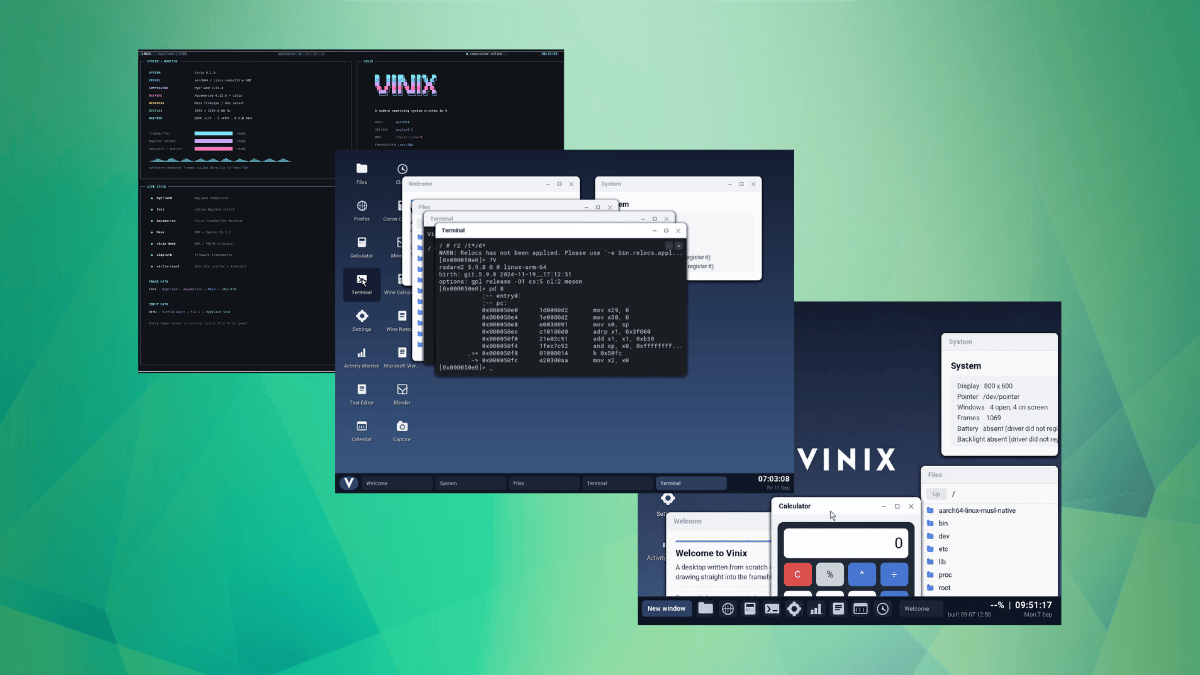
The project has been around since 2021, runs its own kernel, and is written in V.
NVIDIA today released their 615.78.08 Linux driver build with a useful improvement for gamers using Steam Play (Proton) with Direct3D 12 games via VKD3D-Proton along with a variety of other fixes...
The extensible scheduler class, which enables the creation of custom CPU schedulers with BPF, has led to a burst of innovation in this area; the LAVD scheduler has, perhaps, been one of the most noteworthy schedulers to emerge. Though it was originally designed for gaming applications, the LAVD scheduler has since grown to serve other types of workloads as well. At the 2026 edition of Kernel Recipes, Changwoo Min and Gavin Guo presented an overview of this scheduler and how it has evolved over time.
Simon Long has announced a long-awaited release of Raspberry Pi OS, based on Debian 13 ("trixie"), for x86-64 systems. We managed to find the time to update the Desktop for the Buster and Bullseye releases of Debian, but then we all just got too busy with other things, and, while we left the Bullseye version on the website for anyone who wanted it, we simply didn't have time to release any newer versions. But people kept on asking for it – we get two or three emails every week asking when the PC Desktop will be updated, and we haven't had an answer, because we honestly didn't know when we might get a chance to do it. We've continually tried to allocate time to be able to work on this, but it hasn't been easy. [...] Earlier this year, we (or rather Serge) finally got the latest version of the Desktop running on top of a Debian Trixie image. It's now based on 64-bit Debian (the amd64 architecture) rather than the older 32-bit version, as Debian itself has stopped supporting 32-bit for PC architectures. This shouldn't be a major problem – most PCs made in the last 15 years or so will quite happily run the 64-bit version of Debian, as will most Intel-based Macs. (Debian support for Apple Silicon is still experimental, so unfortunately those of you with the latest and greatest shiny fruit products will not be able to run this.)
Security updates have been issued by AlmaLinux (bind, dovecot, freerdp, kernel, mariadb-connector-c, mod_auth_openidc, nodejs22, nodejs:22, sudo, and vim), Debian (node-shell-quote, puma, rails, ruby-jwt, and suricata-update), Fedora (chromium, cockpit, flocq, freerdp, gappalib-coq, golang-x-mod, httpd, janus, libical, musescore, python3-docs, python3.14, python3.15, rocq, rocq-stdlib, tesseract, why3, and zenon), Mageia (srt and tor), Oracle (freerdp, kernel, libpcap, mariadb-connector-c, nodejs22, sudo, and vim), Red Hat (expat and grafana), Slackware (openssh), SUSE (chromium, docker-stable, firefox, jupyter-jupyterlab, libtcnative-1-0, tomcat, tomcat10, libtcnative-1-0, tomcat11, openexr, python310, python313-azure-storage-queue, python313-langchain-anthropic, python313-sglang, python313-Werkzeug, and valkey), and Ubuntu (fluidsynth, freerdp3, freetype, golang-1.18, golang-1.21, golang-1.24, gst-plugins-good1.0, libsoup2.4, libsoup3, libwebsockets, linux, linux-aws, linux-gcp, linux-gke, linux-ibm, linux-oracle, linux-realtime, linux-azure, linux-azure-fde, linux-nvidia-tegra, linux-oem-7.0, redis, sg3-utils, tesseract, and u-boot).
Google engineers are experimenting with Linux kernel device driver isolation using in-kernel sandboxes leveraging LLVM's Lightweight Fault Isolation (LFI) functionality...
Today, the Raspberry Pi project released today an updated version of its Debian-based Raspberry Pi OS distribution for Raspberry Pi single-board computers with new features, improvements, and bug fixes.
Qualcomm's Snapdragon 8 Elite Gen 6 "Hawi" SoC features the Qualcomm Page Compression Engine "QPaCE" hardware accelerator. Linux patches posted recently provide a QPaCE driver for accelerating page compression and decompression for the ZRAM block device...
University of Wisconsin-Madison physicist Francis Halzen has been awarded the 2026 Nobel Prize in Physics for his contributions to understanding astrophysical neutrinos. Halzen led the development of the IceCube Neutrino Observatory beneath the Antarctic ice, which has helped trace high-energy neutrinos back to cosmic sources such as supermassive black holes and opened a new era of "multi-messenger" astronomy. Longtime Slashdot reader schwit1 shares a report from UW-Madison: Embedded in a cubic kilometer of Antarctic ice, IceCube uses thousands of light sensors to survey the universe for neutrinos, nearly massless particles that rarely interact with other matter. Neutrinos provide information about the workings of black holes, galaxies and other objects in the cosmos. "IceCube is like no other telescope in the world," says UW-Madison interim Chancellor Eric M. Wilcots. "And there is no other scientist quite like Francis Halzen, whose idea to create a neutrino detector under almost a mile of ice has led to a remarkable multinational and multi-institutional scientific collaboration and a fundamental shift in how we think about the universe." Unlike the neutral neutrino, cosmic rays are charged particles whose paths cannot be traced directly back to their sources. But the powerful cosmic accelerators that produce them, like supermassive black holes, will also produce neutrinos. These so-called "ghost particles" travel nearly undisturbed from their accelerators, giving scientists an almost direct pointer to their source. Along with observations by other telescopes, the neutrino first detected by IceCube provided the first-ever evidence of a source of high-energy cosmic rays, whose origins have been notoriously difficult to pinpoint since their discovery over 100 years ago by 1936 physics Nobel laureate Victor Hess. Read more of this story at Slashdot.

Submitting product vulnerability reports is no longer possible. You can thank AI for that.
Huawei engineers are experimenting with a new file-system called XMFS. XMFS was presented this week at LPC 2026 in Czechia as a file-system for modern Linux servers with CXL 3.0 or Huawei United Bus connectivity...

Death Falls: Zombies Are Coming is a zombie post-apocalypse tower defense where you build up by day, fight by night as you try to survive the hordes.Read the full article on GamingOnLinux.
Following the Windows Subsystem for Linux 3.0.2 release with support for running WSL2 now on very large servers and also experimental sparse VHD storage support, Microsoft has now released a new version of the WSL2 Linux kernel as their downstream kernel configuration tailored for WSL2 usage...
Back in March Canonical announced switching to ntpd-rs was its next target as part of transitioning more Ubuntu Linux system components to Rust-based implementations. This time synchronization package is available for testing in the upcoming Ubuntu 26.10 release while it aims to be the default for Ubuntu 27.04...
One of the AMD Zen 6 CPU features that hasn't been talked about too widely beyond appearing in a public AMD tech doc is the IBS Memory Profiler. This week in Prague at LPC 2026 an AMD engineer talked up Zen 6's IBS Memory Profiler and its benefits for hot page detection and promotion on Linux systems...

Bazzite Linux has the first stable release out for October, bringing lots of improvements for everyone from handhelds to desktops.Read the full article on GamingOnLinux.

A fresh Humble Choice Bundle for October 2026 has arrived and it's a really good set of games overall for this month to claim.Read the full article on GamingOnLinux.
OpenSSH 10.6 is out with security fixes, the new hybrid post-quantum ssh-mldsa44-ed25519 algorithm, and several new SSH and SFTP features.

Instead of directly racing, you're managing your driver in Backseat Champions - a racing roguelite autobattler.Read the full article on GamingOnLinux.

Warhammer 40,000: Boltgun 2 releases soon on October 14th, and it is now rated Steam Deck Verified and Steam Machine Verified!Read the full article on GamingOnLinux.

Play as characters from the Warhammer 40,000 and Warhammer: Age of Sigmar universes, collect and evolve iconic weapons and destroy endless swarms of enemies.Read the full article on GamingOnLinux.
An anonymous reader quotes a report from Reuters: Google has contracted for 3,590 megawatts of power from Constellation Energy on the largest US power grid, with new nuclear energy accounting for about a quarter of that supply, the companies said on Tuesday. Constellation will make more than $4.3 billion of new investments in its fleet as part of the agreement, which involves adding capacity at several of the power company's nuclear reactors in the Midwest and Mid-Atlantic regions, the companies said. [...] Over the last two years, Constellation unveiled an agreement to restart its Three Mile Island reactor in Pennsylvania to serve Microsoft data centers, while Google contracted to restart NextEra Energy's nuclear power plant in Iowa. In the latest arrangement, Google entered into a 20-year power purchase agreement for 890 megawatts of electricity from multiple Constellation-owned nuclear power plants, which would be upgraded to produce more electricity from existing reactors. Electricity from the first of the upgraded plants is expected to be delivered in 2028, the companies said. Google also entered into a 15-year supply agreement for an additional 2,700 megawatts of power from Constellation in the PJM power grid. That power is not tied to a specific generation source and serves as long-term revenue certainty for Constellation's operating plants, Google said. Maryland-based Constellation is the largest US nuclear power plant operator and owns a major fleet of natural-gas-fired power plants as well as geothermal energy following its acquisition of electricity producer Calpine Corp earlier this year. [...] The 11 nuclear units expected to be upgraded as part of the arrangement with Google are in Illinois, Pennsylvania, and New Jersey, within the footprint of the largest US electric grid -- PJM Interconnection. Joe Dominguez, chairman, president and CEO of Constellation, said the arrangement with Google is a "model for how technology companies and the energy industry can work together to responsibly develop the digital economy and invest in our nation's energy infrastructure in a way that delivers grid-wide benefits for all, funded by private entities." Read more of this story at Slashdot.

Valve released another bug fix with SteamOS 0.4.5 Beta for Steam Frame, along with a bigger stable Steam Client Update For Frame.Read the full article on GamingOnLinux.

New versions of X.Org and XWayland have been released since more security issues have been revealed.Read the full article on GamingOnLinux.
The Raspberry Pi project has finally updated the Raspberry Pi Desktop variant of its Debian-based distribution for PC and Mac systems on the latest Debian 13 “Trixie” operating system series, and it includes all the new features from the latest Raspberry Pi OS release.
Amid multiple ongoing innovations being pursued in the Linux memory management space amid sky high RAM prices, a new patch series posted on Monday aim to enhance the Zswap performance for this compressed RAM cache for swap pages...
RTIPC is a new Linux IPC library combining shared memory with wait-free queues for deterministic, near-zero-overhead communication in hard real-time workloads.
South Korean President Lee Jae Myung says there are signs AI models may have been used in recent cyberattacks against several major banks. "In some hacking incidents, signs have emerged of AI being used, causing considerable public concern and anxiety," Lee said during a cabinet meeting. "Please establish the circumstances swiftly and clearly, and concentrate personnel and resources on minimizing the damage." Reuters reports: South Korea's police have launched a full-scale investigation into the hacking attacks against commercial banks that led to a breach of customers' personal information, the Yonhap news agency reported on Tuesday. Shinhan Bank, KB Kookmin Bank and others had reported cyberattacks, the Financial Services Commission (FSC) said on Friday, while Yonhap reported that Hana Bank and Woori Bank also suffered breaches. Authorities have not yet disclosed details on what kind of AI tools were used in the hacking incidents or the full scale of the breaches. On Sunday, FSC Chairman Lee Eog-weon convened an emergency meeting with financial industry associations, regulators and executives from affected institutions, warning that the sector must respond with the highest level of vigilance. Financial watchdog the Financial Supervisory Service (FSS) and the Financial Security Institute shared data about 28 unique IP addresses and some country information linked to the recent hacking attempts with the financial sector, the FSS said on Tuesday. Read more of this story at Slashdot.
With the assistance of AI, another dozen security vulnerabilities affecting both the conventional X.Org Server as well as XWayland were made public this evening...
"With the push to eliminate the twice yearly clock change, Permanent Daylight Savings Time has emerged as the favorite for most states and provinces," writes longtime Slashdot reader kbahey, sharing the findings from a recent analysis published in the Canadian Medical Association Journal. Sci.News reports: "Ending the clock change solves one problem, but it creates another decision: which time should we live on year-round?" said University of British Columbia's Professor Raymond Lam, lead author of the study. "The health evidence points to standard time, largely because morning light matters for our body clocks, sleep, and mood." Professor Lam and colleagues examined the health consequences of the two possible permanent systems rather than the broader question of whether seasonal clock changes should be abolished. They concluded that the accumulated evidence favors permanent standard time, which keeps the clock more closely aligned with human circadian biology. This distinction, according to the team, becomes particularly important during winter. Permanent daylight saving time would push sunrise an hour later. In cities such as Toronto, for example, the latest winter sunrise would occur at 8:51 a.m., compared with 7:51 a.m. under permanent standard time. In Calgary, the corresponding times would be 9:40 a.m. and 8:40 a.m. The extra hour of morning darkness could leave people traveling to work or school before sunrise, while shifting more daylight into the evening. The change could have consequences for sleep, mood, learning and productivity, particularly among people who already have difficulty sleeping or who must follow early schedules. The reason is rooted in the body's internal clock. "Our biological clocks need morning light to stay synchronized with the 24-hour day," said Simon Fraser University's Professor Ralph Mistlberger, co-author of the study. "Permanent daylight saving time moves that light an hour later just when winter mornings are already darkest." The analysis also highlights concerns about seasonal depression. [...] By delaying natural morning light, permanent daylight saving time would act in the opposite direction, potentially weakening an important circadian signal. Read more of this story at Slashdot.
Canonical is about to release its interim version of Ubuntu, the Stonking Stingray, a.k.a. Ubuntu 26.10, and they are doubling down on security with the upcoming Linux 7.3 kernel series, a slimmed-down GRUB bootloader, and more.
HubSpot is cutting about 7% of its workforce, or roughly 660 employees, as it restructures into what CEO Yamini Rangan described as a "flatter organization" with fewer management layers. Rangan said the layoffs were "not driven by AI-related efficiencies," though AI remains central to HubSpot's strategy as the company adjusts its organization around AI-driven customer outcomes. Fast Company reports: The layoffs come as investors have spent months questioning whether AI will reduce the need for businesses to pay for software like HubSpot's, a fear dubbed the "SaaSpocalypse." HubSpot's platform helps companies manage their customers, sales, and marketing. The company was removed from the FTSE All-World Index (USD) last month after a decline in its stock price, a report from Simply Wall St noted. The stock is down more than 43% this year as of this writing. Yamini Rangan, CEO of HubSpot, explicitly told employees in a memo that the layoffs were "not driven by AI-related efficiencies." Rather, the aim was to focus on "aligning our organization with our strategy and how we need to operate going forward," Rangan wrote. She added that the goal is to "build a flatter organization with fewer layers" by cutting back on management. Still, artificial intelligence has been central to the company's concerns. In August, Rangan blamed AI for why the company "got off to a slow start" in April as HubSpot was trying to adjust its product and pricing. "We're in the middle of a real transition to AI, and we are making deliberate choices to lead in it," she said on an earnings call. The restructuring is estimated to cost between $65 and $75 million, mostly in severance packages. The company said that laid-off employees will receive 20 weeks of base pay, one week per year of service (capped at 30 weeks), five months of COBRA and Modern Health healthcare benefits, and they will be allowed to keep their laptops. Read more of this story at Slashdot.
Amazon has removed Alexa voice control for the 3.5mm aux input on several older Echo speakers, meaning users can no longer ask Alexa to play or pause audio coming through the wired connection. It's unclear why the feature was removed. The Verge reports: Ars Technica points to this Reddit poster claiming they received a message from Amazon and says an unnamed spokesperson confirmed the change. When contacted by The Verge, Amazon did not provide an on-the-record statement. The message does not include any explanation for why the feature was removed. It also doesn't mention any changes to audio output functionality like connecting an external speaker to an Echo Dot, and it appears that control of the port from within the app's settings menu still works. Read more of this story at Slashdot.
ASOS says hackers gained unauthorized access to third-party platforms it uses and sent an "ASOS HACKED" push notification directly to customers, apparently as part of an extortion attempt. The clothing and beauty store says some basic personal information may have been accessed but does not believe payment-card data or passwords were affected. The BBC reports: In an email to customers on Tuesday night, the company apologized and urged customers not to engage with the notification. And it said the website and app are "operating as usual" promising customers they can "shop with confidence" while it investigates the incident. The company has not as of yet informed the UK's data watchdog, the Information Commission's Office (ICO), about any breach. Exactly how many Asos customers received the notification on Tuesday remains unclear, but Google's Play store says the ASOS app has been downloaded to android devices more than 10 million times. The British retailer has a substantial global footprint -- serving around 17 million customers each year across more than 150 markets. Some Asos app users in Australia, France, Sweden and the Republic of Ireland had also received the notification, according to local reports on Tuesday. [...] Users of the Asos app appeared to have received the alarming notification at around 10:00 BST on Tuesday. Headlined "ASOS HACKED" and addressed to the company's data protection officer and IT teams, it said: "We have fully compromised the Snowflake instance." "Engage with us, or we will leak it," it added, before linking to a Telegram channel. The message left many ASOS customers confused. [...] Meanwhile Snowflake -- whose tools are used by dozens of firms to collect, analyze and store data -- told the BBC its investigation was ongoing, but it had so far found "no compromise" of its platform. Read more of this story at Slashdot.
Xfce, Cinnamon, COSMIC, Sway, i3 and more. See all 12 Fedora Spins side by side, with pros, cons, and a comparison table to help you pick fast.
IBM and Red Hat say their AI-powered Lightwell initiative has identified and helped remediate more than 400 previously unknown vulnerabilities across widely used Java libraries. Phoronix reports: They announced this feat today as part of their promoting Lightwell Clearinghouse to GA, which is an enterprise service for their customers to submit open-source software dependencies for priority review and remediation. From today's announcement: "The milestone addresses a growing business risk. As autonomous AI agents become capable of combining several lower-risk software weaknesses into a more serious attack, companies need to do more than identify vulnerabilities. They need a practical way to develop, test and deploy fixes in the software that supports critical applications." Read more of this story at Slashdot.
Back in July I wrote about AMD P-State driver patches boosting 1%-low frame rates for gaming by as much as 31%. That work was done by David Vernet who is a Linux kernel engineer/hacker at Meta. This week Vernet presented on the topic at the Linux Plumbers Conference happening in Prague...
An anonymous reader quotes a report from Ars Technica: VMware customers face multiple obstacles as they rethink their virtualization strategy to reduce dependence on VMware. Today, Rimini Street published its "2026 IT Virtualization Survey -- What's Next for VMware Users." The survey examined 300 organizations worldwide that use VMware. Notably, Rimini sells third-party support for VMware and other software, including Oracle and SAP. That means there's an incentive for Rimini to portray VMware users as experiencing obstacles. However, the survey was also conducted by a third-party research company, Unisphere Research, and the results align with other recent reports about VMware customers. For example, 90 percent of participants in Rimini's survey said they're exploring VMware alternatives due to VMware's higher licensing costs, while 54 percent pointed to Broadcom killing support for perpetual license holders. Since Broadcom took over VMware, customers have said that their VMware costs increased by as much as 1,000 percent, with many more pointing to more modest price hikes of around 100 to 300 percent. In Rimini's survey, 73 percent of participants pointed to cost savings as a top priority in their virtualization roadmap decisions. In today's announcement, Rimini pointed to "significant barriers to progress" for organizations exploring virtualization options, with the most cited barriers being operational complexity (named by 40 percent of respondents), multi-vendor management challenges (38 percent), securing the increased attack surface (37 percent), and team skills requirements (37 percent). "These findings suggest that while organizations are actively pursuing change, they are also looking for ways to reduce risk and avoid unnecessary disruption," Rimini's announcement said. [...] Rimini reported that 60 percent of the organizations it surveyed are considering a multi-hypervisor strategy, which is indicative of "growing interest in more flexible, mixed environments that support both operational and financial goals." "In addition, 47 percent are favoring a hybrid IT virtualization environment consisting of hypervisors and containers for 'best of both worlds' workload placement," the announcement said. Rimini noted that 48 percent of respondents aren't planning to move any of their assets to VMware's hybrid cloud platform, Cloud Foundation. Read more of this story at Slashdot.
Raspberry Pi OS receives a broad desktop-focused update with Linux 6.18.50, Control Centre improvements, refreshed icons, and numerous stability fixes.
Mistral has unveiled Mistral Large 4, or "le Chonk," a 1-trillion-parameter model that it says is the strongest open-weight AI model developed outside China by a wide margin. The model is entering preview for developers, cybersecurity teams and governments before a broader release later this month. CNBC reports: ML4 was trained on 4,000 Nvidia Grace Blackwell GPUs over two months that were deployed in Mistral's own data centers in Europe. When its core parameters are released, ML4 will rank among the top open-weight models globally on aggregate benchmark performance, Mistral said in a statement. The company added that ML4 was the strongest open-weight model developed outside China by a "substantial margin." The new model still lags behind the frontier in areas such as coding. "The model capabilities will further improve as we scale up our training capacity, following our Series D fundraise," said Guillaume Lample, co-founder and chief scientist of Mistral. "Further, the cyber defense capabilities will enable enterprises and governments to defend themselves against threat actors that are jailbreaking closed models to perform cyber attacks," he added. Further reading: Mistral CEO Says US AI Safety Debate Masks Competitors' 'Negligence' Read more of this story at Slashdot.
A status update shows it clearing 400 vulnerabilities from Java libraries and a key service now being generally available.
In this article, you will learn how to use the mount and umount commands in Linux to mount different file systems and then unmount them.
While most everyone understandably likes to talk about AI these days, one of the areas of NVIDIA's Vera CPU I have been most eager to test has been for conventional high performance computing (HPC) workloads. HPC was talked up as one of Vera's strengths thanks to its 1.2TB/s LPDDR5x memory bandwidth and custom Olympus cores. Vera is seeing deployments at HPC labs like Los Alamos. With recently having unfettered remote access to a dual NVIDIA Vera server, I ran through a variety of HPC workloads and similar performance benchmarks. Here is a look at how NVIDIA Vera performs against AMD EPYC and Intel Xeon, including with CPU power and frequency metrics.
Independent researchers say they've identified a large "fleet" of AI agents apparently running on Tencent infrastructure and making parallel queries against Alibaba's Amap mapping service. TechCrunch reports: Researchers, however, resisted the term "swarm," noting that there seems to be little coordination between their different queries. "'Agent fleet,' not 'swarm:'" one researcher wrote in the preliminary report, "many parallel agents on the same kind of task, with no sign of communication between them." The agents were discovered by monitoring traffic to the domain-scanning service urlquery, a technique that previously revealed long-running activity by OpenAI agents. AI agents often use urlquery to load websites that they cannot access directly, leaving a record of their activities that can be valuable to researchers. In this case, the record showed queries to Alibaba's Amap service, seeking directions to different entrances of various public places, including a park, a zoo, and a hospital. The research is ongoing and so few details are available, but the behavior shows how persistent AI agent activity has become on the internet. In the wake of the Hugging Face incident, many researchers are actively monitoring for rogue agent activity on the internet. Much of that activity has been easy to find because agents tend to use the same techniques and make little effort to conceal themselves. Read more of this story at Slashdot.
Python's random and secrets modules both include utilities for obtaining random values, but only one of them is suitable for generating passwords and security tokens. For much of Python's history, random was used for passwords and tokens anyway, despite documentation that called it unsuitable for cryptography. In 2015, Python's core team debated whether to fix that misuse by making random secure by default. Instead, in 2016, Python 3.6 added a second module: secrets. The random module is still misused at times, so it is instructive to look into how the random-number modules should be used.
An anonymous reader quotes a report from ArsTechnica: Cable lobby groups notified the Federal Communications Commission that they will sue the agency to block its controversial repeal of the National Television Ownership Rule, which limits the number of broadcast TV stations a single company may own. The cable groups said that larger broadcast TV station groups will have leverage to demand higher retransmission fees from TV providers, resulting in "higher monthly TV bills for consumers." They said the FCC repeal order "arbitrarily and capriciously ignores the harms that will surely follow from allowing broadcast station groups to exceed the National Cap." The cable lobby groups represent top providers Comcast, Charter, and various other cable operators. Top cable companies have also expanded through mergers. Charter completed a purchase of Cox in August after the FCC rejected protests by advocacy groups that said the cable deal "would create unchecked gatekeeper power over Internet distribution" and make it easier for the biggest cable companies to raise prices. [...] The TV ownership rule prohibits any single broadcast station owner from reaching more than 39 percent of all TV households in the US. Congress directed the FCC to set the cap at 39 percent in 2004. On Friday, cable lobby groups submitted a petition asking the FCC to keep the TV ownership cap in place until litigation over the FCC's authority to repeal the rule is over. The cable groups' filing said the FCC repeal of the TV ownership cap violates the 2004 action by US lawmakers. The decision by Congress to set the cap at a precise numerical threshold was unambiguous, the filing said. "Congress established the National Cap at 39 percent in the 2004 CAA [Consolidated Appropriations Act] in direct response to the FCC's attempt to aggressively raise the Cap to 45 percent and made repeated references to the 39 percent Cap in the statute," the petition said. The petition to the FCC is mainly a procedural step as the commission isn't likely to stay its own order. The cable groups said they intend to sue the commission in a US appeals court once the FCC order is published in the Federal Register. After the lawsuit is filed, they can ask the court to issue a preliminary injunction that would keep the TV ownership cap in place pending the outcome of litigation. [...] The cable groups' petition said the FCC can't change the cap because the 2004 law "references the 39 percent Cap as statutory, not regulatory." A provision requiring divestiture of stations "specified that someone exceeding 'the 39 percent national audience reach limitation in paragraph (1)(B)' of 'section 202(c)' of '[t]he Telecommunications Act of 1996' 'shall have not more than 2 years to divest,'" the petition said. "Likewise, Congress singled out the Commission's only mechanism for setting aside statutory requirements -- the Commission's forbearance authority under 47 U.S.C. 160 -- and made clear that it 'shall not apply to any person or entity that exceeds the 39 percent national audience reach limitation,'" the cable lobby petition said. The FCC order argued that the agency's "ability to forbear from enforcement of its rules is distinct from its power to alter or eliminate those rules," and that the FCC forbearance authority doesn't apply to regulation of broadcasters. Read more of this story at Slashdot.
Canonical released today the beta version of the upcoming Ubuntu 26.10 (Stonking Stingray) distribution ahead of the final release on October 15th, 2026, for public testing, application developers, and early adopters.
Timur Kristóf of Valve's Linux graphics team has done an incredible job improving older AMD GPU support under Linux with migrating GCN 1.0/1.1 era hardware to the modern AMDGPU kernel driver and an assortment of other improvements for various older Radeon GPUs. The newest work is on enhancing the RADV Vulkan driver support for old Radeon RX 400/500 "Polaris" graphics cards...
Chromium, the open-source upstream project for Google's Chrome web browser, is the browser of choice for many Linux users. It has also gained a reputation as being difficult for Linux distributions to package and build: Chromium has a complex build system, the project bundles many of its dependencies, and it has frequent releases. All of that, plus user complaints, has led the maintainers of the Gentoo Chromium package to give up on trying to maintain the package.
Version 10.6 of OpenSSH has been released. The announcement notes that the OpenSSH team has been receiving a large number of AI-assisted security bug reports. "We very much welcome these reports, especially when combined with human triage, analysis, test-cases and particularly when accompanied by proposed fixes". As a result, the project expects to be making more frequent releases to get updates to users more quickly rather than batching the bug fixes until the next planned release. Notable changes in this release include enabling the hybrid post-quantum ssh-mldsa44-ed25519 signature algorithm, addition of a -p option for sftp's lmkdir/mkdir commands, as well as disabling the LZ77 dictionary coder in ssh and sshd to mitigate side-channel leaks (which will result in reduced effectiveness of the Compression option). The scp -R option, which allows copies between two remote hosts, is being deprecated due to security risks; the option will be ignored in the future. See the announcement for full details of all changes and bug fixes.

Star Wars: Galactic Racer is officially out now for everyone across different platforms, bringing back some classic dangerous action.Read the full article on GamingOnLinux.
Security updates have been issued by AlmaLinux (gd, gimp, kernel, kernel-rt, libpcap, librabbitmq, mariadb-connector-c, osbuild-composer, ruby:2.5, and sudo), Debian (libmodule-cpants-analyse-perl, libpng1.6, libreoffice, roundcube, ruby-oauth2, and sabnzbdplus), Fedora (0install, alt-ergo, apron, brltty, chromium, coccinelle, cri-o1.36, emacs-common-tuareg, flocq, frama-c, freetennis, gappalib-coq, guestfs-tools, haxe, hevea, hivex, kernel, lem, libguestfs, libnbd, nbdkit, not-ocamlfind, ocaml, ocaml-afl-persistent, ocaml-alcotest, ocaml-astring, ocaml-atd, ocaml-augeas, ocaml-b0, ocaml-base, ocaml-base64, ocaml-benchmark, ocaml-bin-prot, ocaml-biniou, ocaml-bisect-ppx, ocaml-bos, ocaml-cairo, ocaml-calendar, ocaml-camlbz2, ocaml-camlidl, ocaml-camlimages, ocaml-camlp-streams, ocaml-camlp5, ocaml-camlp5-buildscripts, ocaml-camlpdf, ocaml-camomile, ocaml-capitalization, ocaml-cinaps, ocaml-cmdliner, ocaml-compiler-libs-janestreet, ocaml-cpdf, ocaml-cppo, ocaml-crowbar, ocaml-cryptokit, ocaml-csexp, ocaml-csv, ocaml-ctypes, ocaml-cudf, ocaml-curl, ocaml-curses, ocaml-dbus, ocaml-domain-name, ocaml-dose3, ocaml-dune, ocaml-easy-format, ocaml-expat, ocaml-extlib, ocaml-facile, ocaml-fieldslib, ocaml-fileutils, ocaml-findlib, ocaml-fmt, ocaml-fpath, ocaml-gen, ocaml-gettext, ocaml-graphics, ocaml-gsl, ocaml-integers, ocaml-intrinsics-kernel, ocaml-jane-street-headers, ocaml-jsonm, ocaml-jst-config, ocaml-lablgl, ocaml-lablgtk, ocaml-lablgtk3, ocaml-labltk, ocaml-lacaml, ocaml-lambda-term, ocaml-libvirt, ocaml-linenoise, ocaml-logs, ocaml-luv, ocaml-lwt, ocaml-mccs, ocaml-mdx, ocaml-menhir, ocaml-merlin, ocaml-mew, ocaml-mew-vi, ocaml-mlgmpidl, ocaml-mlmpfr, ocaml-monolith, ocaml-mtime, ocaml-mysql, ocaml-num, ocaml-obuild, ocaml-ocamlbuild, ocaml-ocamlgraph, ocaml-ocamlnet, ocaml-ocp-indent, ocaml-ocplib-endian, ocaml-ocplib-simplex, ocaml-omake, ocaml-omd, ocaml-opam-0install-cudf, ocaml-opam-file-format, ocaml-ounit, ocaml-parmap, ocaml-parsexp, ocaml-patch, ocaml-pcre2, ocaml-perl4caml, ocaml-postgresql, ocaml-pp, ocaml-pprint, ocaml-ppx-assert, ocaml-ppx-base, ocaml-ppx-bench, ocaml-ppx-bin-prot, ocaml-ppx-cold, ocaml-ppx-compare, ocaml-ppx-custom-printf, ocaml-ppx-derivers, ocaml-ppx-deriving, ocaml-ppx-deriving-yaml, ocaml-ppx-deriving-yojson, ocaml-ppx-enumerate, ocaml-ppx-expect, ocaml-ppx-fields-conv, ocaml-ppx-globalize, ocaml-ppx-hash, ocaml-ppx-here, ocaml-ppx-inline-test, ocaml-ppx-let, ocaml-ppx-optcomp, ocaml-ppx-sexp-conv, ocaml-ppx-stable-witness, ocaml-ppx-variants-conv, ocaml-ppxlib, ocaml-ppxlib-jane, ocaml-psmt2-frontend, ocaml-ptmap, ocaml-pyml, ocaml-qcheck, ocaml-qtest, ocaml-re, ocaml-react, ocaml-res, ocaml-result, ocaml-rresult, ocaml-SDL, ocaml-sedlex, ocaml-sexplib, ocaml-sexplib0, ocaml-sha, ocaml-spdx-licenses, ocaml-sqlite, ocaml-ssl, ocaml-stdcompat, ocaml-stdio, ocaml-stdlib-random, ocaml-store, ocaml-swhid-core, ocaml-testo, ocaml-time-now, ocaml-topkg, ocaml-trie, ocaml-unionfind, ocaml-uucd, ocaml-uucp, ocaml-uunf, ocaml-uuseg, ocaml-uutf, ocaml-variantslib, ocaml-version, ocaml-xml-light, ocaml-xmlm, ocaml-xmlrpc-light, ocaml-yaml, ocaml-yamlx, ocaml-yojson, ocaml-zarith, ocaml-zed, ocaml-zip, ocaml-zmq, ocamlify, ocamlmod, opam, perl-DBI, planets, plplot, prooftree, python3.12, rocq, rocq-stdlib, supermin, unison, utop, virt-top, virt-v2v, why3, xen, z3, and zenon), Oracle (bind, expat, gawk, gdb, ghostscript, gimp, gvfs, kernel, libpcap, libvirt, mod_auth_openidc, openssh, rsync, thunderbird, and webkit2gtk3), Red Hat (vim), Slackware (cups), SUSE (apache-sshd, binutils, cups, docker-stable, java-11-openjdk, libraw-devel, libX11, pcre2, perl-DBI, python-msgpack, python312, python313-tokenizers, rpcbind, rpm, rubygem-rails-html-sanitizer, squid, sssd, terraform-provider-susepubliccloud, valkey, and wpa_supplicant), and Ubuntu (aodh, watcher, edk2, libreoffice, libxmltok, linux, linux-aws, linux-aws-5.15, linux-aws-fips, linux-azure, linux-azure-5.15, linux-azure-fde-5.15, linux-azure-fips, linux-fips, linux-gke, linux-gkeop, linux-hwe-5.15, linux-ibm, linux-ibm-5.15, linux-intel-iot-realtime, linux-intel-iotg, linux-intel-iotg-5.15, linux-kvm, linux-lowlatency, linux-lowlatency-hwe-5.15, linux-oracle, linux-realtime, linux-xilinx-zynqmp, linux-azure-5.4, linux-azure-fde, linux-gcp, linux-gcp-fips, linux-gcp-5.15, linux-oracle-5.15, linux-raspi, rabbitmq-server, and unbound).
Intel's LPMD project as the Low Power Mode Daemon for modern Intel Core Ultra desktops and laptops is quite important for achieving peak performance and optimal power efficiency. Here are some of Intel's own findings on the importance of LPMD for Linux gaming..
A Phoronix Premium reader recently inquired about seeing some new benchmarks of AI performance between Vulkan and AMD ROCm back-ends to see how the situation plays out today. Here are some fresh benchmarks on two separate systems with AMD Radeon graphics and using the Lemonade local AI server while exploring the difference between the ROCm and Vulkan Llama.cpp back-ends.
With Blender 5.0 having nice Vulkan API support that's now grown mature, Blender developers are contemplating on potentially removing OpenGL support in Blender 6.0...
CircuitMess launches MAKERphone 2.0, a solder-free ESP32-S3 phone with 4G, MicroPython and C++ support, plus modular hardware expansion.
OpenAI is rolling out an invisible, machine-readable text watermark called textGrain to ChatGPT and Codex, "but only for users in the European Union at first," reports The Verge. From the report: OpenAI says its textGrain watermarking "matched or exceeded" other approaches like Google DeepMind's SynthID for text, which is also the basis for the watermarking Anthropic announced in August. Like OpenAI, Anthropic made the move to meet the requirements of the EU's AI Act; however, not everyone was happy to learn about the addition. OpenAI also included scores from AI benchmarks showing similar performance from watermarked and unwatermarked text. But it notes that textGrain "does not guarantee reliable detection," and says text watermarks don't verify accuracy, determine who owns the text, measure how much a human contributed, or prove human authorship. Read more of this story at Slashdot.
With today's memory shortages, high prices, and ever increasing memory capacity needs, Meta engineers have been working on Compressed RAM "CRAM" for Linux. This hardware-offloaded compression still allows cacheline/byte access to compressed memory and in turn a better implementation than the likes of ZRAM and Zswap. Very promising is that there is near-native performance to raw DRAM speeds with CRAM...