
GOG previously said they planned to Linux closer at Linux, and that it was the next major frontier - and they're now working towards GOG Galaxy on Linux.Read the full article on GamingOnLinux.

Arizona State University has launched a 120-credit bachelor's degree in content creation that teaches video, podcasting, branding, analytics, media law, and social strategy. For their capstone, students are "expected to build a real social media account and demonstrate audience growth during the program," reports Dexerto. From the report: The Content Creation BA is housed within ASU's Walter Cronkite School of Journalism and Mass Communication and appears in the university's 2026-2027 course catalog. The 120-credit-hour degree prepares students to become "an influencer and strategic storyteller" by teaching video production, podcasting, personal branding, audience analytics and social media strategy. The program was approved by the ASU University Senate in March 2026. Its proposal said graduates would be prepared to work independently as influencers and content creators across livestreaming, videography, writing, podcasting, graphics and emerging media.
[...] For the program's final project, students will choose a social media platform, such as TikTok, create a content and growth strategy, and attempt to gain real followers throughout the semester. "They will have demonstrable audience growth," [explained Jessica Pucci, senior associate dean at the Cronkite School]. "They will have a platform of their choice with real content and real followers and a real audience behind them." The curriculum includes courses titled How to Become an Influencer, On-Camera Presence, Introduction to Editing, Videography, Podcasting and Audio Storytelling, Social Media Foundations and The Digital Audience.
Read more of this story at Slashdot.

We still don't know when the Steam Frame from Valve will arrive, but we do know the list of games ready for it continues to build up and there's now over 40.Read the full article on GamingOnLinux.
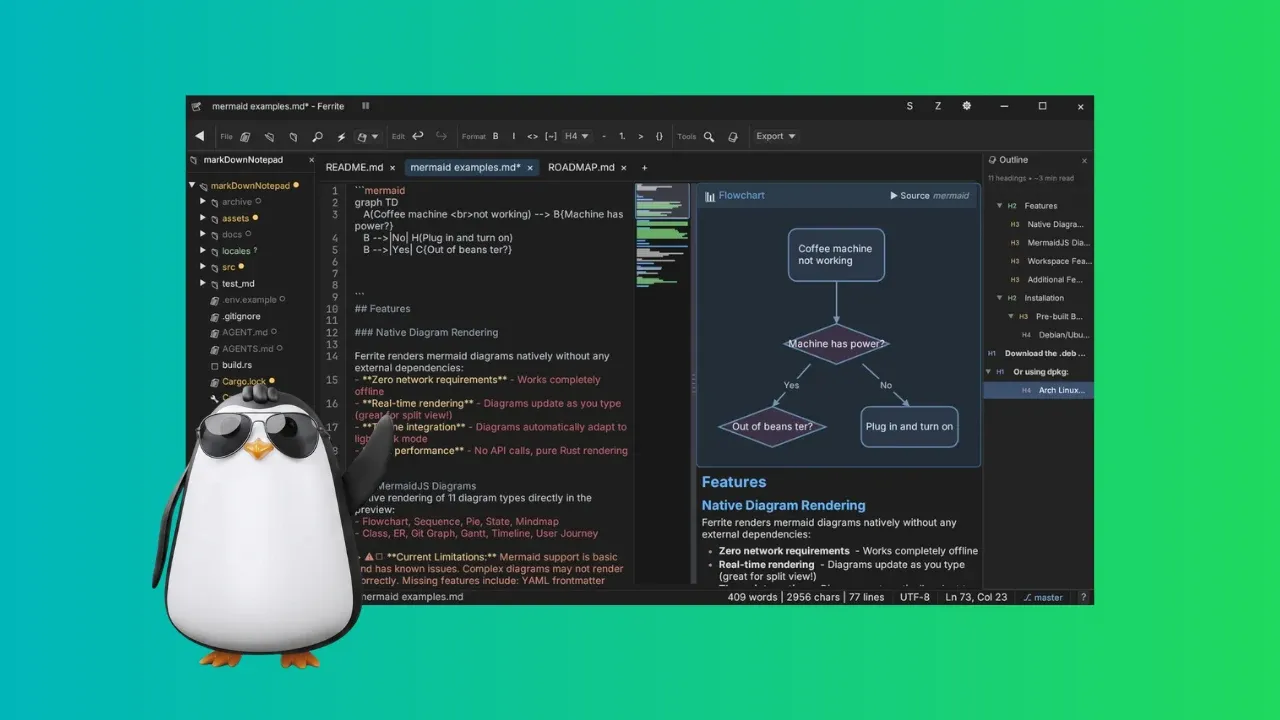
It gives an IDE feel with lots of features that fits the workflow of developers working on technical documentation of their projects.
A set of patches posted today to the Linux kernel mailing list implement per-core Energy Performance Preference (EPP) boosting for recently-busy CPUs. This feature is designed to have a dramatic impact for Linux gaming and helping especially with the 1% low frame-rates improving by 31.8% on the Valve Steam Deck...

Valve pushed out a brand new update for Proton Experimental on July 28th - making more Windows games run well on SteamOS / Linux systems.Read the full article on GamingOnLinux.
Since 2014 there has been a KDE bug report titled Ridiculously slow file copy (multiple small files). With the Dolphin file manager or other KIO-based KDE programs, copying many small files can be much slower than using the cp command directly or other copying programs like rsync, Finally that issue is in the process of being resolved for addressing very slow copy times when dealing with many small files on the KDE Plasma desktop...
In addition to the deprecation and stripping down of AF_ALG, another piece of the Linux kernel crypto code steaming ahead toward removal is the crypto_rng abstraction layer...

An app I haven't covered here before is Mission Center - giving you a tidy interface to monitor CPU, Memory, Disk, Network and GPU and more.Read the full article on GamingOnLinux.

If you're a fan of point and click adventures, Allogloom needs to be not just on your radar but right at the top of your wishlist too.Read the full article on GamingOnLinux.
ASUS laptops support a feature called "Whisper Mode" that intentionally slows down the fan speed and lowers the CPU clock speed in order to keep the device running cool and quiet. The open-source ASUS Armoury Linux kernel driver is now seeing patches to properly support this Whisper Mode on Linux...

007 First Light recently had Denuvo DRM removed, and it's now fully Steam Deck / Steam Machine Verified.Read the full article on GamingOnLinux.
A new analysis of 89 major geological events over the past 260 million years found evidence that mass extinctions, volcanic eruptions, ocean crises, and other upheavals may cluster around a roughly 27.5-million-year cycle. The cause remains unknown, with possibilities ranging from mantle activity and orbital changes to speculative galactic influences. Slashdot reader alternative_right shares a report from ScienceAlert: One possibility lies deep within Earth itself. The planet's mantle is constantly circulating through convection, albeit at an almost unimaginably slow pace. Periodic changes in mantle convection, or the initiation of mantle plumes, could influence volcanism, plate tectonics, mountain building, and other large-scale geological processes. Because these systems are closely interconnected, disturbances originating deep within Earth could eventually ripple through the planet's surface, oceans, climate, and biosphere.
Another hypothesis focuses on interactions between Earth's surface and interior. Long-term orbital variations influence climate and sea level, periodically redistributing enormous amounts of water, ice, and sediment across the planet. [New York University geologist Michael Rampino] discusses the possibility that these changing surface loads subtly modify stresses within Earth's crust and upper mantle, potentially influencing tectonic and volcanic activity over geological timescales.
Rampino also considers possible influences beyond Earth, an idea he has been weighing up since the 1980s. As the Solar System orbits the center of the Milky Way, it oscillates above and below the galaxy's mid-plane, with the timing of these passages aligning with that of Earth's major upheavals. These crossings, other researchers have suggested, could also gravitationally perturb comets in the distant Oort Cloud, increasing the likelihood of large asteroid impacts.
Another, even more speculative, hypothesis suggests that if dark matter is concentrated near the galactic plane, a fraction of it could occasionally be captured by Earth. Over millions of years, this process could generate small amounts of internal heat, potentially influencing geological activity. At present, however, there is no direct evidence supporting either mechanism, so they remain very controversial.
Large asteroid impacts are discussed separately in the paper. Although they were not included in the statistical analysis of the 89 geological events, the timing of several of Earth's largest known impact craters appears broadly consistent with the proposed 27.5-million-year rhythm, as Rampino has discussed in earlier papers. Rampino suggests this correspondence may warrant further investigation, but stops short of claiming a causal relationship.
Read more of this story at Slashdot.
The PineVoice is a compact RISC-V smart speaker designed to operate as a local voice-assistant satellite for Home Assistant and other platforms supporting the Wyoming protocol. The device combines a dual-microphone array, built-in speaker, local wake-word detection, Wi-Fi and Bluetooth connectivity, and open-source firmware. Previously known as the PineVox, the PineVoice is built around Bouffalo […]

They point to MCP, built by two engineers in London, that ended up under US-based governance.
Fwupd developer Richard Hughes released fwupd 2.1.7 today as a new stable update in the fwupd 2.1 series of this open-source project for updating and managing the firmware of various hardware on your Linux distribution.
An anonymous reader quotes a report from Ars Technica: One missing underscore in a Skyrim-themed username put an innocent Nova Scotia man in prison for 18 months. A 2018 child-luring investigation, which began in Madison, Wisconsin, and eventually extended to Halifax, Canada, was based on a false premise. Police were looking for a man using the Kik messaging service under the name "fus__ro_dah" (two underscores after "fus"), but they accidentally requested records for the username "fus_ro_dah" (one underscore after "fus"). This one-character difference led them not to the perpetrator but to a Canadian man named Brandon Klayme. (Ars readers may recognize "fus ro dah" as the Unrelenting Force "dragon shout" from The Elder Scrolls V: Skyrim.)
Despite finding no evidence of the crime on his digital devices, Canadian police arrested Klayme in 2020 on child sex abuse charges. He was convicted after a trial in 2023 and sentenced in 2024 to 18 months in prison. He served the full term. Even after release, Klayme continued to fight his conviction. In the process of preparing his appeal, the username mistake that led to all these years of disruption was finally discovered. On Thursday, the Nova Scotia Court of Appeal overturned Klayme's conviction, writing: "Mr. Klayme is factually innocent of the offences. He should never have been charged, let alone convicted." [...] As the court puts it, "Although the information about the usernames was available at the time of the trial, there is no evidence confirming or explaining how it went unnoticed."
Read more of this story at Slashdot.
Mozilla updated the Firefox Nightly builds today to the new design it teased earlier a couple of months ago, so we’re taking a closer look at Firefox’s brand-new look out of curiosity.
YouTube Premium will include Peacock Premium at no extra charge beginning in early 2027. "The deal brings a slew of premium content to the [$15.99 per month] YouTube Premium subscription, including live sports like the NFL, NBA and MLB and entertainment like Law & Order, Saturday Night Live and Love Island," reports The Hollywood Reporter. "It also has the potential to dramatically scale Peacock, which remains smaller than many of its streaming competitors." From the report: Peacock has 48 million subscribers, while YouTube Premium and YouTube Music have a combined 125 million subscribers, though they don't break out how many each of those offerings have. The agreement, which expands on the deal the company inked with YouTube parent company Google last year, will also extend the entertainment company's programming deal with YouTube TV, while bringing some of YouTube's offerings to Comcast Xfinity and Xumo platforms.
There's also a notable sports and production element to the deal, with NBC Sports agreeing to stream some live sporting events on its YouTube channels, and with NBC agreeing to serve as the production partner for select live events on YouTube. YouTube will also bundle some of the company's International streaming offerings like Universal+ and Hayu in select markets.
Read more of this story at Slashdot.
Amazon has asked the FCC to approve a 5,105-satellite constellation launching in 2028 that would provide global direct-to-cell "voice, messaging, data, and emergency services," similar to Starlink's partnership with T-Mobile. The network would use Globalstar spectrum, support future Apple satellite services, and complement Amazon's existing Leo broadband constellation. The Verge reports: Advanced Television points out that the FCC application also includes a request to use spectrum assigned to Iridium's satellite network outside the US, even as Rocket Lab is in the process of acquiring Iridium with plans to expand.
The new constellation and direct-to-device service will "complement" the broadband services Amazon also plans to offer through its Leo platform. In addition to consumer satellite service, it would also be used for things like disaster response and emergency messaging.
Amazon says the new direct-to-device satellites "will process the signals in orbit before relaying them to improve performance." The new constellation will be nearly double the size of Amazon's initial Leo constellation, which is planned to include around 3,200 satellites. As of July 2nd, Amazon says "over 375" of those satellites have launched so far.
Read more of this story at Slashdot.
Looking to be added to the Linux kernel source tree for the upcoming Linux 7.3 cycle is test_amd_pmf, a small testing application for exercising the AMD Platform Management Framework (PMF) interfaces and dumping various system data points...
wiredmikey shares a report from SecurityWeek: Nvidia and a large group of technology, cybersecurity, and enterprise software companies have launched new initiative aimed at developing and sharing open source tools, models, and techniques for securing AI systems and agents. The new Open Secure AI Alliance aims to give defenders more open tools for testing, auditing and protecting AI models and agents. Nvidia points to the recent security incident involving OpenAI and Hugging Face, noting that when closed AI tools could not differentiate between attackers and defenders and blocked forensic work, Hugging Face used the open-weight GLM 5.2 model on its own systems to review over 17,000 actions and contain the breach. "The right response is not to deny defenders access to capable open systems. It is to pair openness with strong safeguards, clear rules against malicious misuse, rigorous evaluation and rapid remediation. In cybersecurity, the safer path is the one that gives more defenders the ability to test, verify and strengthen the systems on which society relies," Nvidia said.
Thanks to longtime Slashdot reader SphericalCrusher for also sharing the news.
Read more of this story at Slashdot.
Collabora Online 26.04 is now available with an optional AI assistant, Markdown support, improved document review, and new Calc features.
Longtime Slashdot reader AmiMoJo shares a report from Hackaday: Community-led open source project hosting site Codeberg has formally announced that projects whose code is largely or fully machine-generated through LLMs and other 'AI' tools will no longer be welcome. This follows on the heels of a similar ban on cryptocurrency-related projects. The community vote was on two issues, the first being the notion that scraping of project code for the use in LLMs should be forbidden, which was a motion that easily passed. The second motion was on disallowing projects whose code was substantially generated by LLMs like Claude, OpenAI Codex, and similar. This motion passed with 358 in favor versus 144 against.
In the earlier linked blog post the reasoning behind especially this second issue is expanded upon, covering not only "license whitewashing," but also the direct and indirect hardware costs, with the expanding 'AI' datacenter hyperscaling having massively increased hardware costs for Codeberg over the past years, as the costs have been largely externalized. Also covered is the aspect of these LLM-based tools destroying the OSS community, which is something that is backed up by recent studies.
Read more of this story at Slashdot.
The new release also adds reproducible tarballs and new tools, while dropping Gold from the main tarball.
According to The Information (paywalled), a state-backed Shanghai company has begun mass-producing China's first homegrown immersion DUV lithography machines, with about five units expected this year for SMIC, Hua Hong, and CXMT. Roughly 20 more units are expected in 2027. Tom's Hardware reports: The Information didn't name the manufacturer, but its sources described the operation as having pulled DUV development teams from several Chinese companies, one of them the state-backed startup Shanghai Yuliangsheng Technology. SMIC has been testing a Yuliangsheng immersion tool since September 2025. Most components in the new systems are domestic, though some critical parts still come from Japan, and delays at local suppliers have held back output this year.
[...] China accounts for around 20% of ASML's net sales this year, down from 33% in 2025, driven mainly by mainstream logic demand... Independent analysis from the AI Futures Project in June put commercial-scale Chinese immersion DUV in the mid-2030s, with ASML holding 98.7% of the immersion market. Qualifying the new machines for production lines could take many months, and they trail ASML's tools on performance and build quality. China's domestic EUV effort, which Reuters first reported as a working prototype in December, remains years away.
Read more of this story at Slashdot.
An anonymous reader quotes a report from Ars Technica: OpenAI's ChatGPT is now refusing requests to generate text that directly mimics the style of famous authors. When asked to do so, the popular LLM instead offers a response that draws on the "broad qualities" of those authors "while remaining distinct in its own voice," for example. This morning, Ars received the following response to a test prompt asking for a story introduction in the style of Stephen King: "I can definitely write with the hallmarks of atmospheric, character-driven horror and small-town dread, but I can't write in Stephen King's exact style or closely imitate his distinctive voice. Here's an original opening that captures a similar feeling while remaining its own..."
In testing, ChatGPT generated similar dodges for other authors both living (J.K. Rowling, Amy Tan) and dead (Charles Dickens, Ernest Hemingway). An analysis published by No Latency earlier this month (PDF) found the same behavior for living authors but found ChatGPT complied with style-copying requests for deceased authors. In refusing to directly copy the "exact style" of various authors, ChatGPT offered instead to capture an overall "feeling" by incorporating some of the common features found in those authors' work. That may seem like a distinction without a real difference at first glance. But the slight alteration could be legally important as OpenAI continues to fight a number of lawsuits brought by book authors alleging large-scale copyright infringement by models trained on their work. One of those suits specifically cites ChatGPT's "uncanny ability to generate text similar to that found in copyrighted textual materials," for instance. An OpenAI spokesperson did not respond to a request for comment from Ars Technica.
In the US, copyright law generally protects only a specific expression of an idea, not the more intangible style of an author. But an AI-generated stylistic imitation could become infringing if it becomes "substantially similar" to the work of the original author. "We've never had a situation in which this personal style of individual creators could be imitated as well and as inexpensively as we now have with AI," George Washington University Law School Professor Robert Brauneis told Bloomberg Law.
Read more of this story at Slashdot.
MacRumors interviewed AI critic Ed Zitron, author of the Where's Your Ed At newsletter and host of the Better Offline podcast, about what could happen to Apple if the costly AI infrastructure boom collapses. Zitron argued that Apple is relatively well insulated because it has spent far less on data centers than rivals such as Microsoft, Google, and Amazon. He said the company could use the downturn to make selective acquisitions, though it might simply continue operating largely as before. "I think they will sit on the sidelines and watch everything burn," Zitron said. Here's an excerpt from the report: If the bubble deflates the way you expect (write-downs, too much compute supply, possibly OpenAI cratering), can you walk us through what that would actually look like for Apple? Does anything break for iPhone users, or does Apple mostly watch it happen from the sidelines? Could it even benefit Apple?
I think things would look much the same for Apple. I think they will sit on the sidelines and watch everything burn. I could see them doing some choice acquisitions as things begin to collapse, but I could also see them do nothing.
I think Apple is in a very weird place at the moment. The Vision Pro was a dud, but it was also the most interesting and future-forward thing I've seen anyone put out in a while. If they were smart, they'd tread water and sink as much money into making that as small as humanely possible -- no matter how long it takes -- because the entire AI bubble is a result of everybody running out of hypergrowth ideas, mostly because we're flat out of new interfaces.
I want to be clear that what they want to do with the Vision Pro requires it to basically be weightless and invisible and never need adjustments. When it works, it's genuinely awesome. But that's a load-bearing when. One slight movement means the whole thing goes out of focus. I can't even use mine anymore because it needs an update that requires you to wear the thing the whole time. So much promise, released too early, shoved out the door by a CEO on his way out.
Read more of this story at Slashdot.
The kernel's read-copy-update (RCU) subsystem ensures that data will not be
deleted until it is known that there are no threads holding references to
it. RCU works well and is widely used throughout the kernel, but it can
increase memory use and add significant delays before unused kernel objects
are cleaned up. Hazard pointers are
an alternative approach to lockless data updates that offers better
performance, for some situations at least. The kernel community is
currently considering a
hazard-pointer implementation by Mathieu Desnoyers and Paul McKenney.
Last October on Phoronix we were first to point out there being some mysterious intrigue around a new x86 implementation from a "corporate entity other than Intel/AMD" with the developer involved not elaborating on the matter. Now that same developer has posted another semi-cryptic message to the Linux kernel mailing list to talk about 16-tile and 32-tile Advanced Matrix Extensions (AMX) implementations. To date Intel only has 8-tile AMX...
Fwupd 2.1.7 is out today as the newest update to this open-source firmware updating utility that pairs with the Linux Vendor Firmware Service (LVFS) for offering a nice firmware upgrade story on Linux systems...
China too seems to be "on the move
European misinformation researchers say TikTok, X, and Meta are obstructing access to platform data required under the EU's Digital Services Act through rejections, restrictive quotas, costly APIs, and burdensome security demands. Although regulators have fined X and pushed platforms to improve access, researchers remain skeptical that the changes will provide reliable, reproducible data at scale. Ars Technica reports: In recent years, social media companies shut down public access tools like Meta's CrowdTangle and replaced them with content libraries, or, like X, paywalled their API data, forcing academics to pay "hundreds of dollars a month," said Duncan Allen, a research officer at Democracy Reporting International (DRI) in Germany. Researchers say that without API access, what Iamnitchi describes as the "black holes" in what society knows about how these platforms recommend content or handle reports regarding sensitive content will only grow. Others, like TikTok, cap how many posts any researcher account can pull each day, which Allen said can make it "impossible to study anything at scale."
The DSA was meant to solve this by allowing vetted researchers at credible institutions to have access to API data if they could show it would help in studying systemic risks, from illegal content to threats to fundamental rights. But two years after the law took effect, researchers say they struggle to meet its security requirements and face narrow interpretations from platforms of what qualifies as a systemic risk. Application forms differ by platform, but most require data to be stored on infrastructure that cannot be compromised -- such as a machine physically disconnected from the Internet -- a resource most universities lack, [said Adriana Iamnitchi, chair of computational social sciences at Maastricht University in the Netherlands, who leads research into online disinformation campaigns.]
Even for researchers who secure approval, "there's no guarantee that the data is good," said L. K. Seiling, coordinator of the DSA40 Collaboratory, a German initiative that tracks 46 DSA applications. API data is often difficult for a colleague to reproduce, so a researcher's work cannot be checked for errors, which Iamnitchi said is a "basic requirement of science." DSA40 data shows that of 46 tracked applications, 20 were approved and 14 rejected. But approval rates vary widely: TikTok approved 11 of 13 applications, while X rejected 11 of 23. The true rejection rate is likely higher because the tracker relies on voluntary reporting, Seiling said. "There's no structured advantage for researchers to use this pathway," Seiling said. "Data access as it's set up right now tries to disincentivize researchers."
Read more of this story at Slashdot.
Version
2.47 of GNU
Binutils has been released. In addition to the usual bug fixes
there are some notable new features in this release including added
support for a number of RISC-V standard extensions, a command-line
option (-M annotate) which displays the symbol for
undefined instructions for AArch64, and more. The 32-bit s390 target
has been deprecated with this release.
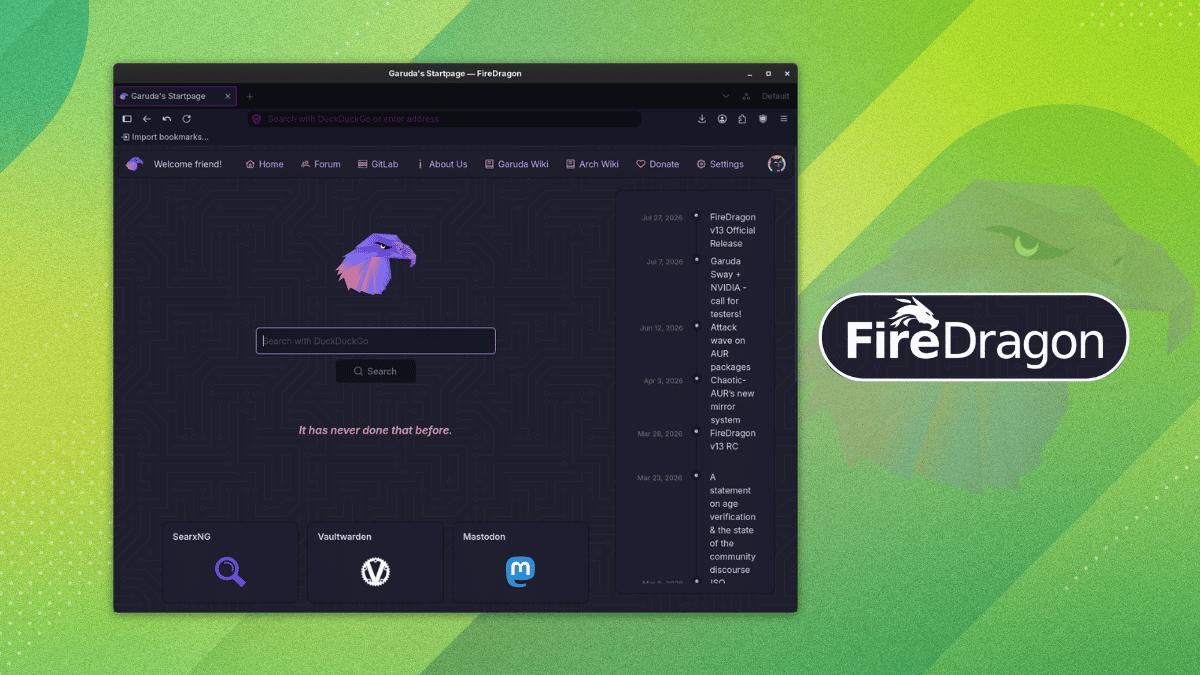
It's been rewritten from scratch to provide some good gains.
Back in April, Framework Computer announced the Framework Laptop 13 Pro as a ground-up re-design of their modular/upgradeable laptop. This new Framework Laptop 13 Pro features a much larger battery (74Wh), LPCAMM2 memory support, a full CNC aluminum chassis, haptic touchpad, and a new power-optimized touch display. Paired with the very efficient Intel Core Ultra Series 3 "Panther Lake" SoCs, the Framework Laptop 13 Pro ends up being an incredible offering from the hardware perspective.
An anonymous reader quotes a report from Reuters: Nvidia is in talks to provide roughly $250 billion in financing guarantees for OpenAI as part of a massive data center project, the Wall Street Journal reported on Sunday. The backstop from Nvidia would help the ChatGPT maker lease a 10-gigawatt project that SoftBank's energy subsidiary is developing in southern Ohio, the newspaper said, citing people familiar with the matter. For OpenAI, a deal would be the first step toward controlling its own infrastructure instead of renting it from Microsoft, Amazon, and Oracle, while for Nvidia, it would guarantee demand for its chips for years to come.
The project is expected to cost more than $500 billion in total, including the chips inside the data center, according to the WSJ. The $250 billion guarantee covers the data center lease and debt financing, but would not cover the Nvidia chips inside the center, the WSJ said, adding that the chipmaker was also discussing financing OpenAI's chip purchases worth up to $350 billion. Nvidia's backing would support financing vehicles aimed at reassuring lenders about the project's funding, the report added. The first phase of the project is expected to be finished in 2028, with around 800 megawatts of power, the Journal said. The report notes that the U.S. government will control access to the power, while Japan will fund it separately under a trade agreement tied to Tokyo's $33 billion investment in a natural gas plant. Commerce Secretary Howard Lutnick will reportedly help determine who receives access.
Read more of this story at Slashdot.

Some big names are coming together to form the "Open Secure AI Alliance", with a plan to "share open tools that promote responsible use of and trust in AI".Read the full article on GamingOnLinux.

S.T.A.L.K.E.R. 2: Cost of Hope is the first major expansion for the open-world shooter, with a release date now set for August 20th.Read the full article on GamingOnLinux.
Security updates have been issued by Debian (chromium, hplip, and linux-6.1), Fedora (firefox, GitPython, google-osconfig-agent, lego, libgit2, libreswan, libwebsockets, moby-engine, p11-kit, pam, python-idna, rust-libgit2-sys, skopeo, systemd, trafficserver, webkitgtk, and xrdp), Mageia (giflib, graphite2, libnfs, vorbis-tools, wget, and yelp), Red Hat (firefox, thunderbird, and webkit2gtk3), and SUSE (amazon-ecs-init, chromedriver, ffmpeg-7, ffmpeg-8, firefox, google-osconfig-agent, gpg2, java-17-openjdk, java-25-openjdk, kernel, libsrt1_5, nginx, perl-HTTP-Date, perl-XML-Bare, proftpd, python-pyasn1, python-soupsieve, python313-astropy, python313-urwid, systemd, thunderbird, and trivy).
Catch up on the latest Linux news: COSMIC 1.4, VirtualBox 7.2.14, Firefox 153, Wine 11.14, Hyprland 0.56, OBS Studio 32.2, Debian developers debate ban on AI-assisted contributions, and more.
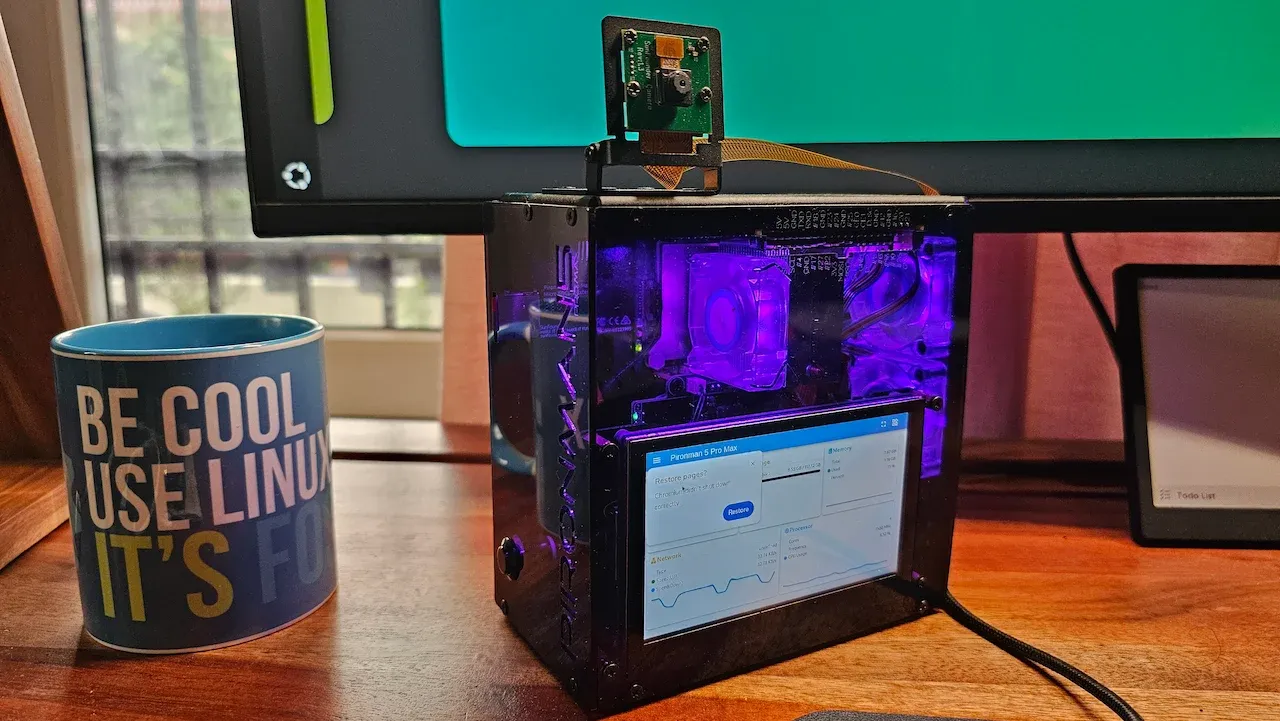
SunFounder's flagship Pironman case now ships with a 4.3" touchscreen, a camera mount, and room for an AI accelerator, built for Raspberry Pi 5 owners who want to experiment with local AI, not just add cooling and storage.

Skate 3 Recomp 2.0 brings the classic Xbox 360 version of Skate 3 to modern platforms, and now with a modern renderer using Vulkan (or Direct3D on Windows).Read the full article on GamingOnLinux.

I've grown to love a few idle incremental games recently and started discovering more - like Swarmslam, which has a fun idea about smashing through planets.Read the full article on GamingOnLinux.
An anonymous reader shared this report from Phoronix:
A patch series that appears destined for the upcoming Linux 7.3 merge window is what's dubbed the "KVM Chainsaw" as a major code clean-up in dealing with the kvm_mmu "god data structure". Red Hat engineer and KVM maintainer Paolo Bonzini has merged the kvm-chainsaw branch to KVM's "next" Git branch. With this KVM Chainsaw work now in the next branch, it should be submitted for the upcoming Linux 7.3 cycle.
The KVM Chainsaw work deals with the kvm_mmu structure being overloaded with multiple uses and splits it down into three parts for better handling current KVM usage. Paolo explains of KVM Chainsaw with the merge to the KVM.git next branch:
"The kvm_mmu is a "god data structure" that includes three different tasks: describing the guest page table's format, walking the guest page tables and building the page tables. This means that the (already poorly named) nested_mmu is only used in part, since it has no page tables to construct. Furthermore, some parts are reused across guest and host page tables (such as the reserved bits detector) but others are not; for example permission_fault is replaced by simplified code such as is_executable_pte().
This series cleans this up by splitting kvm_mmu in three parts...
Read more of this story at Slashdot.
Ubuntu has long provided hardware enablement "HWE" stacks for Ubuntu LTS releases to provide a newer kernel and Mesa drivers and more for better supporting new/modern hardware on the long-term support Ubuntu Linux releases. With Ubuntu 26.04 LTS, Canonical will also now be providing a virtualization HWE stack for shipping newer virtualization / confidential computing features...
Since 2017 in Linux 4.12 has been the Realtek rtl8723bs WiFi driver where it was introduced into the staging area and remains there nearly a decade later. The rtl8723bs driver for this Realtek 802.11n WiFi SDIO driver has seen a lot of code cleaning over the years and all these years later still is needing lots of code clean-ups from unnecessary code abstractions to dealing with malicious WiFi APs for what Greg Kroah-Hartman has called a "beast of a driver". The latest twist is there now being patches for adding Realtek RTL8723BS and RTL8723B onto the existing RTW88 driver...

With Minecraft: Java Edition getting a big rendering upgrade with Vulkan, it was time for the system requirements to get adjusted.Read the full article on GamingOnLinux.

For those of you who want to do some emulation on the Steam Machine, EmuDeck is likely a good option and it should work better now.Read the full article on GamingOnLinux.
Valve don't seem to be able to catch a break with their hardware releases - as Qualcomm reportedly plan to raise prices a lot.Read the full article on GamingOnLinux.
Last month I wrote bout new AMD Linux patches introducing a new "low power" CPU core type as an alternative to their standard performance cores and dense efficiency cores. That work now is poised to land with the upcoming Linux 7.3 kernel...

From publisher New Blood Interactive, the wonderful retro crime noir FPS 'Fallen Aces' has episode 2 out now.Read the full article on GamingOnLinux.
The Wayfire modular and extensible Wayland compositor formerly used by default on Raspberry Pi SBCs is nearing its v1.0 release. Wayfire 0.11 was released on Sunday for this Compiz-inspired, wlroots-powered compositor with that being their hopeful last planned version before Wayfire 1.0 releases...
The FreeBSD project published today their Q2-2026 status report that highlights all of their interesting open-source development initiatives for the past quarter. A lot is happening including FreeBSD seeing an AMD ROCm port and also their own NTSYNC driver being created...
The latest LibreOffice maintenance update pushes Skia back to experimental mode on Mac and Windows.
NVIDIA and more than two dozen other companies have started the Open Secure AI Alliance for helping to keep open-source AI models secure. The other founding members range from Microsoft to Adobe, IBM, Red Hat, SpaceX, OpenClaw, Palantir, and others...
Besides the FreeBSD graphics and WiFi drivers lagging behind Linux and other operating systems, the FreeBSD audio driver support and handling of audio streams with FreeBSD on the desktop can be problematic depending upon the hardware/system. One of the most active mailing list threads this week in the FreeBSD camp was over the "tragic state" of FreeBSD audio/sound support...
"The rise of TikTok, Instagram Reels and Amazon storefronts has created a new kind of white-collar exit strategy," reports Bloomberg. Workers ditch office jobs not to become celebrities, necessarily, "but to piece together an income online through brand deals, affiliate links and highly personal videos documenting everyday life."
In many cases, the followers necessary to sustain a living are smaller (and more attainable) than people might assume. A small but loyal audience can now generate enough income to rival a midlevel salary. Welcome to the middle-class creator economy. Last year, 25-year-old Abi Platock balanced a corporate marketing job in New York while posting online in her spare time. She built her audience by posting one or two videos a day, offering career advice, beauty tips and daily vlogs. "I signed my first brand deal in the four-figure range, and for me that was just such a big eye-opening moment," Platock says of her partnership with deodorant brand Secret. She had 8,000 followers on TikTok at the time. "You can totally make it work without having hundreds of thousands of followers." Platock, who now has roughly 25,000 followers across platforms, has signed about $25,000 in brand deals so far this year and expects her annual creator income to reach around $50,000 by yearend.
Her experience reflects a broader shift in advertising. Brands are increasingly moving money toward so-called microinfluencers — smaller online personalities who have less than 100,000 followers. "They are hiring a bunch of microcreators at scale instead of hiring a handful of macrocreators for what could potentially be the same cost," says Ali Grant, co-chief executive officer of the Digital Department, a creator management company. And they perform where it matters most: engagement. An engagement rate of 3% is considered strong, and some microinfluencers exceed 10%, Grant says of the closely watched metric that tracks how often followers interact with content through likes, comments, shares and saves. Microinfluencers average a 3.2% engagement rate, almost triple the 1.1% rate for macroinfluencers (more than 1 million followers), according to growth marketing agency ATTN... A TikTok partnership with a creator who has around 50,000 followers can run a brand more than $3,500 for a single post, Grant says; with 10 times the followers, that fee might just triple, to around $10,000....
The influencer marketing economy ballooned to a projected $33 billion in 2025 up from $1.7 billion in 2015. The segment gained momentum after the COVID-19 pandemic, as dissatisfaction with traditional work pushed many to reconsider conventional career paths, says Brooke Duffy, a professor of communications at Cornell University. "They realized the trade-offs in terms of the investments of time, energy and human capital were not necessarily worth sacrificing so much of one's personal self for," she says. Success online can bring greater freedom — and even higher pay than many traditional office jobs, which have a median US salary of $69,000, according to Glassdoor. But the middle-class hustle still requires constant effort to maintain. The career has no promise of lifetime longevity. And unlike traditional workers, creators have no predictable paycheck or job protections, making career stability elusive. Roughly 57% of 3,000 surveyed full-time creators earn below a living wage from content creation, according to a report last year from Influencer Marketing Hub. Income from social media can fluctuate wildly from month to month, driven by shifts in algorithms, sponsorship cycles and platform trends.
"You could have a month where you make zero dollars, or you could have a month where you make $10,000," Platock says.
The article cites Gallup Poll data released last year that found employee engagement in the U.S. had fallen to its lowest level in a decade [with engagement defined as "the psychological attachment workers have to their work/team/employer]. "Among the hardest-hit groups were Generation Z and workers in finance and technology. Broader workplace challenges, including rapid organizational change, hybrid and remote work transitions, and rising employee expectations are considered drivers of the overall trend."
"For many workers, influencing can seem like a better deal; flexible schedules and independence wrapped in a veneer of creativity and fun. Almost 60% of Gen Zers say they'd become an influencer if given the opportunity, according to a 2023 survey from Morning Consult."
Read more of this story at Slashdot.
The MUSE Pi Pro is an 85 × 56mm single-board computer built around SpacemiT’s M1 processor, combining eight 64-bit RISC-V cores with 2.0 TOPS of AI processing capability. The board provides up to 16GB of LPDDR4X memory, onboard eMMC storage, NVMe expansion, Gigabit Ethernet, Wi-Fi 6, and multiple camera and display interfaces. The SpacemiT M1 […]
In working toward releasing the stable Linux 7.2 kernel in less than one month's time, out today is Linux 7.2-rc5 to ship this week's latest bug/regression fixes and help facilitate more testing of this in-development kernel version...