
With Sony's decision to stop selling games on disc for PlayStation consoles, they were of course going to get roasted by many - including GOG.com.Read the full article on GamingOnLinux.
Visor is a new open-source UEFI boot manager for Linux, designed to launch kernels, UKIs, Windows, and other EFI applications.

Astronauts on SpaceX's Fram2 mission successfully captured diagnostic X-ray images in orbit for the first time. The milestone gives space medicine a second imaging option beyond ultrasound and could help future crews diagnose injuries, inspect equipment, and support longer missions to the moon or beyond. Popular Science reports: Commercial off-the-shelf X-ray machines like the ice cooler-sized MinXray TR90BH now allow users to perform scans on subjects far away from traditional facilities. In 2022, [Mayo Clinic researcher Sheyna Gifford] assisted in preparing a crew to successfully generate digital X-rays while experiencing microgravity during a parabolic flight. Gifford's team then spent years collaborating with SpaceX to plan another feasibility study. This time, they didn't want to operate an X-ray machine aboard an aircraft simulating the conditions in space -- they intended to use the equipment during an orbital mission.
The process was detailed in a recently published study in the journal Radiology, and focuses on last year's Fram2 mission. Instead of days of medical training, astronauts spent only four hours learning how to use their portable radiography device. They then took preflight X-rays of a hand, forearm, chest, abdomen, and pelvis ahead of their SpaceX Falcon 9 rocket launch on March 31, 2025. Once in orbit, the team calibrated the system before testing their MinXray on the same body parts as well as a smartwatch.
Once the crew returned, a trio of independent radiologists reviewed the orbital X-ray images based on their positioning, spatial and contrast resolutions, and general scan quality. Although positioning scores were slightly decreased for the central body images, every other scan held up to similar examples created on Earth. Meanwhile, the astronauts reported that using the machine was easy despite minimal prior coaching. Looking ahead, researchers hope to conduct further X-ray tests during orbital missions, while continuing to reduce the overall size of equipment.
Read more of this story at Slashdot.
Overnight Linux creator Linus Torvalds wrote another well crafted message that reaffirms the Linux kernel position of not being against AI and lashing back against some kernel developers that are against AI/LLM usage within the kernel project...
Ubuntu 26.10 is notably working on laying the foundation for a context-aware desktop and their initial deliverable being worked on is Myna as a speech-to-text solution for the Linux desktop. Interestingly there is already a promising voice dictation / speech-to-text solution for the Linux desktop called Vocalinux that continues advancing and is usable right now for those looking at their own speech-to-text desktop solution...

The adventurous developer who recently ported Linux to the Atari Jaguar (1993) has brewed up a version of the open source OS for the Sega 32X (1994).

The flaw lets any repository auto-execute code on Cursor for Windows, and researchers say the company ignored it.
The FreeBSD Foundation's Laptop Support and Usability Project, which has received more than $750k USD in funding to improve the experience of FreeBSD on laptops, is out with its newest monthly progress report. A lot continues to happen for improving the FreeBSD laptop story, which in many aspects also benefits FreeBSD on the desktop too...
KosmicKrisp as the Vulkan API driver built atop Apple's Metal API in Mesa for macOS and iOS systems is now advertising Vulkan 1.4 compatibility...

Dear Passengers could be the next huge "friendslop" hit, one where you and friends become the crew of the world's worst airline.Read the full article on GamingOnLinux.

Time to cosy up with a friend with some fab co-op games available in the Squad Goals Humble Bundle.Read the full article on GamingOnLinux.
COSMIC Desktop 1.3 introduces its long-awaited frosted glass appearance, improved GPU monitoring, AVIF wallpapers, and numerous fixes.

Valve discontinued the last Steam Deck LCD model late in 2025, and it appears spare parts are going to become rare for it.Read the full article on GamingOnLinux.

Valve continue to roll out changes to improve the user experience on the new Steam Machine, which now has a "Great on Machine" section in the Steam Library.Read the full article on GamingOnLinux.
The House voted 308-117 to pass the Sunshine Protection Act, which would make daylight saving time permanent nationwide and end the twice-yearly clock change. The bill faces an uncertain future in the Senate, "where one G.O.P. leader said it was unclear whether it could move ahead and at least one Republican appears inclined to try to block it," reports The New York Times. Some sleep experts oppose permanent daylight saving time, arguing that year-round standard time better aligns with circadian rhythms and winter morning safety. The New York Times reports: President Trump has championed the effort to save an extra hour of daylight before nightfall and make the time zone permanent, describing the ritual of moving clocks forward in the spring and back in the fall a "ridiculous, twice yearly production." "We are going with the far more popular alternative, Saving Daylight, which gives you a longer, brighter Day," Mr. Trump wrote in a social media post in May. "And who can be against that."
A sizable bloc of Florida Republicans in Congress is leading the charge on legislation that would do just that, mandating daylight saving time nationwide for the entire year. Representative Vern Buchanan of the Tampa Bay area is backing the bill, and Representative Anna Paulina Luna, another Tampa Bay-area Republican, cosponsored it. House leaders agreed to allow a vote on the measure this week as a sweetener for Ms. Luna in their efforts to persuade her to lift a legislative blockade she had maintained as she sought to force Senate action on a voting restriction bill Mr. Trump has championed.
Read more of this story at Slashdot.
Clonezilla Live maintainer Steven Shiau released today Clonezilla Live 3.3.3 as the latest stable version of this partition and disk imaging/cloning live Linux system based on Debian GNU/Linux.
Blender 5.2 LTS introduces experimental cloth and hair physics in Geometry Nodes, remotely hosted asset libraries, and major rendering improvements.
An anonymous reader quotes a report from TechCrunch: The Iranian government abused well-known vulnerabilities in the global telecoms infrastructure to locate U.S. military personnel in the build-up to the Iran War, as well as in the early days of the conflict, according to Financial Times. The Iranian government exploited Signaling System 7, or SS7, a set of protocols for 2G and 3G networks that has long been the backbone of how cellular networks connect to each other to route subscribers' calls and texts around the world, the newspaper reported, citing research by the Mobile Surveillance Monitor, as well as anonymous government officials with knowledge of the spy campaign.
Intelligence agencies have long abused SS7 to track cellphones abroad, which is what happened in this campaign. Using this technique, Iran was reportedly able to locate U.S. military forces stationed in military bases as well as hotels in Iraq, Bahrain, and other countries in the Middle East, which allowed the regime to strike them. These attacks resulted in several injuries. Apart from SS7, Iran also abused advertising technology used to serve tailored ads to cellphone users, another well-known surveillance technique that relies on everyday technology.
Read more of this story at Slashdot.
Back in May OpenCL 3.1 was announced with a focus on AI and HPC workloads. Just over two months later, this incremental update over OpenCL 3.0 now has its first listed conformant OpenCL 3.1 implementation for passing the OpenCL 3.1 conformance test suite cases. It's Apple Silicon M1/M2 graphics running on Asahi Linux with the Mesa Rusticl driver...
System76’s refreshed Adder Pro trims weight, adds Panther Lake silicon and RTX 50?series GPUs, and ships with Pop!_OS or Ubuntu for Linux?first power users.
Linux hardware vendor System76 released COSMIC 1.3 today as the latest stable version of this Rust-based desktop environment for Pop!_OS Linux and other GNU/Linux distributions.
OpenAI is reportedly developing a screen-free, portable smart speaker meant to act as a personalized home computer and humanlike AI companion. "It will help control smart-home appliances, play media, answer questions, respond to messages and tap into the range of capabilities offered by OpenAI's ChatGPT," reports Bloomberg, citing people familiar with the matter. The device, expected to be unveiled this year and released in 2027, would mark OpenAI's first major hardware push after acquiring Jony Ive's io Products. Bloomberg reports: Apple sued OpenAI last week, accusing the company of stealing trade secrets. But OpenAI believes that the device veers significantly from anything Apple has on the market today and that it's unlikely that it violates trade secrets belonging to the iPhone maker, the people said. OpenAI's success in hardware will hinge on bringing a novel approach to the market -- something it aims to do with the smart speaker. For instance, the device's technology is meant to become increasingly personalized and proactive as it gains a deeper understanding of its owner over time, according to the people.
OpenAI envisions the device anticipating needs, surfacing information proactively and serving as an expert on its user, they said. Though the speaker is designed to stay in the home, it will be easy to move around the house. OpenAI believes the product's defining feature will be its personality and ability to connect on a humanlike level with users. The speaker incorporates mechanical elements that can move on their own, creating a sense that it is alive and not just an object responding to commands. The machine also will draw on personal information such as emails to better understand its owner. The goal is for the device to feel like a companion and become a physical manifestation of OpenAI's ChatGPT. Still, the exact plans could change as the company works through the development and legal process.
The device's communication abilities will rely on a more advanced version of the ChatGPT Voice Mode -- GPT-Live -- that OpenAI rolled out this month. The new voice mode is designed to act more like a human. It can listen and talk at the same time, adapt more naturally during conversations, and quickly process information. Though the new product resembles a speaker, OpenAI internally describes it as the first of its kind: a computer built for AI to help make busy people more productive. It includes a camera and other sensors that help it understand a user's surroundings and context, as well as advanced AI models beyond those available on conventional smart speakers. Another central difference is that the device includes a rechargeable battery, allowing it to be carried from room to room throughout the day. A user could bring it into the laundry room while doing chores, move it into the kitchen for cooking assistance, and later place it in a living room or bedroom to have it play music. It can also remain plugged into a single room if the customer chooses.
Read more of this story at Slashdot.
For those that were intrigued by the COSMIC desktop's "Frosted Glass" effect, it's now available in released form with today's COSMIC Epoch 1.3 release...
Google Images is getting a Pinterest-like redesign that turns image search into a personalized discovery feed, with "For You" galleries, real-time updates, and collections for saving visual ideas. "Google is also adding a way for users to create AI images right in Search, as it celebrates 25 years since the debut of Google Images," reports TechCrunch. From the report: After navigating to the redesigned Google Images, users will see a "For You" gallery of images tailored to their interests and browsing history. Like Pinterest, the gallery is designed for continuous browsing, with Google saying it updates in real time with new images. As users browse, they can save ideas to their "collections," which will appear as tabs above the main gallery of photos. For example, users can create collections for things like vacation outfit ideas, travel inspiration, and ways to design a reading nook, which they can come back to later.
[...] As for generating images directly in Search, Google says the feature is meant for moments when you have a highly specific idea for an image that doesn't already exist online. Google is bringing image generation directly into AI Overviews on Search and will use its latest Nano Banana model to transform a text prompt into a custom visual. The feature can also help users reimagine spaces and visualize ideas, such as seeing what a room might look like painted red or what a dorm room with a coastal theme could look like.
Read more of this story at Slashdot.
A lawsuit from 26 Meta employees alleges the company used AI-driven scoring and monitoring systems to select workers for layoffs, disproportionately targeting employees with disabilities or those who had taken protected medical, family, pregnancy, or parental leave. "Meta did not assemble the termination list through the considered judgment of managers who knew the work. Instead, Meta used a constellation of internal artificial-intelligence systems -- including a system referred to internally as 'Metamate,' employee-trained 'second-brain' agents, keystroke- and activity-monitoring data, AI-token-usage dashboards, and algorithmically assisted performance ranking and calibration -- to score, rank, and select employees for inclusion on the list," the lawsuit (PDF) said. Ars Technica reports: Employees were allegedly graded, among other things, on how much they used Meta's AI tools. "Meta's internal dashboards classified employees by their stage of adoption of its artificial-intelligence tools, using categories such as 'AI Native,' 'AI First,' and 'AI Enabled,'" the lawsuit said. The lawsuit is apparently "the first against a major U.S. company to challenge the alleged use of AI in conducting layoffs," according to Reuters. The complaint alleges that Meta's tools for monitoring employees did not account for differences caused by disabilities and protected leaves. "Those tools draw on inputs -- performance ratings, calibration scores, productivity and output metrics, 'AI-native' ratings, and AI-token consumption -- that, by design, cannot be accumulated by an employee who is on protected medical or family leave, or whose output is reduced by a disability," the lawsuit said.
The lawsuit alleged that Meta management did not take steps to adjust scores for employees who took leave or who requested reasonable accommodations for disabilities. "Meta did not neutralize those inputs for protected leave; did not exclude protected-leave-takers or accommodation-seekers from the selection cohort; and did not pause the system for the individualized, leave- and accommodation-neutral review that the law requires," the complaint alleged. "The result was that employees who took protected leaves were disproportionately selected for layoff, based on scoring that not only failed to account for their protected leaves, but in effect penalized the employees for exercising their legal rights to these leaves." The 26 plaintiffs requested leaves or disability accommodations in the 24 months before being selected for layoffs, the lawsuit said. The layoffs are not yet finalized, but employees are scheduled to start losing their jobs on July 22, the lawsuit said. "These claims lack merit and are not based on facts," said Meta in a statement. "Workforce management and organizational decisions were and are made by people, not AI."
Read more of this story at Slashdot.
Google DeepMind chief Demis Hassabis is calling for a U.S.-led AI standards body to review frontier models for national security risks such as cybersecurity and biological threats. His proposal would create a federally overseen public-private organization, initially voluntary and eventually mandatory for U.S. deployment. CNBC reports: Google DeepMind boss Demis Hassabis, a Nobel laureate, said in an article posted on X on Tuesday that "urgent action" was needed to address risks associated with artificial general intelligence (AGI) -- the point at which AI matches or surpasses human intelligence. "We've already seen the challenges frontier models pose for cybersecurity, and other threats including nuclear and bio risks may soon emerge as capabilities continue to advance," he said.
[...] Hassabis said the U.S. was well positioned to lead in developing an AI framework "given its economic and technical standing." "It could establish a new Standards Body modelled on a federally overseen public-private partnership or self-regulatory organisation, much like the Financial Industry Regulatory Authority (FINRA), with a board that includes independent leading technical experts and open-source representatives," he added. FINRA regulates brokerage firms and exchange markets in the U.S.
The proposed body would need "substantial" funding "in order to attract world-class technical talent and provide the necessary compute resources for large-scale testing," Hassabis said. Funding would "likely" come from industry, he added. Frontier labs would initially voluntarily share models with the body for review up to 30 days before release, before becoming mandatory for deployment in the U.S. market after being shown to be "effective." "Specific agentic AI tests could look for attempts to bypass safety guardrails or signs of deception, and ensure best practices, such as digitally watermarking AI-generated images and generating human-readable output tokens to understand model reasoning," Hassabis said. Further reading: Over 200 Economists Say 'We Must Act Now' On AI's Economic Impact
Read more of this story at Slashdot.
As of this past week in the FreeBSD source tree for FreeBSD 16, the last of the GNU GPL licensed code from the base system has been retired...
For those that were intrigued by the recent launch of the AMD Ryzen AI Halo developer platform with a very capable mini PC but looking for something more affordable and not needing quite as much horsepower or AI focus, BOSGAME recently launched their VTA-439 mini PC. The BOSGAME VTA-439 is powered by the AMD Ryzen AI 9 HX 470 with Radeon 890M graphics for those wanting still quite a capable mini PC that retails for around $1,049 USD while sporting 32GB of RAM and 1TB NVMe SSD storage.
OnePlus will reportedly announce this week that it is shutting down its brand in the U.S. and Europe, following months of signs that parent company Oppo was winding down the brand's global presence. India and China are reportedly unaffected, but it's unclear whether Oppo will replace the brand directly in those markets. The move also raises questions about future support for existing OnePlus users. 9to5Google reports: WinFuture reports that OnePlus is gearing up for an official withdrawal from the U.S. and European markets, with the announcement due in the "coming days" this week. Closed-door press conferences have apparently happened, with no details shared on the exact reason OnePlus as a brand is shutting down in these markets. India and China are, as far as this report claims, not affected. The report, citing "well-informed sources," notes that this OnePlus announcement will come amid "fundamental changes" to Oppo's strategy, but the big point here is the global death of OnePlus.
Read more of this story at Slashdot.
IBM shares plunged after the company warned that Q2 revenue and earnings would miss expectations, blaming customers' sudden shift in spending toward AI hardware instead of software services. However, CEO Arvind Krishna did not place all the blame on IBM's customers. The CEO also said it "faltered" by failing to "anticipate the magnitude of the capex reprioritization."
"These conditions require our teams to execute perfectly, and this quarter we faltered. We did not adapt and move quickly enough, and numerous large deals failed to close on the timelines we expected, driving the majority of our shortfall." Fast Company reports: In the preliminary report, IBM said that for its second quarter of fiscal 2026, it expects revenue of $17.2 billion, which is up 1%. It also said it expects a Non-GAAP Diluted Earnings Per Share (EPS) of $2.93, up 5%. However, as noted by CNBC, these preliminary results are below what analysts were expecting, which was $17.86 billion in revenue, and an EPS of $3.01, according to FactSet data.
Read more of this story at Slashdot.
Rob Kennedy has posted the
story of the birth of Linux.org — one
of the earliest Linux-related web sites — and its more recent rebirth.
The site was founded in May 1994 by Michael McLagan, at a time when
Linux itself was barely three years old. Linus Torvalds had only
just released it to the world, there was no real way for a newcomer
to find their footing, no search engines, no Wikipedia, none of the
infrastructure people take for granted now for figuring out a new
piece of technology. Michael built linux.org to fill that gap, a
place for people to learn about Linux and follow the movement as it
grew.
Blender 5.2 is out today as the newest Long Term Support release for this leading, open-source 3D modeling software...
New York has become the first U.S. state to impose a moratorium on large new data centers, pausing construction for one year over concerns that AI-driven data center growth is raising utility bills, straining water supplies, and burdening communities. "As data center development threatens to hike up utility bills, deplete our natural resources, and create uncertainty for New Yorkers, it's my responsibility to take action and lead," said New York Governor Kathy Hochul. She will also pursue legislation to repeal sales tax exemptions for large data centers, Hochul added. Reuters reports: The construction ban will apply to data centers that use 50 megawatts or more of power, officials in the governor's office said. During the moratorium, the state's Department of Environmental Conservation will not issue any discretionary permits not already deemed complete, the governor's office said. Instead, Hochul directed state officials to develop a Generic Environmental Impact Statement to ensure that new data centers coming online are held to "consistent standards," as well as examine the potential environmental impacts of the construction and operation of data centers in the state. The ban will be lifted once the state finalizes those standards, according to Hochul's office.
Read more of this story at Slashdot.
System76 today announced their new Adder Pro laptop that they are promoting as the "gamer's dream machine" with its NVIDIA graphics, 2K OLED 500 nit display, up to 96GB RAM, and 3.37 lb weight...
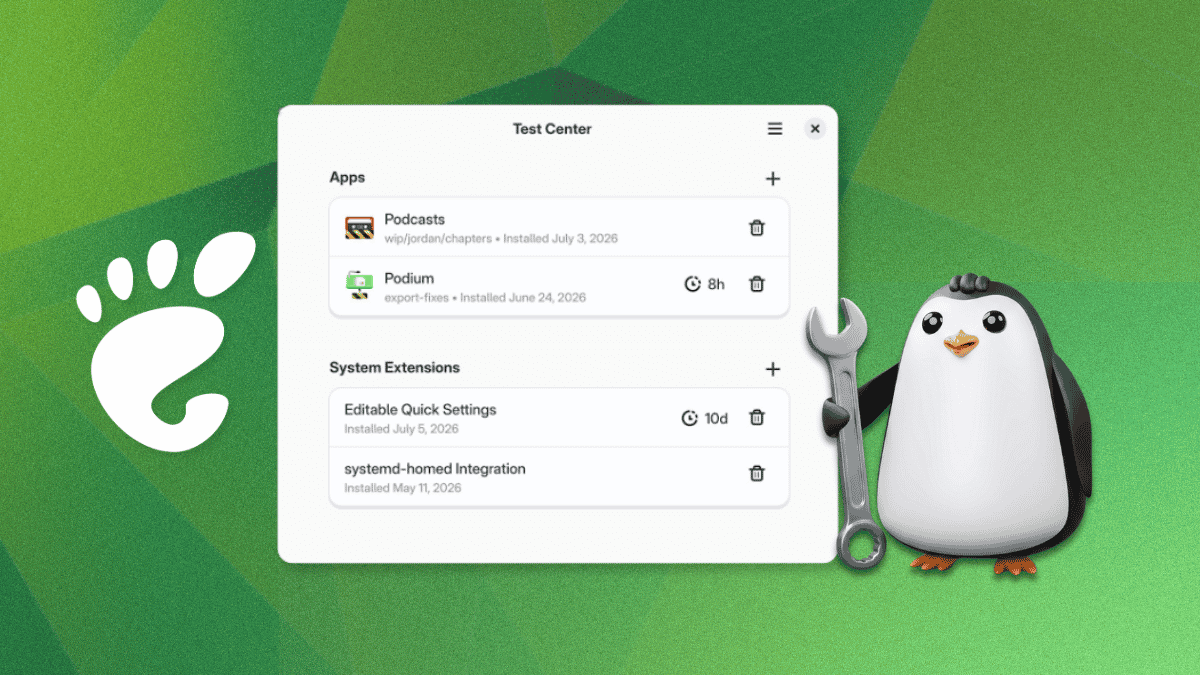
Here's how GNOME plans to make testing safer and more accessible for everyone.

If you're a Linux fan wanting a fully supported brand new laptop, the new System76 Adder Pro has been revealed today.Read the full article on GamingOnLinux.
An anonymous reader quotes a report from the BBC: StubHub and its CEO, Eric Baker, have been hit with a proposed $5-million class-action lawsuit in the United States over the company's ties to large-scale scalpers -- connections reported by CBC News last week. The suit, filed Monday by New York ticket buyer Louis Sanquini, alleges deceptive practices and fraudulent misrepresentation over StubHub's promoting itself as a "marketplace for fans to buy and sell tickets." The online ticket resale giant has faced a storm of customer complaints after cancelling thousands of World Cup tickets. The company has repeatedly said it is simply a technology platform that does not buy, sell or possess tickets. However, CBC reported last week that Baker disclosed in recent filings with the U.S. Securities and Exchange Commission that he runs Andro Capital, a hedge fund that engages in large-scale resale of millions of dollars' worth of sports and concert tickets on the StubHub resale platform.
Sanquini filed the proposed class action in the Southern District of New York, arguing consumers were kept in the dark and that he believed StubHub was a "neutral" marketplace. Lead counsel Kevin Steinberg told CBC News in an emailed statement that "consumers deserve honesty and transparency." A CBC investigation found that the CEO of online ticket reseller StubHub owns and manages a hedge fund that scalps millions of dollars of its own tickets. "While what StubHub is alleged to have engaged in and perpetrated upon millions of patrons is unfathomable, this case is about transparency and consumer trust. If companies make representations to the public, consumers are entitled to expect that those representations are complete and accurate," he said.
The claim reads: "Defendants' failure to disclose this conflict of interest, while affirmatively marketing StubHub as a fan-to-fan marketplace, deceived Plaintiff and the Class and caused them to pay prices, and accept terms, they would not have accepted had the truth been known." Sanquini argues that had he known StubHub's CEO held a financial interest and that the company was helping finance professional resellers, he would never have used the resale site to buy tickets to see rock band Kiss in 2023 or to attend a New York Red Bulls-New York City FC Major League Soccer match in 2024.
Read more of this story at Slashdot.
The Maintainers Summit is an annual, invitation-only gathering of kernel
developers and maintainers to discuss development-process issues; see LWN's 2025 Maintainers Summit coverage for an
example. The call for
topics for the 2026 gathering (Prague, October 8) has gone out.
One of the best ways to obtain an invitation to the Summit is with a good
topic proposal. For best consideration, topics should be submitted before
July 24.
There is yet-another-foundation being stewarded by the Linux Foundation that further broadens its scope outside of the typical Linux/open-source umbrella. Today the Linux Foundation announced the launch of the x402 Foundation for aiming to standardize Internet-native payments for AI agents and applications...
Tetragon, the BPF-based security monitoring tool,
uses BPF to monitor different aspects of a running kernel and
enforce user-specified policies. It sends its data to a user-space process,
which forwards the data to a central monitoring service elsewhere in the
network, however. This
presents a point of vulnerability: if an attacker can kill Tetragon's user-space
agent, it won't be able to properly report on the situation. Song Liu, Mahé
Tardy, and Liam Wiseheart spoke about their work removing the need for the
user-space agent at the 2026
Linux Storage, Filesystem, Memory-Management, and
BPF Summit.
Security updates have been issued by AlmaLinux (389-ds:1.4, buildah, freeipmi, freerdp, gegl, gimp, golang, kernel, libreoffice, maven:3.9, openexr, perl-DBI, plexus-utils, podman, tomcat, tomcat9, xorg-x11-server, and xorg-x11-server-Xwayland), Debian (imagemagick, p7zip, and redis), Fedora (breezy, calibre, and golang-github-openprinting-ipp-usb), Mageia (ffmpeg, gzip, haproxy, libheif, libtiff, libxml2, packages, perl-List-SomeUtils-XS, and perl-Socket), SUSE (alsa, chromedriver, curl, dhcpcd, docker-compose, glibc, haproxy, ImageMagick, jq, kernel, kubernetes, libpng15, libredwg-devel, libslirp, nghttp2, php8, python-Pillow, python313-Django, python313-weasyprint, qemu, rust-keylime, sccache, and systemd), and Ubuntu (cifs-utils, libexif, libreoffice, libssh2, openssh, and pipewire).
A new Direct Rendering Manager (DRM) kernel graphics driver has been sent out for GlandaGPU, an open-source custom 3D graphics core designed in VHDL and running on FPGA hardware...
Ahead of the next Intel Compute Runtime release, IGC 2.38.2 was released today as the newest feature update to this open-source graphics compiler used by Intel iGPU/dGPU hardware on both Windows and Linux...
Hyunjun Ko with Igalia continues advancing the Vulkan Video capabilities of the Intel open-source "ANV" Vulkan driver for Linux systems...

Trello has changed a lot since I started using it in 2013. If you want that old-school Kanban simplicity back, here are the open source alternatives worth a look.

Fanatical are doing an "All Star Bundle Week" where multiple bundles will launch with some popular stuff - the first is the Best of Killer Bundle.Read the full article on GamingOnLinux.
Scientists at the Indian Institute of Technology, Madras (IIT-M) have created what they describe as the world's most detailed 3D cellular atlas of the human brainstem, linking whole-brain MRI views to individual neurons across more than 500 tissue sections. The free online atlas, called Anchor, could help researchers better understand diseases such as Alzheimer's, Parkinson's, stroke, and SIDS by showing how healthy and diseased brain tissue differs cell by cell. The BBC reports: Built from high-resolution microscope images rather than costlier molecular techniques, it creates a detailed three-dimensional map of the brainstem, identifying more than 200 clusters of brain cells and nerve pathways. Eight chemical markers help distinguish different cell types, producing one of the clearest pictures yet of this vital, but poorly, understood part of the brain. The brainstem occupies only a sliver of the brain, yet it keeps people alive. It links the brain to the spinal cord and controls breathing, heartbeat, sleep, wakefulness and movement.
[...] Users can zoom from the whole brainstem seen on MRI down to individual neurons while maintaining their precise spatial relationships. The researchers have made the atlas freely available online, hoping it becomes a reference tool for neuroscientists, neurologists and neurosurgeons worldwide. Its applications could also extend well beyond anatomy. By comparing healthy brainstem maps with diseased tissue, scientists may better understand disorders ranging from Parkinson's disease and stroke to Alzheimer's disease and sudden infant death syndrome (SIDS). More precise maps could also help neurosurgeons navigate one of the brain's most delicate regions with greater confidence.
Read more of this story at Slashdot.

HYPERWIRED brings together the worlds of arcade shooters with some roguelike mechanics of repeatable runs and upgrades - but with a finite resources twist.Read the full article on GamingOnLinux.
While there has been the Apple System Management Controller "SMC" hardware monitoring driver with the intent on exposing battery/power stats as well as thermal and more for Apple Silicon SoCs on Linux, it hasn't yet been working out properly on the mainline kernel. Between missing Device Tree nodes to the hodgepodge mess of sensors between the different Apple M-Series SoCs, it's a mess...
The BeOS-inspired Haiku open-source operating system project has published their June 2026 status report. In the past month the developers merged their NVMM VM monitor support, hardware driver improvements, and progressed toward the upcoming Haiku sixth beta release...
A month ago there was a change proposal raised for offering a "light" version of the GRUB2 bootloader for use in confidential computing environments. While there were some differing views on the matter for this alternative, stripped-down GRUB package as opposed to just using other bootloaders like systemd-boot, ultimately, the proposal is now approved...
Overnight the Weston 16.0 release occurred as the latest milestone for this reference Wayland compositor...

You can build up your gaming library nicely with the Narrative 12 for $10 Humble Bundle - with some real gems included in it.Read the full article on GamingOnLinux.

This looks like a serious amount of fun! Inspired by some classics like GoldenEye and Perfect Dark, the shooter Agent 64: Spies Never Die launches August 11th.Read the full article on GamingOnLinux.

Inspired by classics from the PlayStation 1 era, Pulsebreaker is a back to basics survival horror game that looks like you'll need spare pants to play.Read the full article on GamingOnLinux.

This upcoming indie survival game looks quite unusual with its mixture of atmospheric storytelling and immersive survival mechanics.Read the full article on GamingOnLinux.

Abyssal Merge looks just as crazy as it sounds with you needing multi-tasking skills to beat this unique upcoming bullet hell.Read the full article on GamingOnLinux.
Astronomers have detected erythrulose, a sugar found in raspberries and self-tanners, in a gas cloud near the center of the Milky Way. While not essential for life itself, the molecule can convert into a form thought to be important for life's origins, adding evidence that key prebiotic ingredients may be widespread across the galaxy. The Associated Press reports: Using two dish-shaped radio telescopes in Spain, researchers collected data from a large gas cloud near the center of the Milky Way. They identified the sugar in gas form by comparing telescope signals to samples in the lab. It's the latest kind of sugar detected in space -- in a region crossed by NASA's twin Voyager, the farthest spacecraft to ever travel from Earth.
Scientists have found interesting chemistry in our galaxy, including building blocks for genetic material and parts of the cell. They spotted a cousin to table sugar near the center of the Milky Way about 25 years ago, and black grains from asteroid Bennu retrieved by NASA's Osiris-Rex spacecraft yielded other sugars, including a key DNA ingredient. The latest sugar isn't essential for life, but can easily convert to a form that's thought to be crucial to kick-starting life on Earth. And it's one of the most complex sugars spotted so far, said astrophysicist Erika Hamden with the University of Arizona. The results were published in the journal Nature Astronomy.
Read more of this story at Slashdot.
Stemming from looking at a proposed Linux kernel patch to alter the Linux kernel's system call number handling, veteran Linux kernel developer Thomas Gleixner went down a rabbit hole of the kernel's system call entry handling to make a number of clean-ups and improvements to the code. That rework to the system call entry handling is now expected to land for the Linux 7.3 kernel cycle...
IncidentRelay is a new self-hosted platform for on-call scheduling, alert routing, escalations, and incident response.